Free templateMyth vs fact carousel
Knuckle cracking, checked
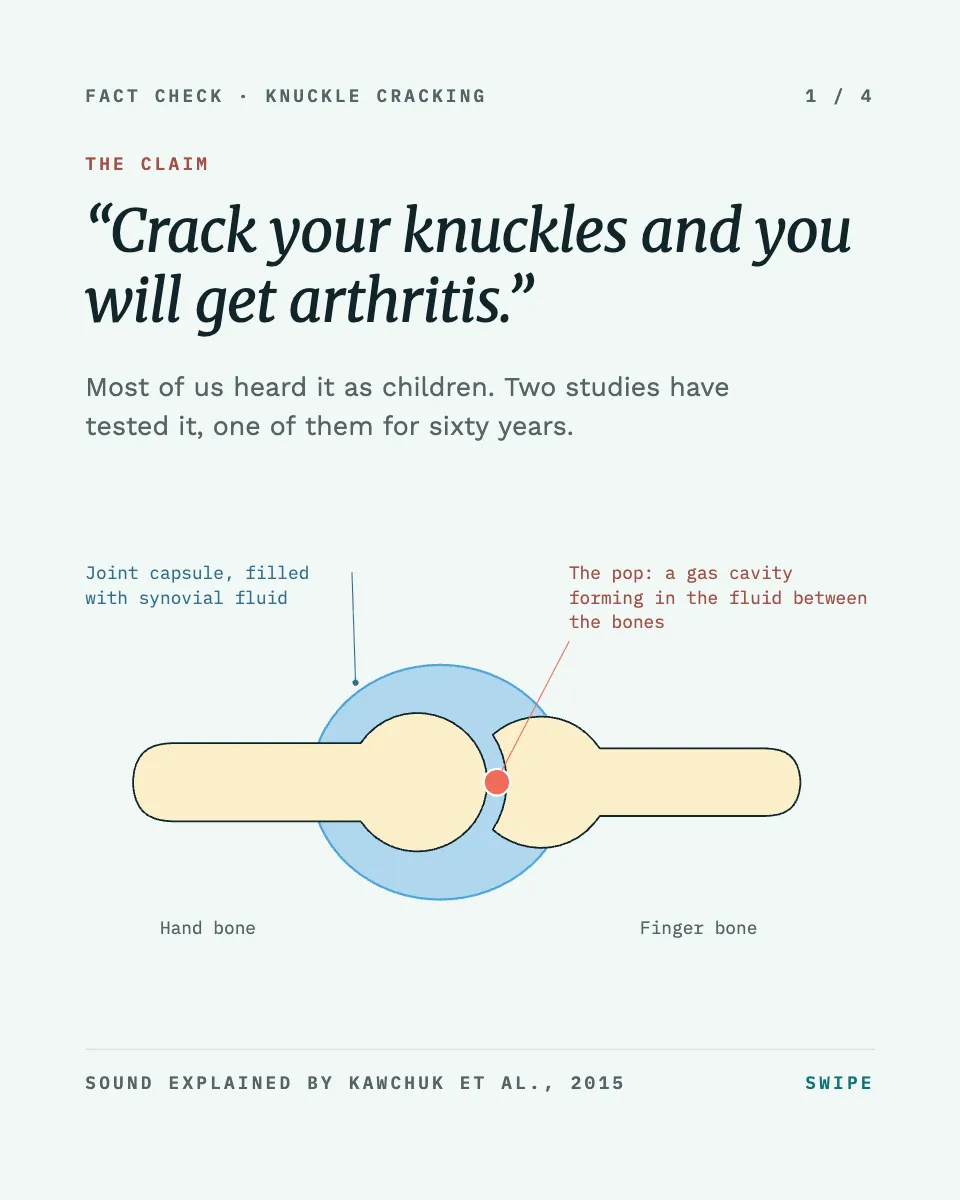
A four-page fact check that shows its working: the joint where the pop happens, a sixty-year experiment drawn to scale, a plain verdict and its sources.
Free. It opens in the Motionix editor as your own copy.
Download the pictureWebP, 960 × 1200, free to use. To change the words or colours, open it in the editor.
- Size
- 1080 × 1350 px
- Pages
- 4
- Motion
- Yes, plays live and in GIF or video
- Category
- Social posts
Every page
 Page 2
 Page 3
 Page 4
What it shows
- Claim, evidence, verdict, sources
- Studies drawn to scale
- Outlined verdict label
Good for
How to use it
- Open the template. It becomes a project in your account.
- Change the words, colours and pictures. Every part is an ordinary shape, line or text box.
- Press Play to watch it build, then present it or export it.
What is a myth vs fact carousel?
A myth vs fact carousel takes one popular belief and checks it against the evidence over several slides: the claim, what the research found, a plain verdict and the sources. Done well, it shows its working rather than just announcing an answer, so readers can judge for themselves. Knuckle cracking and arthritis is a classic case, with a doctor's sixty-year experiment on his own hands.
When it helps
- A health educator correcting a belief that patients keep raising at appointments.
- A science communicator explaining how evidence is weighed, using one familiar claim.
- A clinic or charity answering a myth that is spreading on social media.
- A teacher showing older pupils how to read a study before sharing a claim.
Tips
- Say "not supported" rather than "false" when the evidence is the absence of a link; it is more accurate, and readers who know the research will trust you for it.
- Never show the myth huge and unlabelled; mark it clearly as the claim, so a quick scroller does not leave believing it.
- Give each study its own page. Readers follow evidence better in sequence than crammed into one chart with mixed scales.
How to make a myth vs fact post
State the myth as people say it
Open with the claim in its everyday words, such as "crack your knuckles and you will get arthritis". Readers should recognise it at once.
Find the original studies
Look for the research itself, not articles about it. Note the authors, journal, year and how many people were studied.
Draw the evidence
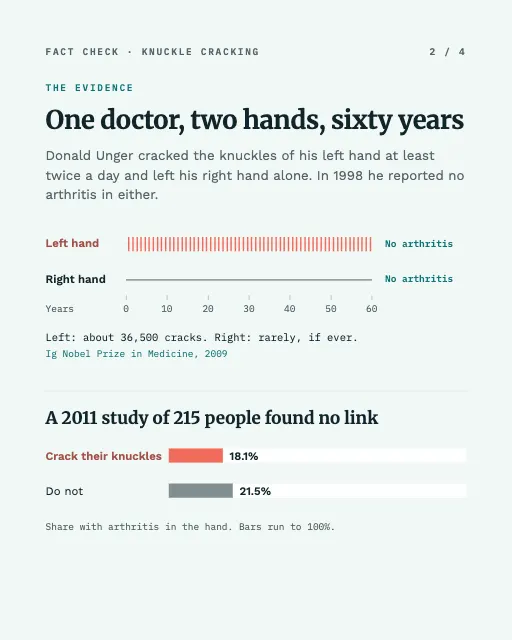
Show what each study compared at a glance: two hands over sixty years, or two groups with similar arthritis rates. A picture of the comparison persuades more than a summary.
Give a verdict with its limits
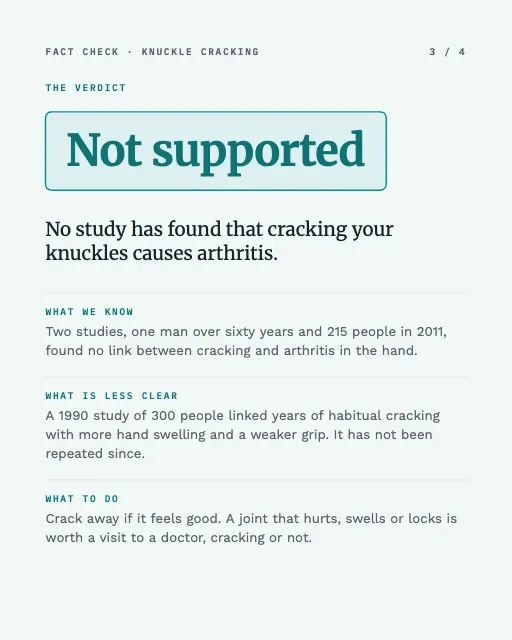
Say plainly what the evidence supports, such as "not supported", and add what is still uncertain. Honest caveats make the verdict more credible, not less.
List the sources
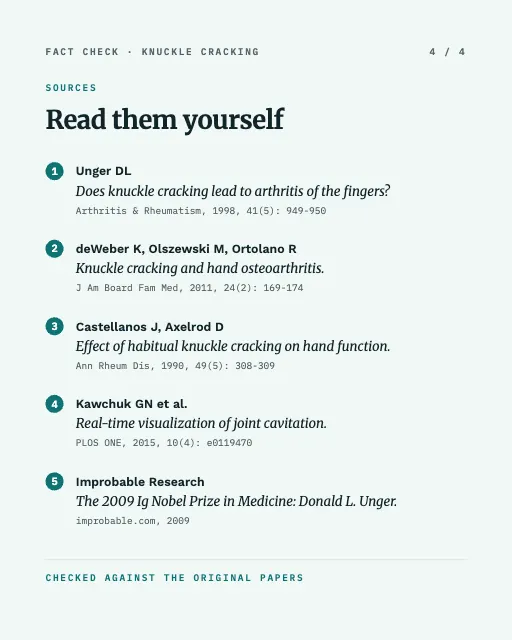
End with full references so anyone can check them. A last page of citations signals that you did the reading.
FAQQuestions
Common questions.
Does cracking your knuckles cause arthritis?
The evidence says no. Dr Donald Unger cracked the knuckles of one hand for about sixty years and found no arthritis in either hand, and a 2011 study of 215 people found no link with arthritis in the hand. An older 1990 study did link habitual cracking with hand swelling and weaker grip.
What causes the sound when you crack your knuckles?
A 2015 study filmed finger joints in an MRI scanner as they cracked and saw a gas cavity forming in the fluid between the bones at the moment of the pop. Earlier explanations blamed a bubble collapsing, and researchers still debate the exact mechanism.
How do you fact-check a health claim?
Find the original study, not a news story about it. Check how many people took part, whether groups were compared fairly and whether other studies agree. Look for guidance from health bodies, and be wary of one small study presented as settled.
More social posts templates
Carousels, stories and single posts for LinkedIn and Instagram.