Free template50/30/20 budget carousel
The 50/30/20 rule
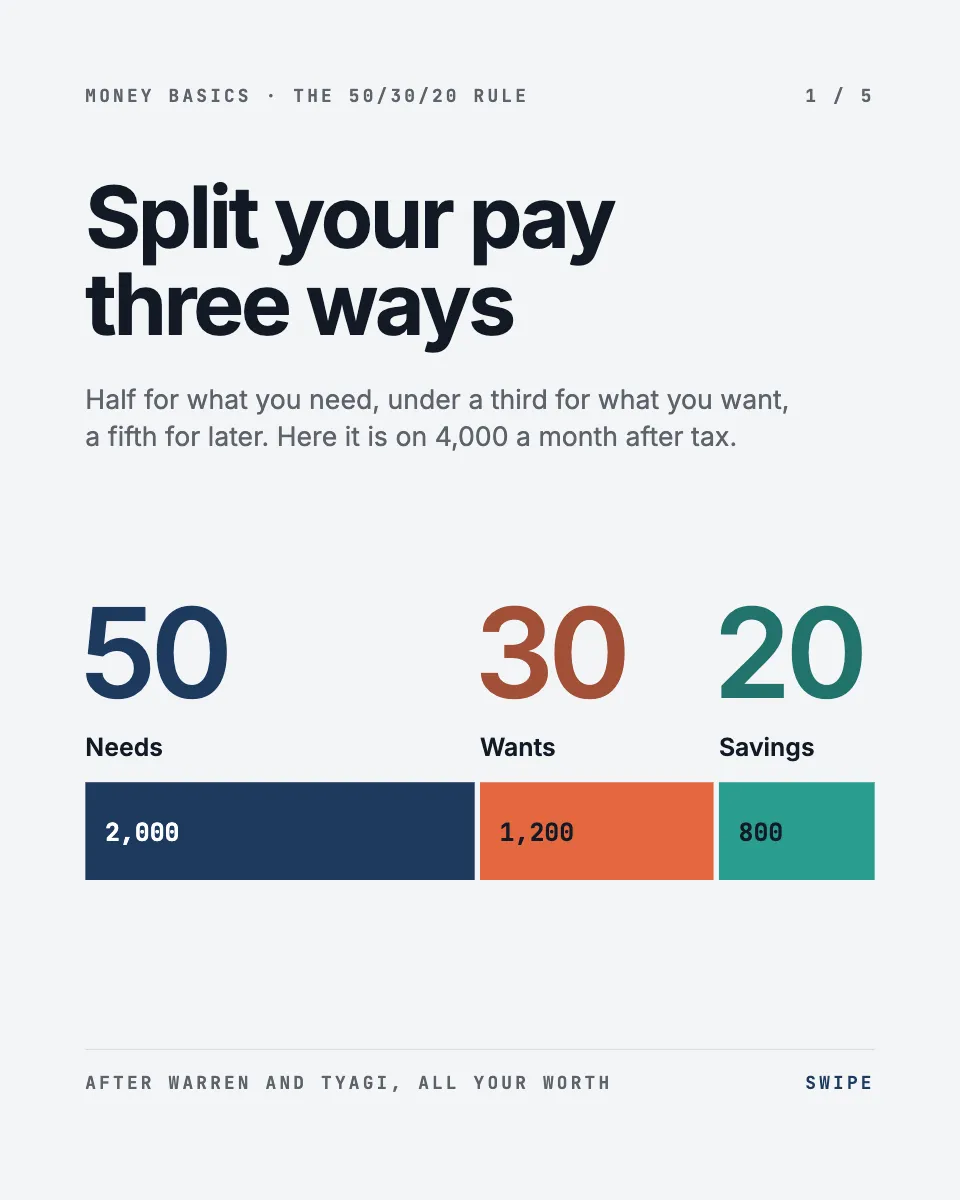
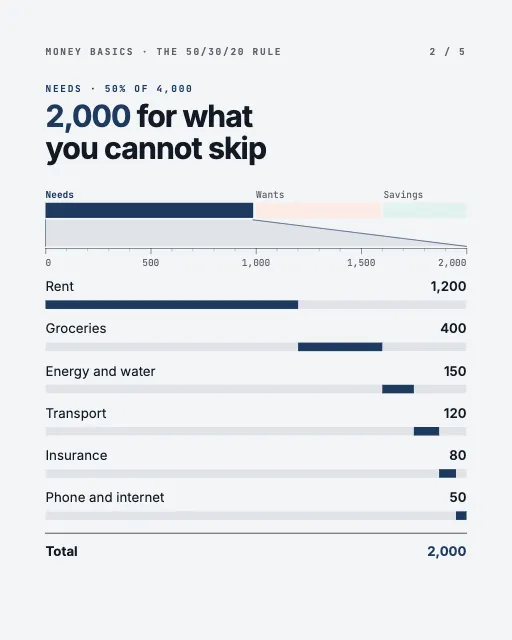
A five-page carousel for finance educators: one bar split 50/30/20 recurs, and each page zooms into a share whose items add up exactly.
Free. It opens in the Motionix editor as your own copy.
Download the pictureWebP, 960 × 1200, free to use. To change the words or colours, open it in the editor.
- Size
- 1080 × 1350 px
- Pages
- 5
- Motion
- Yes, plays live and in GIF or video
- Category
- Social posts
Every page
 Page 2
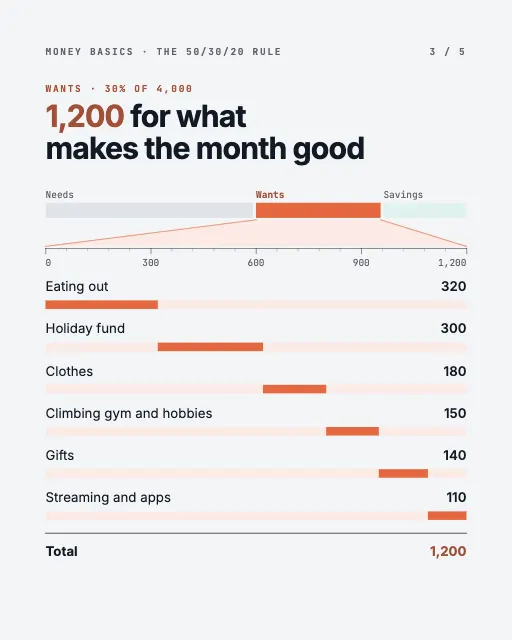 Page 3
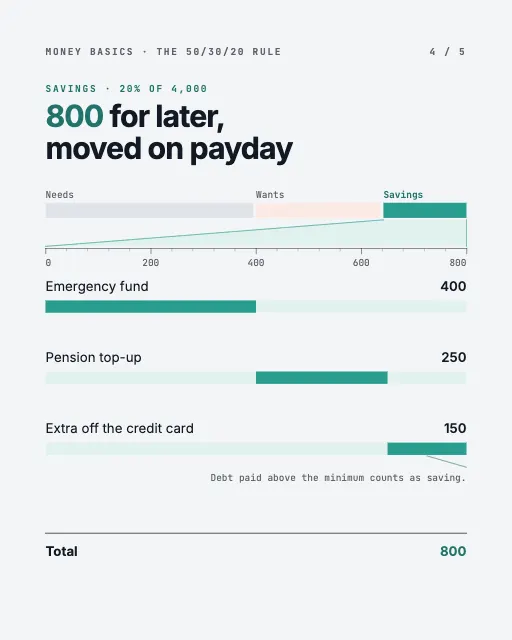 Page 4
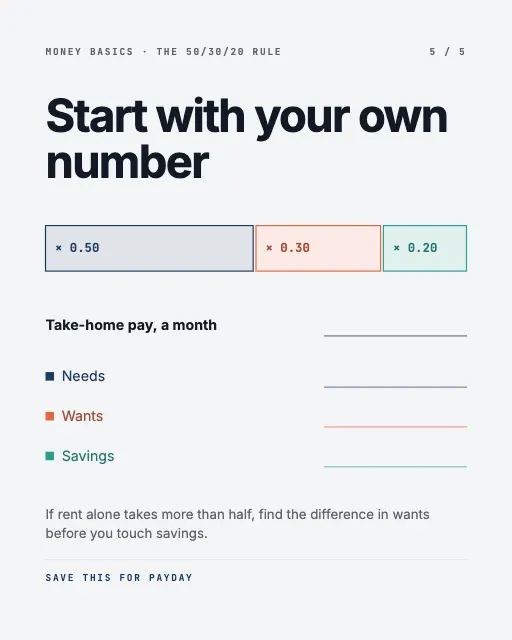 Page 5
What it shows
- A figure that recurs on every page
- Zoom into a segment
- Waterfall that sums exactly
Good for
How to use it
- Open the template. It becomes a project in your account.
- Change the words, colours and pictures. Every part is an ordinary shape, line or text box.
- Press Play to watch it build, then present it or export it.
What is the 50/30/20 budget rule?
The 50/30/20 rule splits take-home pay three ways: half for needs such as rent, groceries and bills, 30% for wants such as eating out and holidays, and 20% for savings and paying down debt. It was popularised by Elizabeth Warren and Amelia Warren Tyagi in their 2005 book All Your Worth. On 4,000 a month after tax, that is 2,000, 1,200 and 800.
When it helps
- A finance educator showing followers how the split works on one realistic monthly income.
- A graduate drawing up a first budget on their first salary, having never tracked spending.
- Checking whether rent or a new car loan pushes needs well past half of pay.
- A workplace wellbeing session on money, where a simple rule beats a spreadsheet.
Tips
- Count debt repayments above the minimum as savings. Minimum payments are a need, but anything extra strengthens your position just as saving does.
- Treat the split as a starting point, not a test. In expensive cities needs often exceed half, and the rule still shows where to adjust.
- Work one income through to the last item. A real budget whose lines add up exactly persuades far more than percentages on their own.
How to make a 50/30/20 budget
Start from take-home pay
Use the amount paid into your account each month after tax and deductions, not the salary written in your contract.
Work out the three amounts
Multiply take-home pay by 0.5, 0.3 and 0.2. On 4,000 a month, that gives 2,000 for needs, 1,200 for wants and 800 for savings.
Sort your spending
List every regular cost and decide whether it is a need, which you must pay to live and work, or a want. Rent, energy and transport are needs; streaming and eating out are wants.
Make each share add up
Total the items in each group and compare them with the target. If needs come to more than half, take the difference from wants before touching savings.
Move savings on payday
Set up a standing order for the 20% on the day you are paid, so saving happens before spending rather than from whatever is left.
FAQQuestions
Common questions.
What counts as a need in the 50/30/20 rule?
Costs you would have to pay even in a lean month: rent or mortgage, utilities, basic groceries, insurance, transport to work and minimum debt payments. If cancelling it would harm your health, home or job, it is a need. Upgrades within those, like a bigger flat, can be partly wants.
Is the 50/30/20 rule realistic?
For many people it is a useful benchmark rather than an exact plan. Where housing is expensive, needs can take 60% or more, and people adjust to 60/20/20 or similar. Its value is in seeing the three groups clearly and protecting savings first.
Does the 50/30/20 rule use gross or net income?
Net income, the take-home pay after tax. Using gross pay overstates what you can spend. If pension contributions come out of your salary before you are paid, some people count them towards the 20% savings share.
More social posts templates
Carousels, stories and single posts for LinkedIn and Instagram.