Free templateEmployee onboarding timeline
Your first 90 days
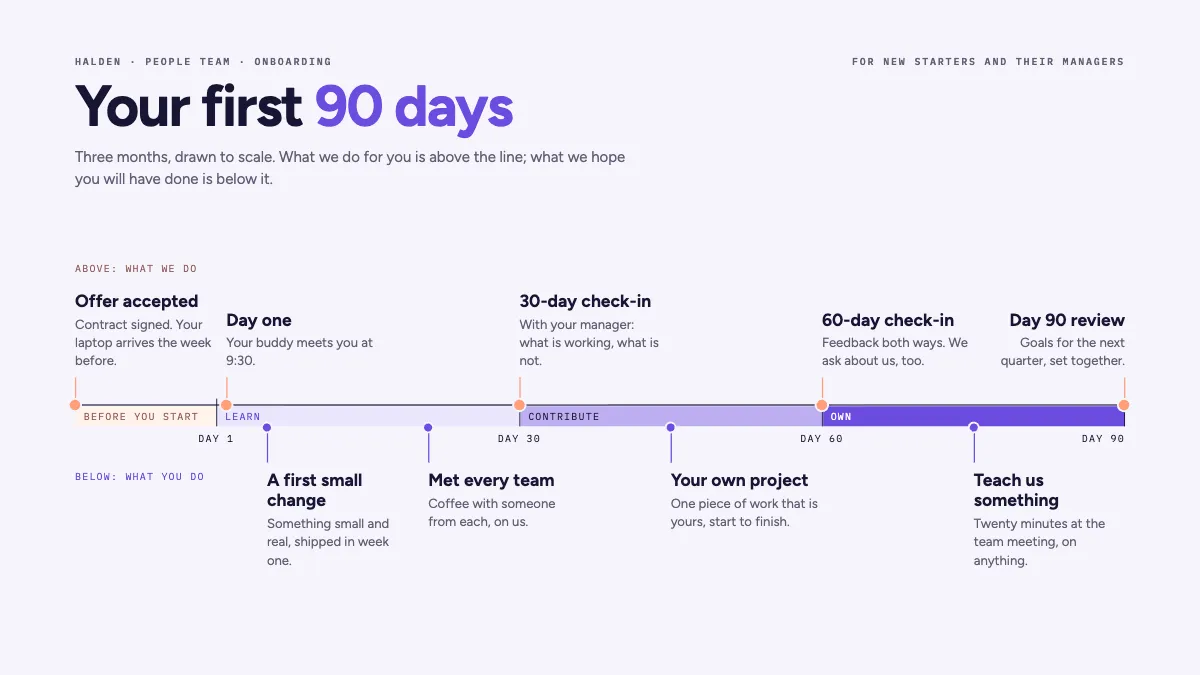
An onboarding line from offer to day 90, drawn to scale: what we do above the line, what you do below it.
Free. It opens in the Motionix editor as your own copy.
Download the pictureWebP, 1200 × 675, free to use. To change the words or colours, open it in the editor.
- Size
- 1920 × 1080 px
- Pages
- 1
- Motion
- Yes, plays live and in GIF or video
- Category
- Processes
What it shows
- Timeline to scale
- Milestones either side of one line
- Phases as soft bands
Good for
How to use it
- Open the template. It becomes a project in your account.
- Change the words, colours and pictures. Every part is an ordinary shape, line or text box.
- Press Play to watch it build, then present it or export it.
What is an employee onboarding timeline?
An employee onboarding timeline sets out what happens for a new starter from the accepted offer to the end of their first few months, usually ninety days. It shows what the company will do, such as equipment, a buddy and check-ins, alongside what the new employee is expected to achieve, often in phases like learn, contribute and own.
When it helps
- A people team sending new starters a clear picture of their first three months before day one.
- A manager planning check-ins at thirty and sixty days so feedback is not left until probation ends.
- Agreeing with a new hire what success looks like by day ninety.
- Comparing onboarding across teams so every new starter gets the same basics.
Tips
- Give the new starter something small and real to finish in the first week. Early, visible progress builds confidence faster than a fortnight of reading documents.
- Assign a buddy who is not their manager. New starters ask a peer the questions they worry are too basic to ask the person who reviews them.
- Make goals concrete enough to check. Understand the product cannot be confirmed at day ninety; give a short talk on how the product works can.
How to make an employee onboarding timeline
Start before day one
Include the weeks between offer and start: contract, equipment, accounts and a welcome message. New starters form their impression of a company before they walk in.
Split it into phases
Divide the ninety days into phases, such as learn for the first month, contribute for the second and own for the third, so expectations grow at a sensible pace.
Separate the two sides
Show the company's commitments and the new starter's goals apart, for example above and below a line. Both sides can then see what they owe each other.
Set milestones on real days
Place each milestone on the day it should happen: a first small task in week one, meeting every team by week three, a first project of their own by the halfway point.
Schedule the check-ins
Put regular conversations with the manager on the timeline, at least at thirty, sixty and ninety days, with feedback asked for in both directions.
FAQQuestions
Common questions.
What is a 30 60 90 day plan?
A 30 60 90 day plan sets goals for a new employee's first three months in three stages. The first month is usually about learning the role, people and systems; the second about contributing to real work; and the third about taking ownership and showing independent results.
How long should employee onboarding last?
Practice varies, but many organisations treat the first three months as onboarding, and some extend it to the end of the first year. Paperwork and orientation take days; becoming fully productive in a role usually takes months, so onboarding should cover that period too.
What is the difference between orientation and onboarding?
Orientation is a short event, often the first day or week, covering introductions, policies, systems and the building. Onboarding is the longer process of helping someone become effective and settled in their role, which includes orientation but continues for months.
More processes templates
Flowcharts, procedures and step-by-step journeys.