Free templateOpening checklist
Opening the café
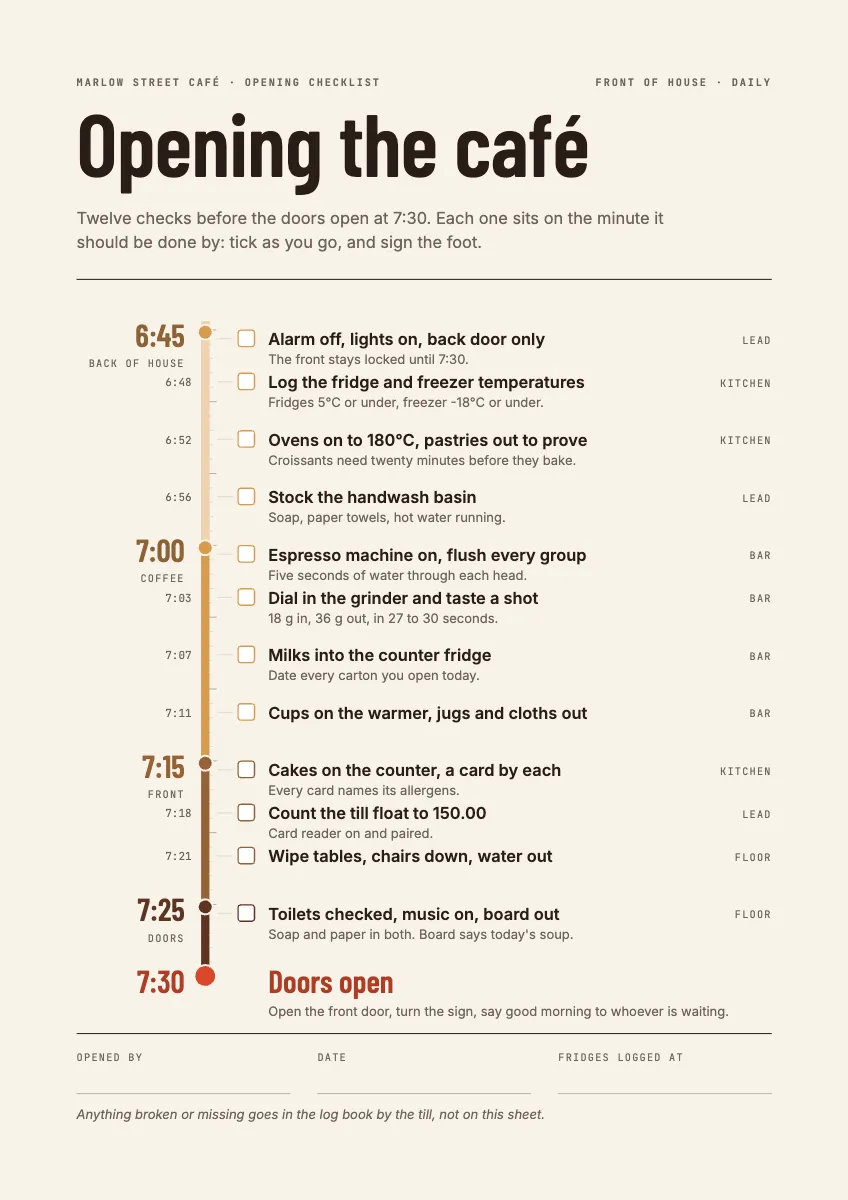
An A4 opening checklist set on a minute ruler: twelve checks in four timed blocks, each with a tick box and who does it.
Free. It opens in the Motionix editor as your own copy.
Download the pictureWebP, 848 × 1200, free to use. To change the words or colours, open it in the editor.
- Size
- 1240 × 1754 px
- Pages
- 1
- Motion
- Yes, plays live and in GIF or video
- Category
- Processes
What it shows
- A4 print
- Time drawn to scale
- Tick boxes and sign-off
Good for
How to use it
- Open the template. It becomes a project in your account.
- Change the words, colours and pictures. Every part is an ordinary shape, line or text box.
- Press Play to watch it build, then present it or export it.
What is an opening checklist?
An opening checklist is the list of tasks a shop, café or restaurant must finish before the doors open, in the order they should be done and with the person responsible for each. Good ones are timed back from opening, so the shift knows not just what to do but when it should be done by, and they end with a signature showing the checks were made.
When it helps
- A café owner handing the morning shift to a new supervisor who has never opened alone.
- Showing an environmental health officer that fridge temperatures are logged every day before service.
- Training weekend staff, so the opening runs the same whoever holds the keys.
- Spotting which jobs keep running late by reading back a month of signed sheets.
Tips
- Write each line as an action that starts with a verb, such as log, count or wipe. Vague lines like fridges or toilets get ticked without anyone checking anything.
- Keep faults off the checklist itself. A separate log for broken or missing things means problems get passed on instead of lost in a pile of old sheets.
- Review the list after any complaint, inspection or near miss. A checklist nobody has changed in a year usually describes a shop that no longer exists.
How to make an opening checklist
Walk the opening once
Shadow your best opener from unlocking to the first customer and write down every task they do, including the ones they no longer notice, such as switching on the card reader.
Group tasks by area
Sort the list into blocks such as kitchen, coffee, front of house and doors, so each person can see their own section and nobody hunts across the page.
Time it back from opening
Start at the opening time and work backwards. Give each task the latest minute it can be done by, and put slow jobs, like ovens heating or dough proving, first.
Name an owner for each line
Write a role, not a person, beside every task: lead, kitchen, bar or floor. Roles survive rota changes; names go out of date within a month.
Add the numbers that matter
Where a check has a pass mark, print it: the fridge reading, the sum the float should count to, the time a shot should take. A tick without a target proves little.
End with a sign-off
Leave space for the name of whoever opened, the date and the time readings were taken. Keep the signed sheets, since they are your record if anything is ever questioned.
FAQQuestions
Common questions.
What should be on a restaurant opening checklist?
Food safety checks first: fridge and freezer temperatures, handwash basins stocked, and date labels on anything opened. Then equipment switched on and tested, stock and float counted, the dining area cleaned and set, toilets checked, and the doors opened on time. Each item should have someone responsible for it.
What is the difference between an opening checklist and an SOP?
A standard operating procedure explains how a task is done and why, in as much detail as a new starter needs. An opening checklist is the short version used on the shift itself: it names each task, when it is due and who does it, and assumes the procedure has already been taught.
What temperature should a commercial fridge be?
Food safety guidance in the UK and many other countries recommends keeping chilled food at 5°C or below, and freezers at -18°C or colder. Check the rules that apply where you trade, and log the reading at the same time each day so any drift stands out.
More processes templates
Flowcharts, procedures and step-by-step journeys.