Free templateInsurance claim process
Making a home insurance claim
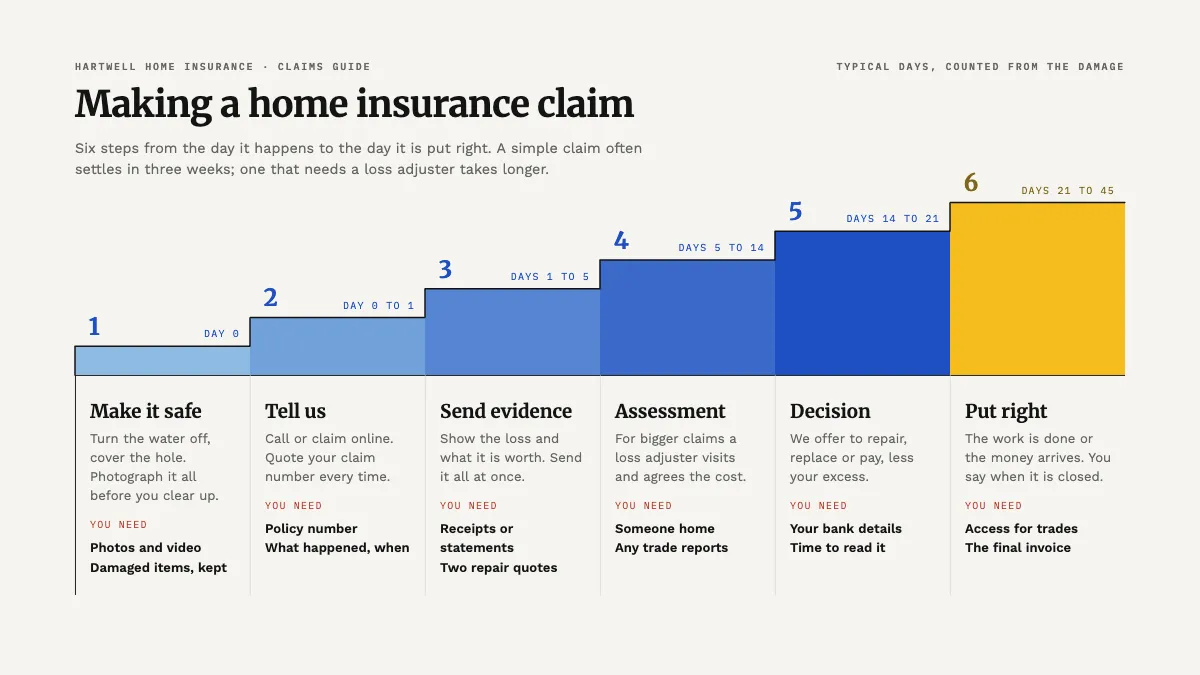
Six steps drawn as a staircase from the day of the damage to the day it is put right, with what you need at each.
Free. It opens in the Motionix editor as your own copy.
Download the pictureWebP, 1200 × 675, free to use. To change the words or colours, open it in the editor.
- Size
- 1920 × 1080 px
- Pages
- 1
- Motion
- Yes, plays live and in GIF or video
- Category
- Processes
What it shows
- A staircase that draws itself
- Six columns hung from one figure
- Typical days on every step
Good for
How to use it
- Open the template. It becomes a project in your account.
- Change the words, colours and pictures. Every part is an ordinary shape, line or text box.
- Press Play to watch it build, then present it or export it.
What is the insurance claim process?
The insurance claim process is the sequence of steps from the moment loss or damage happens to the moment it is repaired, replaced or paid for. For home insurance it usually means making the property safe, telling the insurer, sending evidence, an assessment of the loss, the insurer's decision and finally the settlement. Exact steps and timings depend on the insurer and the policy.
When it helps
- An insurer's website showing customers what happens after they report a burst pipe or a break-in.
- A broker explaining to a client why a large claim needs a loss adjuster's visit.
- A homeowner keeping track of what to gather while dealing with the damage.
- Training claims handlers to explain the next step the same way on every call.
Tips
- Tell customers to keep damaged items until the insurer says they can go. Throwing them away before they are seen is one of the easiest ways to weaken a claim.
- Use the words the policy uses, such as excess, loss adjuster and settlement, but explain each one the first time it appears.
- Show the timings as ranges, not promises. A guide that says three weeks and takes six creates more complaints than one that was honest from the start.
How to explain the insurance claim process
Start from the day of loss
Begin the guide at the moment of damage, not at the phone call, because what people do first, such as stopping a leak and photographing everything, shapes the whole claim.
Break it into clear stages
Use the stages customers recognise: make safe, report, send evidence, assessment, decision and settlement. Six or fewer keep the route easy to remember under stress.
List what is needed at each
Under every stage, say what the customer must have ready: photos, the policy number, receipts, repair quotes, bank details. Missing documents are a common cause of delay.
Give typical timings
Add a realistic range for each stage, counted from the day of damage, and say what makes a claim take longer, such as a loss adjuster visit or a disputed cause.
Explain the money plainly
Say how the settlement works: repair, replacement or payment, minus the policy excess. Customers who know about the excess in advance are rarely surprised by the final figure.
FAQQuestions
Common questions.
What does a loss adjuster do?
A loss adjuster is an independent specialist an insurer appoints to investigate larger or complex claims. They visit the property, establish the cause and extent of the damage, check it is covered by the policy and agree a fair cost of putting it right.
What is an insurance excess?
The excess is the part of each claim you pay yourself, as set out in your policy. If a repair costs 2,000 and your excess is 250, the insurer pays 1,750. In some countries it is called a deductible. Choosing a higher voluntary excess usually lowers the premium.
How long does a home insurance claim take?
Simple claims, such as a small leak with clear evidence, can settle within a few weeks. Claims that need a site visit, specialist reports or extensive repairs take longer, sometimes months. Sending complete evidence early and answering questions quickly are the two things a policyholder can do to speed it up.
More processes templates
Flowcharts, procedures and step-by-step journeys.