Free templateChore chart
Chore chart for two
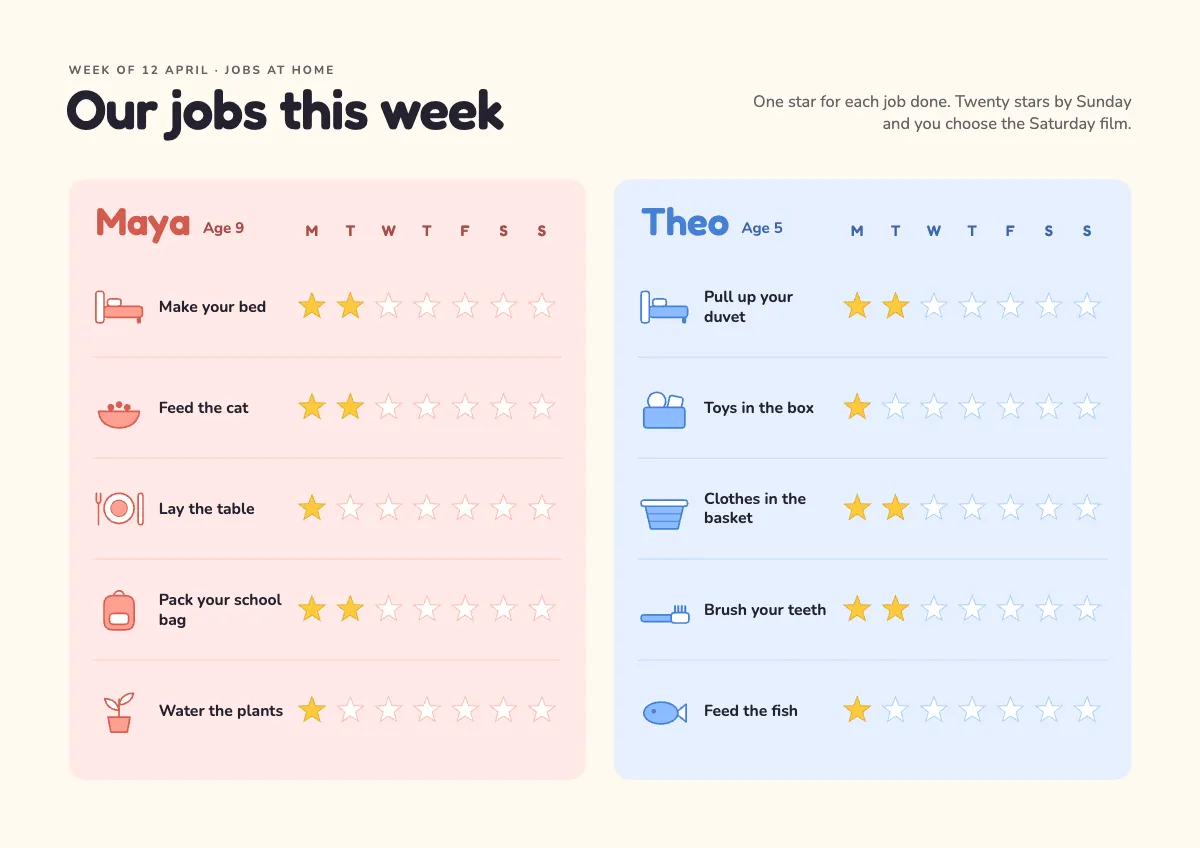
A week of jobs for two children, each chore a simple drawing a five-year-old can read, with stars to earn every day.
Free. It opens in the Motionix editor as your own copy.
Download the pictureWebP, 1200 × 848, free to use. To change the words or colours, open it in the editor.
- Size
- 1754 × 1240 px
- Pages
- 1
- Motion
- Yes, plays live and in GIF or video
- Category
- Plans
What it shows
- Drawn pictograms
- One colour per child
- Stars that pop in
Good for
How to use it
- Open the template. It becomes a project in your account.
- Change the words, colours and pictures. Every part is an ordinary shape, line or text box.
- Press Play to watch it build, then present it or export it.
What is a chore chart?
A chore chart is a weekly grid of household jobs for children, with a space to mark each day a job is done, often with stars or stickers that add up to a reward. For young children, pictures of each chore let them read the chart without words, and seeing their own progress helps them take responsibility for small tasks at home.
When it helps
- Parents of two young children sharing out simple daily jobs fairly.
- Building a morning routine, such as making the bed and packing a school bag.
- Agreeing a weekly treat that children earn through a set number of stars.
- Helping a child who cannot yet read follow their jobs from pictures alone.
Tips
- Let children put the stars on themselves. Doing the marking gives them ownership, and the small moment of adding a star is a reward in itself.
- Praise the effort straight away, not just the total at the end of the week. Young children link a reward to an action best when it follows quickly.
- Change the jobs as children grow. A chart that still lists toddler tasks at seven feels babyish and soon stops working.
How to make a chore chart
Pick age-appropriate jobs
Choose a few jobs each child can do alone: toys in a box for a toddler, laying the table or feeding a pet for a five or six year old.
Keep the list short
Give each child four or five jobs. A short list they can finish every day works better than a long one that feels impossible.
Use pictures
Draw a simple picture for each chore, such as a bed, a bowl or a toothbrush, so children who cannot read yet can follow the chart themselves.
Give each child a colour
Use one colour per child so each one can find their own row at a glance and siblings do not argue over whose star is whose.
Agree the reward
Decide with the children what the stars add up to and when, such as choosing the weekend film for a set number collected by Sunday.
FAQQuestions
Common questions.
What chores can a 5 year old do?
Most five year olds can make their bed roughly, put toys away, lay the table, feed a pet, water plants, put dirty clothes in the basket and help pair socks. Expect each job to be done their way, and show them a few times before adding it to the chart.
Do reward charts work for children?
They can work well for building specific routines, especially for children aged around three to eight, if the goals are clear and achievable and the rewards come reliably. Many parents phase out the rewards once the routine is established, keeping the chart as a reminder.
Should children be paid for chores?
Families differ. Some link pocket money to chores to teach the value of work; others keep everyday chores as part of family life and pay only for extra jobs. Whichever you choose, be consistent, and explain to children why the family does it that way.
More plans templates
Timelines, schedules, itineraries and trackers.