Free templateCompliance calendar
Compliance year dial
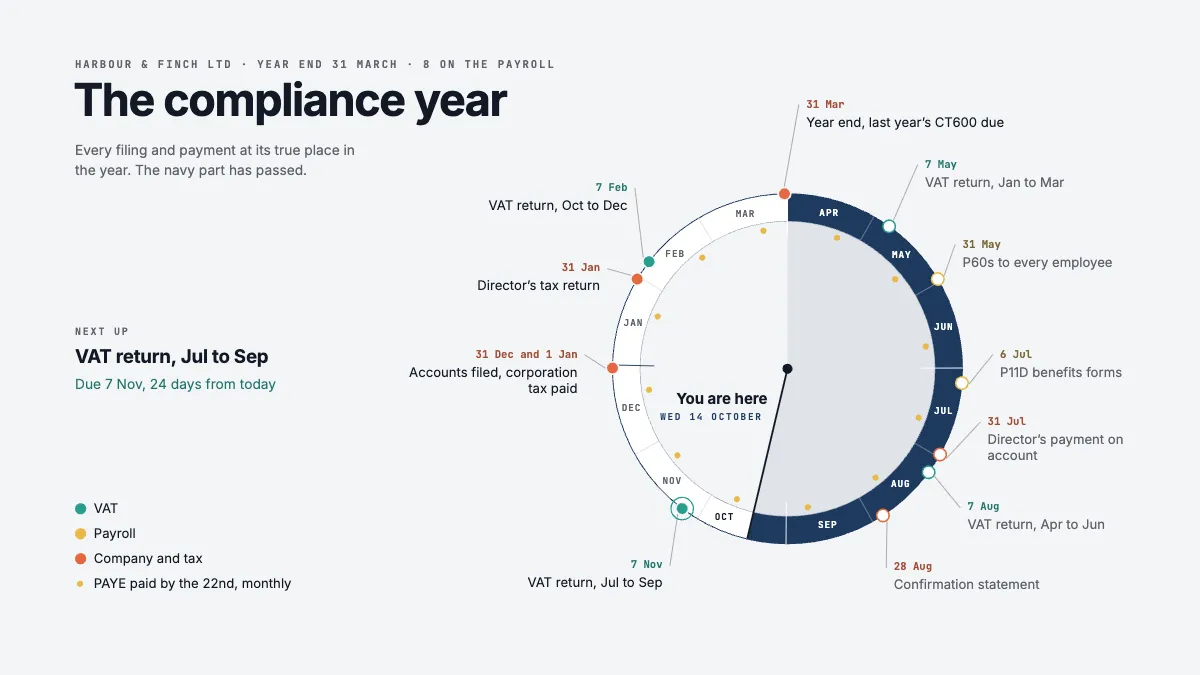
A small company’s filing and payment year as one dial, each deadline at its true day, with the passed months shaded and a hand on today.
Free. It opens in the Motionix editor as your own copy.
Download the pictureWebP, 1200 × 675, free to use. To change the words or colours, open it in the editor.
- Size
- 1920 × 1080 px
- Pages
- 1
- Motion
- Yes, plays live and in GIF or video
- Category
- Plans
What it shows
- Deadlines at their true angle
- You are here hand
- Next deadline worked out
Good for
How to use it
- Open the template. It becomes a project in your account.
- Change the words, colours and pictures. Every part is an ordinary shape, line or text box.
- Press Play to watch it build, then present it or export it.
What is a compliance calendar?
A compliance calendar lists every filing and payment deadline a business must meet over its year, such as tax returns, VAT, payroll forms and company filings, each on its due date. Laid out across twelve months, it shows when the busy periods fall and what is due next. Deadlines differ by country; the example shown follows UK rules for a company with a 31 March year end.
When it helps
- A bookkeeper keeping track of deadlines for several small company clients at once.
- A company director planning cash so tax payments do not come as a surprise.
- An accountant explaining to a new client what the company must file each year.
- Handing over finance duties with a clear record of every recurring obligation.
Tips
- Work in the company's financial year, not the calendar year, if they differ. Many deadlines are counted from the year end, and that is where people miscount.
- Separate filing deadlines from payment deadlines. They often fall on different days, and missing either can bring its own penalty.
- Review the calendar every year. Rules, thresholds and dates change, and a calendar copied forward without checking can carry an old deadline for years.
How to make a compliance calendar
List every obligation
Write down every regular filing and payment the business has: tax returns, sales tax or VAT returns, payroll submissions, employee forms, annual accounts and company register filings.
Find each deadline
Look up the due date for each obligation from the official tax authority or company registry. Many depend on the company's own year end, so work them out from that date.
Place them on the year
Put each deadline on its true day across the financial year, using one colour for each type, such as company tax, sales tax and payroll.
Mark today and what is next
Show where the year has reached and highlight the next deadline, so the calendar answers the question that matters most: what is due now.
Set reminders ahead
Add a reminder well before each deadline, not on it. Most filings need information from someone else, and gathering it takes time.
FAQQuestions
Common questions.
What deadlines does a UK limited company have?
Common ones include annual accounts to Companies House, the corporation tax return and payment to HMRC, the confirmation statement, VAT returns if registered, and payroll obligations such as P60s and P11D forms. Most dates depend on the company's year end, so confirm each with HMRC, Companies House or an accountant.
What is the difference between a compliance calendar and a tax calendar?
A tax calendar covers tax filings and payments only. A compliance calendar is broader, adding non-tax obligations such as company register filings, licence renewals, insurance and regulatory reports. For a small company the two often overlap almost completely.
How do you keep track of compliance deadlines?
Keep one list of every obligation with its due date, owner and the information needed, set reminders several weeks ahead, and review the list whenever the business changes, for example when it registers for VAT or hires its first employee. Many small businesses also rely on an accountant to watch the dates.
More plans templates
Timelines, schedules, itineraries and trackers.