Free templateRevision timetable
Six-week exam countdown
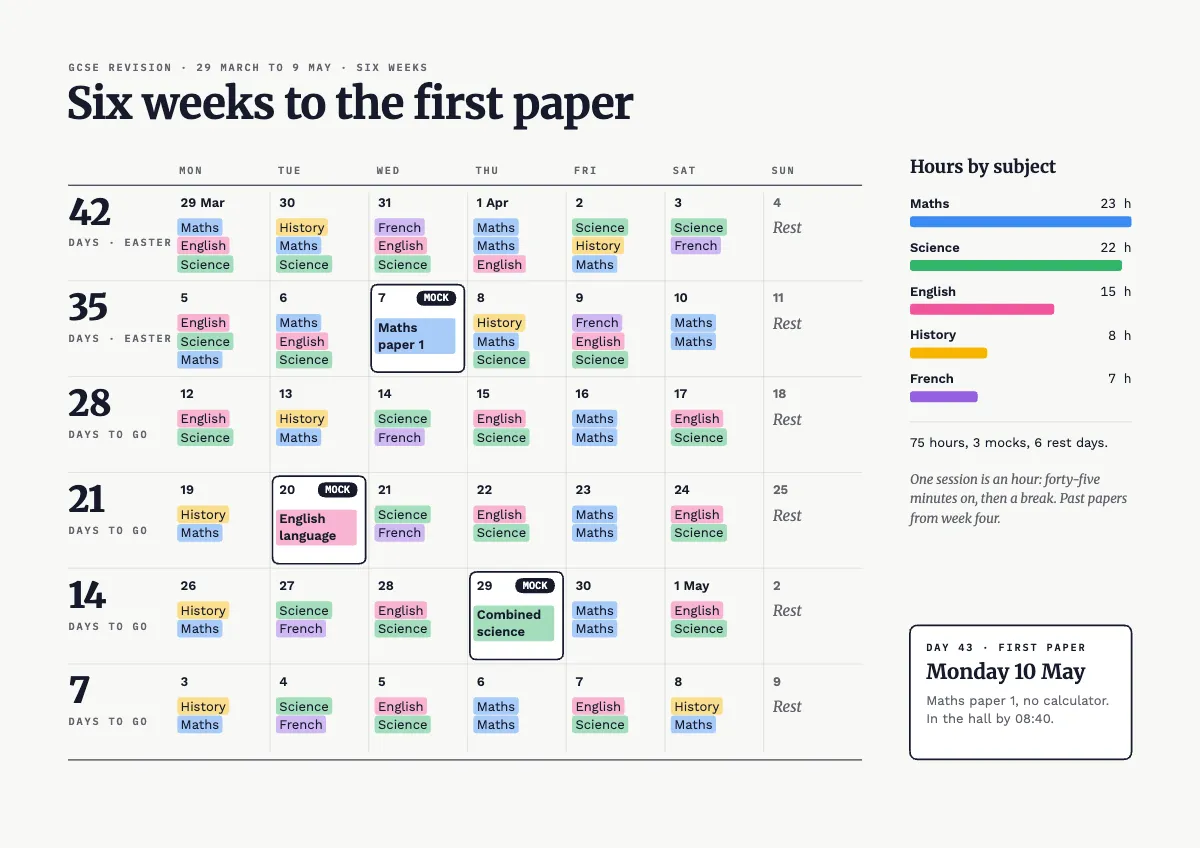
A revision calendar counting down to the first paper, with mocks marked, Sundays kept free and the hours per subject added up.
Free. It opens in the Motionix editor as your own copy.
Download the pictureWebP, 1200 × 848, free to use. To change the words or colours, open it in the editor.
- Size
- 1754 × 1240 px
- Pages
- 1
- Motion
- Yes, plays live and in GIF or video
- Category
- Plans
What it shows
- Calendar that counts down
- Hours summed from the plan
- Mocks and rest days marked
Good for
How to use it
- Open the template. It becomes a project in your account.
- Change the words, colours and pictures. Every part is an ordinary shape, line or text box.
- Press Play to watch it build, then present it or export it.
What is a revision timetable?
A revision timetable is a calendar that plans which subjects you will revise on each day in the weeks before exams, counting down to the first paper. It spreads every subject across the weeks so topics are revisited instead of crammed, and includes mock exams, past papers and rest days, so you can see how many hours each subject gets.
When it helps
- A GCSE or A level student planning the six weeks before the first exam.
- Parents helping a teenager see that the workload is manageable when spread out.
- A teacher showing a class how to balance subjects and build in mock exams.
- Checking that the subjects you find hardest are getting enough hours.
Tips
- Mix subjects within a day rather than spending a whole day on one. Switching between topics, known as interleaving, feels harder in the moment but helps you remember more.
- Test yourself instead of rereading. Flashcards, practice questions and past papers feel uncomfortable because they show what you do not know, which is exactly why they work.
- Plan rest on purpose. A timetable with no free time gets abandoned within a week; one with a protected day off is far more likely to last.
How to make a revision timetable
Count back from the first exam
Write in your exam dates first, then count back to today. Knowing how many days are left turns revision from a vague worry into a plan.
Block out what is fixed
Mark lessons, mock exams, work shifts and family commitments before planning anything else, and keep at least one day a week free for rest.
Share out the subjects
Give each subject sessions across every week rather than one week each, and give more sessions to the subjects you find hardest or that have the most papers.
Use short sessions
Plan sessions of about forty-five minutes to an hour, with a short break between each, and two to four sessions on a typical day.
Move to past papers
In the final weeks, switch from reading notes to past papers under timed conditions, then check them against the mark scheme.
Add up the hours
Total the planned hours for each subject. If the balance looks wrong, adjust it now, not in the last week.
FAQQuestions
Common questions.
How many hours a day should I revise?
In the weeks before exams, many students find two to four focused hours on school days and four to six in the holidays is sustainable. Quality matters more than hours: short, active sessions with breaks beat long periods of rereading notes.
When should you start revising for GCSEs?
Many teachers suggest starting structured revision two to three months before the first exam, building up gradually. Starting six weeks out can still work with a clear timetable. Regular review of topics throughout the year makes the final weeks far less stressful.
What is spaced repetition?
Spaced repetition means revisiting material at increasing intervals, such as a day, a few days and then a week after first learning it. Each review comes just as you are starting to forget, which strengthens memory more than going over the same material many times in one sitting.
More plans templates
Timelines, schedules, itineraries and trackers.