Free templateNow next later roadmap
Now, next, later roadmap
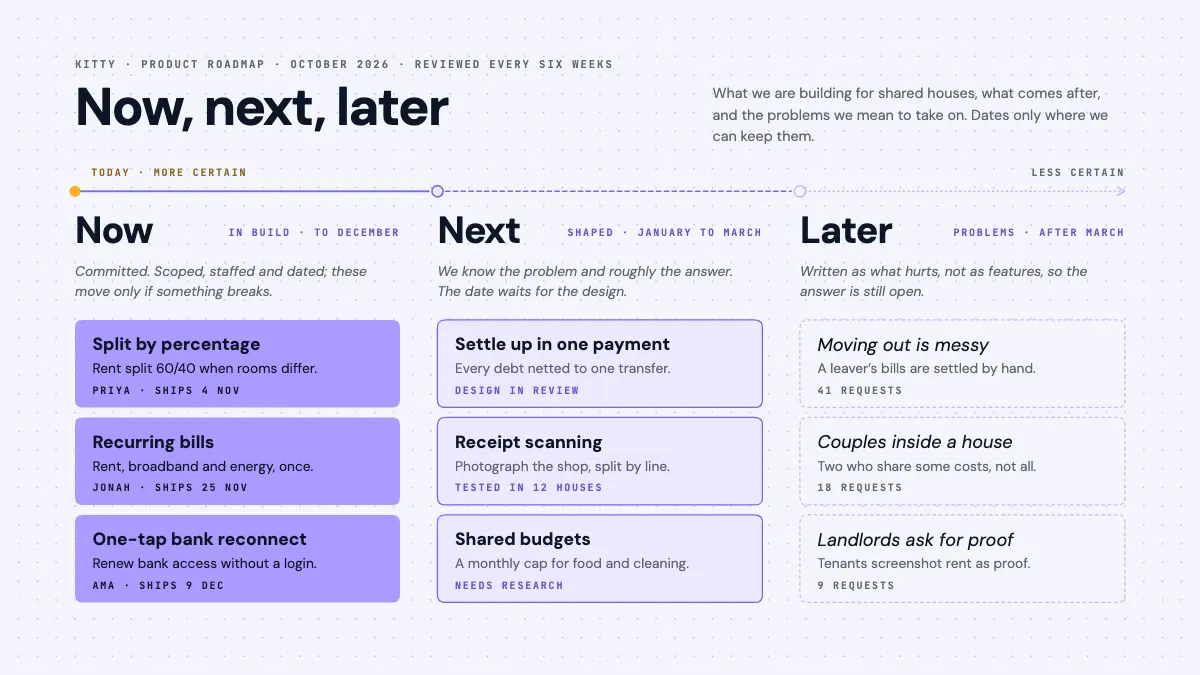
A product roadmap where certainty is drawn: firm chips now, outlined ones next, and dashed problems for later.
Free. It opens in the Motionix editor as your own copy.
Download the pictureWebP, 1200 × 675, free to use. To change the words or colours, open it in the editor.
- Size
- 1920 × 1080 px
- Pages
- 1
- Motion
- Yes, plays live and in GIF or video
- Category
- Plans
What it shows
- Certainty drawn as line
- Why note per column
- Builds column by column
Good for
How to use it
- Open the template. It becomes a project in your account.
- Change the words, colours and pictures. Every part is an ordinary shape, line or text box.
- Press Play to watch it build, then present it or export it.
What is a now next later roadmap?
A now next later roadmap groups product work into three columns by certainty instead of placing it on dates: now for work that is committed and in progress, next for problems the team has shaped and plans to tackle soon, and later for problems it intends to explore. The format is usually credited to Janna Bastow, and it avoids promising dates a team cannot keep.
When it helps
- A product manager presenting plans to a board without committing to dates beyond the quarter.
- A startup showing customers what is coming while keeping the freedom to change direction.
- Aligning engineering, design and sales on what is committed and what is still open.
- Replacing a timeline roadmap whose far-off dates keep slipping and eroding trust.
Tips
- Let certainty show in the design: solid detail for now, lighter for next, open for later. Readers should sense the level of commitment without reading a disclaimer.
- Keep each column short. Too many items in later turns the roadmap into a wish list and makes it harder to say no to new requests.
- Add a line per column saying what it means to your team. Now, next and later are vague unless you say how firm each column really is.
How to make a now next later roadmap
Start from goals
Write down the outcomes the product is trying to achieve this year. Every item on the roadmap should trace back to one of them, or it does not belong there.
Fill now with commitments
Put only work that is scoped, staffed and in progress or about to start in now. These items can carry owners and dates, because the team has committed to them.
Shape the next column
Put problems the team understands and has a likely answer for in next. Show where each one stands, such as design in review or needs research, rather than a date.
Write later as problems
Describe later items as customer problems, not features, so the solution stays open. Evidence such as the number of requests helps people see why each one is there.
Review it regularly
Move items across the columns at a fixed rhythm, monthly or quarterly. A roadmap that is not kept up to date quickly stops being trusted.
FAQQuestions
Common questions.
Who created the now next later roadmap?
The now next later format is generally credited to Janna Bastow, a co-founder of the product management company ProdPad, who described it as an alternative to timeline roadmaps. It has since been adopted widely by product teams who want to communicate priorities without fixed dates.
What is the difference between a now next later roadmap and a timeline roadmap?
A timeline roadmap places features on dates, which suggests a certainty that rarely holds beyond a few months. A now next later roadmap orders work by confidence and priority instead. It is honest about uncertainty, though some stakeholders still need dates for near-term work, which the now column can provide.
How far ahead should a product roadmap go?
Most product teams plan in detail for the next quarter and in broad themes for six to twelve months ahead. Beyond that, plans change so often that detail is wasted effort. A now next later roadmap reflects this by getting less specific the further out it looks.
More plans templates
Timelines, schedules, itineraries and trackers.