Free templateYearly goals planner
2027: three things
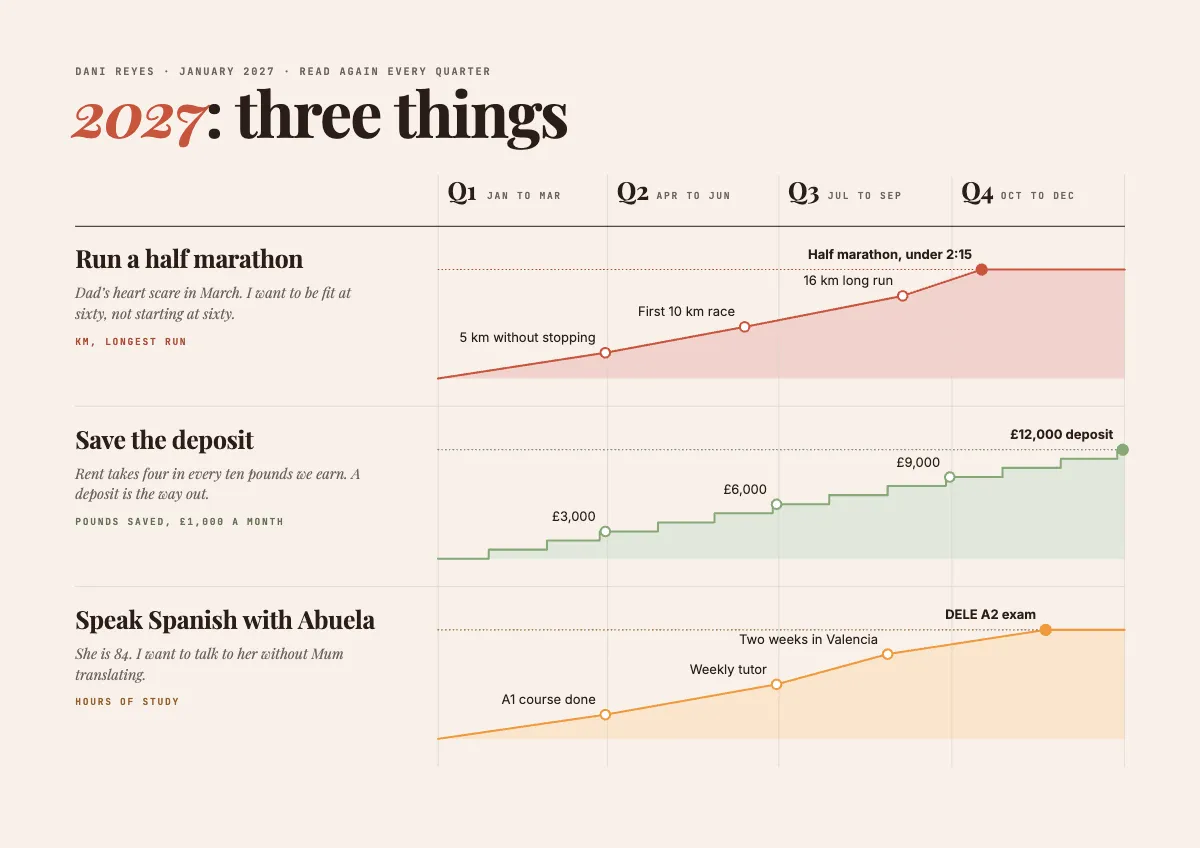
Three goals for the year as three lanes across the quarters, each a small chart of the real measure climbing to the goal.
Free. It opens in the Motionix editor as your own copy.
Download the pictureWebP, 1200 × 848, free to use. To change the words or colours, open it in the editor.
- Size
- 1754 × 1240 px
- Pages
- 1
- Motion
- Yes, plays live and in GIF or video
- Category
- Plans
What it shows
- Goal map, not a vision board
- Milestones on true dates
- Lines that draw on
Good for
How to use it
- Open the template. It becomes a project in your account.
- Change the words, colours and pictures. Every part is an ordinary shape, line or text box.
- Press Play to watch it build, then present it or export it.
What is a yearly goals planner?
A yearly goals planner sets out a small number of goals for the year and breaks each into milestones across the quarters, with a measure you can track, such as kilometres run, money saved or hours studied. Unlike a vision board, it shows how far along each goal should be at every point in the year, so you can tell early when you are falling behind.
When it helps
- Setting three personal goals in January and checking them at the end of each quarter.
- A coach helping a client turn a vague resolution into dated milestones.
- Saving towards a house deposit with a monthly target to measure against.
- Training for a race, with progressively longer runs placed on real dates.
Tips
- Make goals specific and measurable. Run a half marathon by October can be checked; get fitter cannot, and goals that cannot be checked quietly disappear by March.
- Track the behaviour as well as the result. You control the weekly runs and savings transfers, not the race time, and the habits are what move the line.
- Put the planner where you will see it. Goals reviewed once in January and again in December rarely survive the months between.
How to make a yearly goals planner
Choose three goals at most
Pick the few goals that matter most this year. Fewer goals get more attention, and you can say no to things that do not serve them.
Write why each matters
Add one honest sentence on why each goal matters to you. When motivation fades in a dull month, the reason is what keeps you going.
Pick one measure per goal
Choose a number you can track, such as longest run in kilometres, money saved or study hours, so progress is a fact rather than a feeling.
Set quarterly milestones
Break each goal into steps with dates, roughly one a quarter, so the year has checkpoints instead of one deadline in December.
Plot the path
Draw each goal as a line from where you start to the target, through the milestones. Your real progress can then be drawn against it.
Review every quarter
Put review dates in your diary. Adjust milestones when life changes, but keep the goal unless you decide on purpose to drop it.
FAQQuestions
Common questions.
What are SMART goals?
SMART is a checklist for setting goals: specific, measurable, achievable, relevant and time-bound. The idea was introduced by George Doran in a 1981 management article, and different writers have since swapped in slightly different words, but the aim is a goal clear enough to know when you have reached it.
How many goals should you set for a year?
Most people do better with a small number, often three to five. Each goal needs regular time and attention, and too many compete for the same evenings and weekends. Choosing a few also makes it easier to say no to commitments that would get in their way.
Why do New Year's resolutions fail?
Common reasons are goals that are too vague to measure, too big to start, or have no plan for the weeks in between. Breaking a resolution into dated milestones, tracking a simple measure and reviewing progress regularly make it far more likely to last beyond January.
More plans templates
Timelines, schedules, itineraries and trackers.