Free templateHabit tracker
Thirty-day habit tracker
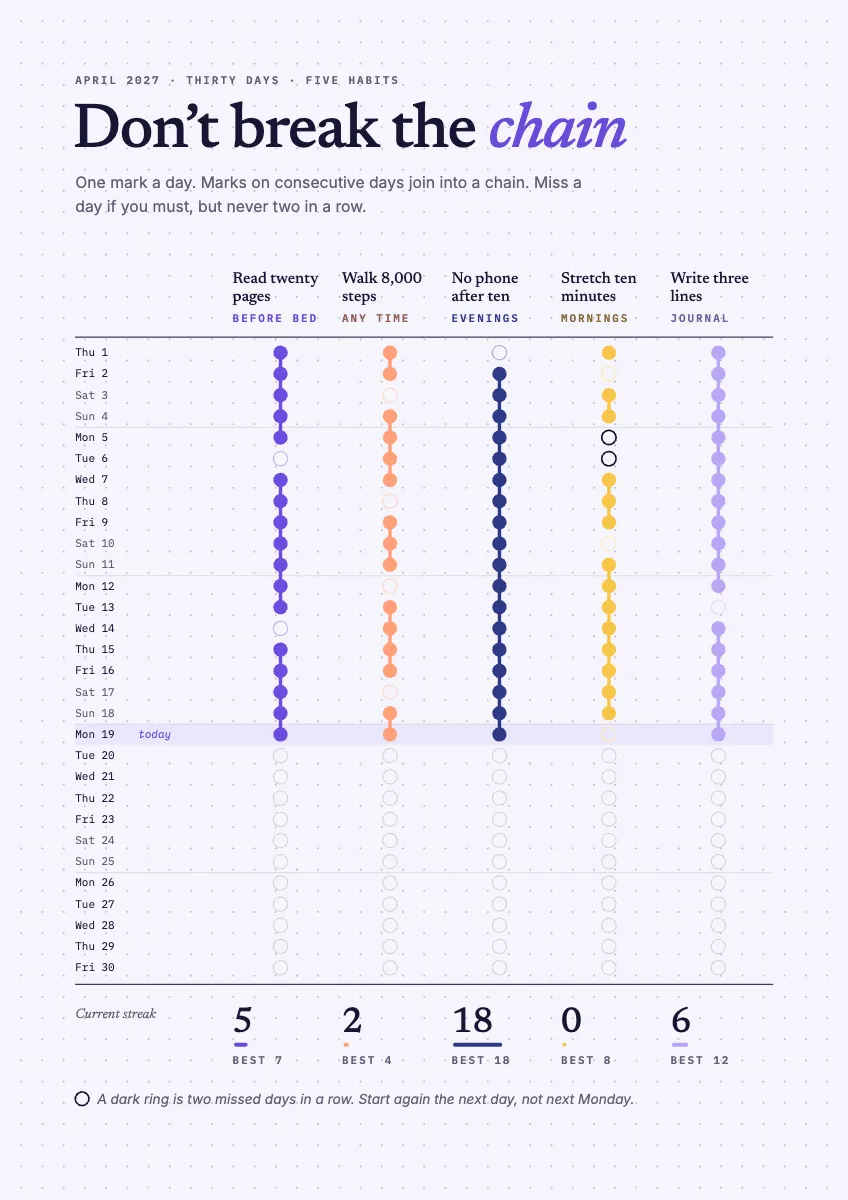
Five habits over thirty days, where kept days string together into chains and the streaks are counted at the foot.
Free. It opens in the Motionix editor as your own copy.
Download the pictureWebP, 848 × 1200, free to use. To change the words or colours, open it in the editor.
- Size
- 1240 × 1754 px
- Pages
- 1
- Motion
- Yes, plays live and in GIF or video
- Category
- Plans
What it shows
- Streaks drawn as chains
- Example month filled in
- A4 print
Good for
How to use it
- Open the template. It becomes a project in your account.
- Change the words, colours and pictures. Every part is an ordinary shape, line or text box.
- Press Play to watch it build, then present it or export it.
What is a habit tracker?
A habit tracker is a simple chart with the days of a month along one side and the habits you are building along the other, where you mark each day you keep a habit. The marks build into visible streaks, and many people find that not wanting to break a streak keeps them going on days when motivation is low.
When it helps
- A student building a daily reading habit through the month before exams.
- Someone tracking steps, stretching and screen time together to see which habit slips first.
- A journaller adding a monthly spread to their notebook.
- Reviewing a month to choose which habit to keep and which to drop.
Tips
- Never miss twice. A single missed day is normal; two in a row is the start of a new pattern, so get straight back on the next day.
- Make the habit small enough to do on your worst day. Two minutes of stretching that happens beats twenty minutes that does not.
- Keep the tracker where you will see it. A chart hidden in a drawer reminds nobody; one on the fridge or the desk does.
How to make a habit tracker
Choose a few habits
Pick three to five habits at most. Tracking ten at once turns the chart into a chore and makes it hard to keep any of them.
Make each one specific
Write habits you can tick without judgement, such as read twenty pages or walk 8,000 steps, rather than read more or be active.
Draw the month
Lay out the days of the month in a column or row and a column for each habit, with weeks marked so you can find today quickly.
Mark it at the same time
Fill in the tracker at a fixed point each day, such as before bed. Tying the mark to an existing routine makes the tracking itself a habit.
Count the streaks
At the end of the week or month, count your current and best streak for each habit. Seeing the numbers shows what is sticking.
FAQQuestions
Common questions.
How long does it take to form a habit?
Usually longer than the popular figure of 21 days. A 2009 study at University College London led by Phillippa Lally found the median time for a behaviour to become automatic was 66 days, with a wide range from 18 to 254 days depending on the person and the habit.
What is the don't break the chain method?
It is a habit technique often credited to the comedian Jerry Seinfeld: mark each day you do the habit on a calendar, and the marks form a chain. The goal becomes simply not breaking the chain, which turns a long-term aim into one small action each day.
What habits should I track?
Track habits that support a goal you care about and that happen most days, such as reading, exercise, sleep, water, study or screen time. Choose ones you can answer with a simple yes or no each day, and start with no more than five.
More plans templates
Timelines, schedules, itineraries and trackers.