Free templateFrench weather flashcards
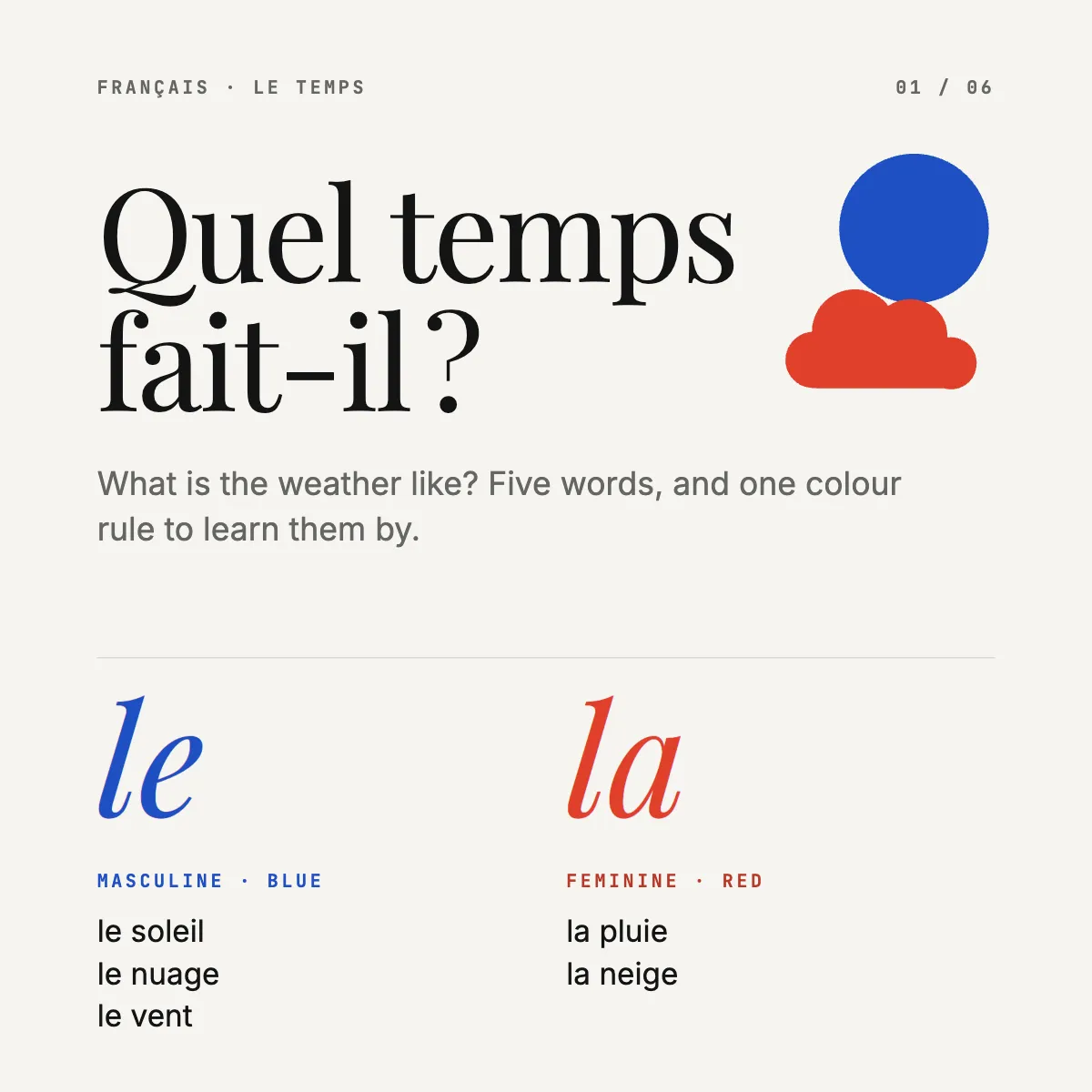
Quel temps fait-il
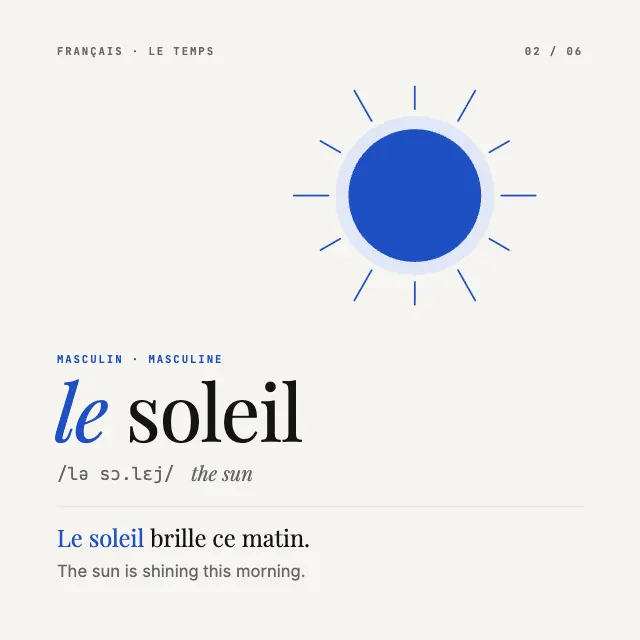
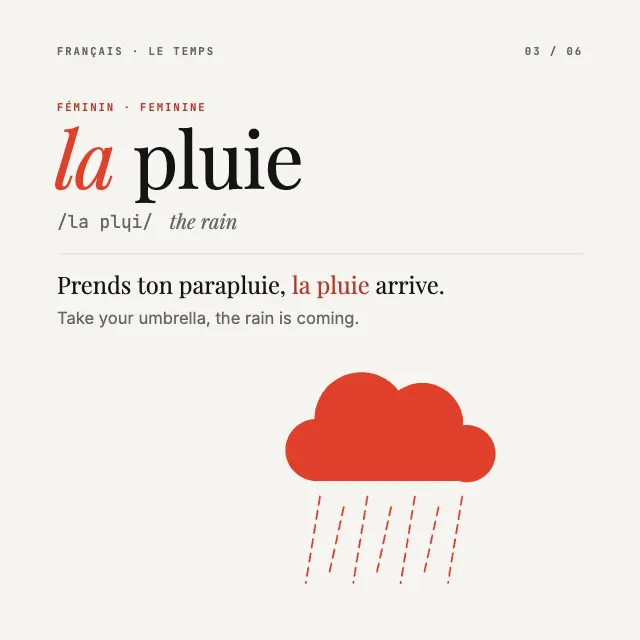
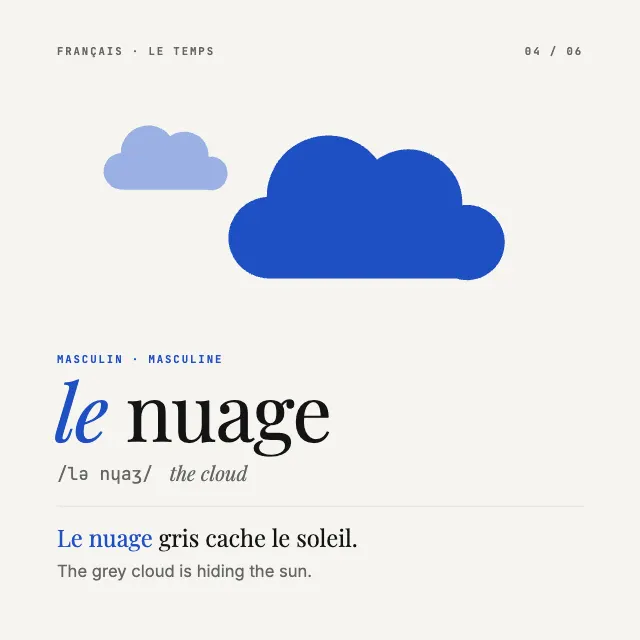
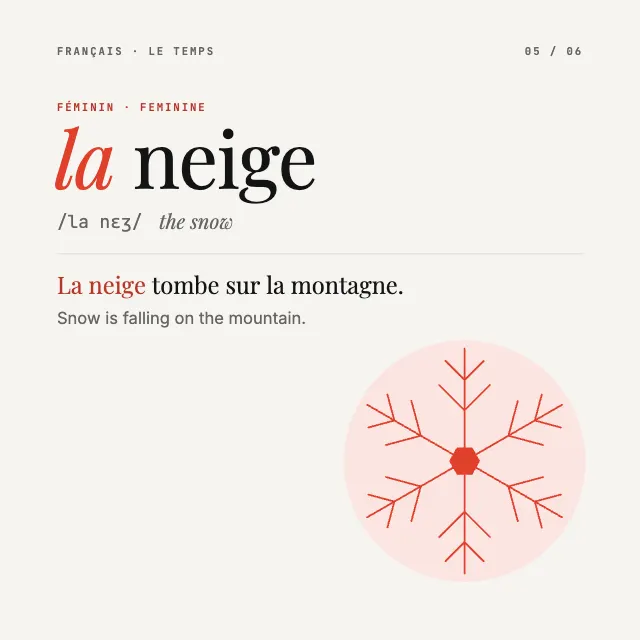
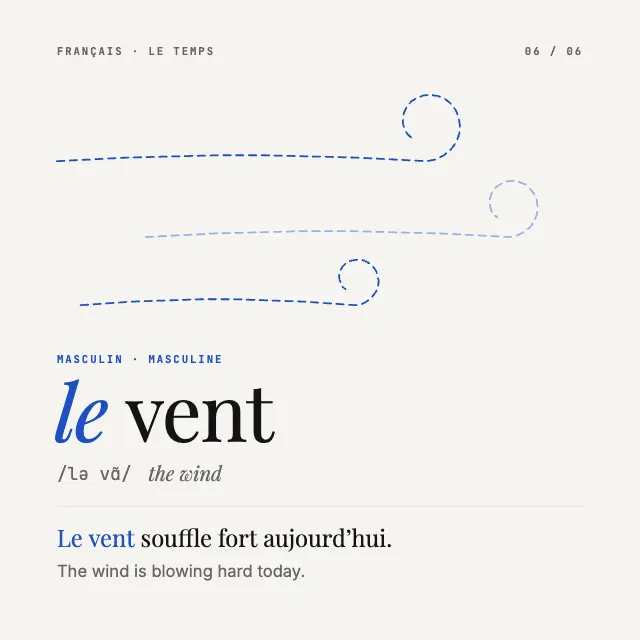
Six square French vocabulary cards on the weather, where blue means le and red means la, each with a drawing, its sound and an example.
Free. It opens in the Motionix editor as your own copy.
Download the pictureWebP, 1200 × 1200, free to use. To change the words or colours, open it in the editor.
- Size
- 1080 × 1080 px
- Pages
- 6
- Motion
- Yes, plays live and in GIF or video
- Category
- Lessons
Every page
 Page 2
 Page 3
 Page 4
 Page 5
 Page 6
What it shows
- Colour that encodes grammar
- IPA in mono
- Composition that varies by card
Good for
How to use it
- Open the template. It becomes a project in your account.
- Change the words, colours and pictures. Every part is an ordinary shape, line or text box.
- Press Play to watch it build, then present it or export it.
What are French weather flashcards?
French weather flashcards pair each weather word with a picture, its article and an example sentence, so learners remember le soleil, la pluie or le vent as whole units rather than bare nouns. They usually sit alongside the key question Quel temps fait-il ? and phrases such as il fait beau, il pleut and il neige, which are how French speakers actually describe the weather.
When it helps
- Starting a beginner French topic on the weather with pupils aged 7 to 12.
- A daily warm-up where one pupil checks the window and reports the weather in French.
- Revising grammatical gender by colour: blue for masculine le words, red for feminine la words.
- Self-study for adult learners who want vocabulary and pronunciation in one place.
Tips
- Teach the weather phrases as well as the nouns; learners need il pleut and il fait froid to answer the question, and nouns alone leave them stuck.
- Keep gender colours the same across every topic and year group; once pupils trust that blue means le, they start predicting the article for new words.
- When reviewing, show the picture before the word, so learners retrieve the French from the image instead of translating from English.
How to make French vocabulary flashcards
Choose a small set
Pick five to eight words around one theme, such as le soleil, la pluie, le nuage, la neige and le vent. Too many at once and none of them stick.
Always include the article
Write le or la with every noun. French gender has to be learned word by word, and the article is the easiest way to carry it.
Colour by gender
Use one colour for masculine and another for feminine, and apply it to the article, the picture or the card border. Keep the code the same on every set you make.
Add the sound
Give the pronunciation in IPA or a simple respelling, for example /la plɥi/ for la pluie, and say it aloud as you introduce each card.
Use the word in a sentence
Add one short example with its English, such as "La neige tombe sur la montagne", so learners see the word at work and not only named.
FAQQuestions
Common questions.
How do you say "what is the weather like" in French?
Quel temps fait-il ? is the standard question, literally "what weather does it make". Replies usually begin with il fait, il y a or a weather verb: il fait beau (it is fine), il y a du vent (it is windy), il pleut (it is raining).
Is soleil masculine or feminine in French?
Masculine: le soleil. In the same set, le nuage and le vent are masculine too, while la pluie and la neige are feminine. Meaning gives no reliable clue to gender, which is why learning each noun with its article matters.
Why is there a space before the question mark in French?
French typography puts a thin non-breaking space before question marks, exclamation marks, colons and semicolons, so the question is written Quel temps fait-il ? in France. Canadian and Swiss usage differs, and many people drop the space in casual writing.
More lessons templates
Concepts, processes and revision pages for classrooms and courses.