Free templateSolving quadratics worked example
Solving a quadratic
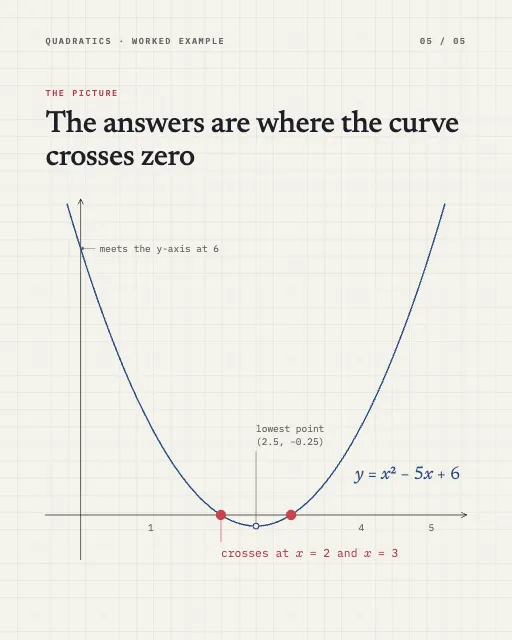
A five-page carousel that solves x² − 5x + 6 = 0 a line at a time, lighting the line that changed and ending on the curve itself.
Free. It opens in the Motionix editor as your own copy.
Download the pictureWebP, 960 × 1200, free to use. To change the words or colours, open it in the editor.
- Size
- 1080 × 1350 px
- Pages
- 5
- Motion
- Yes, plays live and in GIF or video
- Category
- Lessons
Every page
 Page 2
 Page 3
 Page 4
 Page 5
What it shows
- Working that grows page by page
- Margin notes that explain each move
- A parabola computed from the equation
Good for
How to use it
- Open the template. It becomes a project in your account.
- Change the words, colours and pictures. Every part is an ordinary shape, line or text box.
- Press Play to watch it build, then present it or export it.
What is a worked example of solving a quadratic?
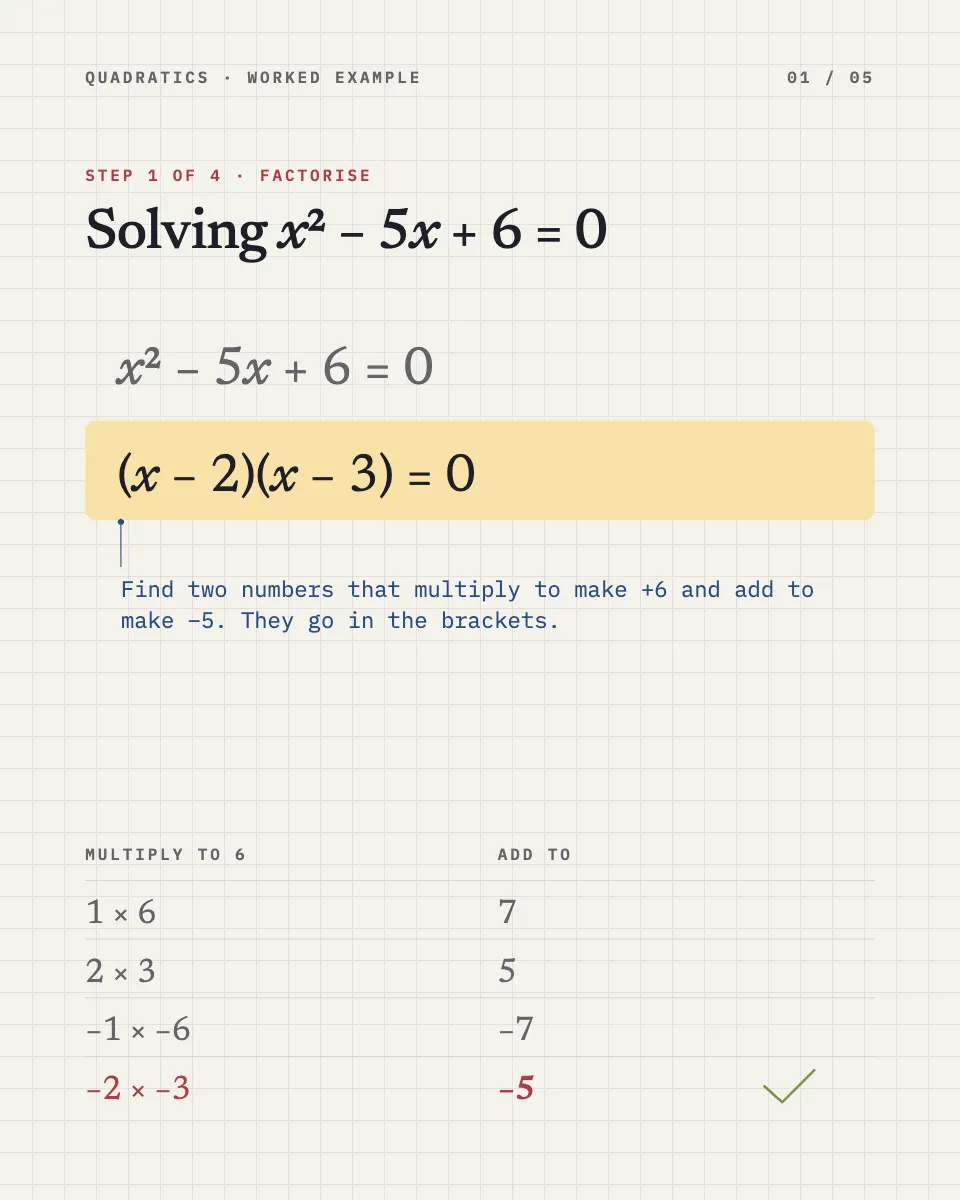
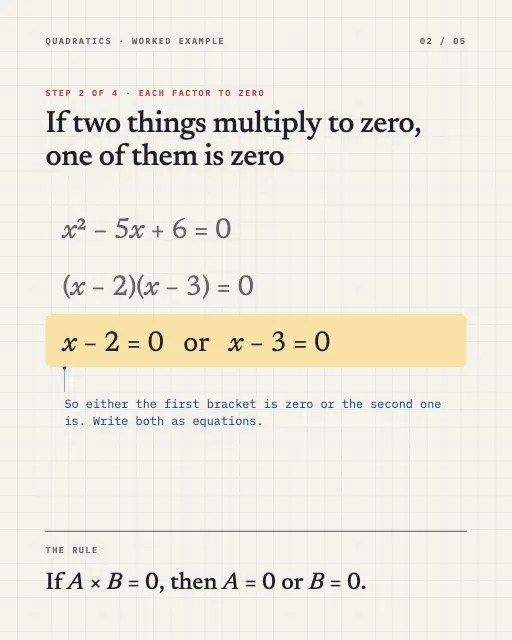
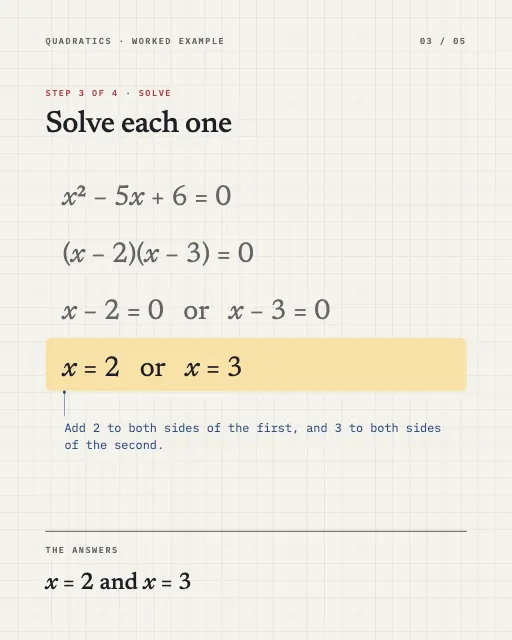
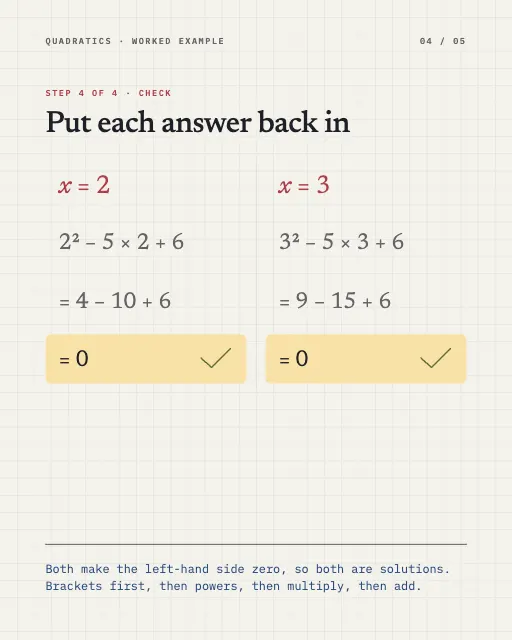
A worked example of solving a quadratic shows every line of the method, with a reason for each move, so a student can follow the logic and then copy the routine. For x² − 5x + 6 = 0, that means factorising into (x − 2)(x − 3) = 0, setting each bracket to zero, solving to get x = 2 and x = 3, and substituting both back in to check.
When it helps
- Introducing factorising to GCSE students before they try a set of similar equations alone.
- A tutor's model answer showing how much working an examiner expects to see.
- Revising before a test by covering the next line and predicting it before reading on.
- Linking algebra to graphs, with the solutions shown where the curve crosses the x-axis.
Tips
- Write one change per line and say what changed; students who skip lines in a model answer skip them in their own work and lose method marks.
- List negative factor pairs as well. Students who only try 1 and 6, 2 and 3 get stuck whenever the middle term is negative.
- Finish with the graph. Seeing the parabola cross the axis at 2 and 3 makes two answers feel natural rather than strange.
How to solve a quadratic equation by factorising
Set the equation equal to zero
Rearrange so everything is on one side, in the form ax² + bx + c = 0. Factorising only gives the solutions when the other side is zero.
Find the factor pair
For x² − 5x + 6, look for two numbers that multiply to +6 and add to −5. Listing the factor pairs of 6, negatives included, shows that −2 and −3 work.
Write the brackets
Put the numbers into two brackets: (x − 2)(x − 3) = 0. Expanding them again is a quick check that the factorising is right.
Set each bracket to zero
If two things multiply to make zero, one of them must be zero. So either x − 2 = 0 or x − 3 = 0.
Solve and check
Solve each to get x = 2 and x = 3, then substitute both into the original equation. Each one should make the left-hand side exactly zero.
FAQQuestions
Common questions.
What are the ways to solve a quadratic equation?
There are three main methods: factorising, completing the square and the quadratic formula. Factorising is quickest when the numbers are friendly. The formula, x = (−b ± √(b² − 4ac)) ÷ 2a, works for every quadratic, including ones that do not factorise neatly.
Why does a quadratic have two solutions?
Because its graph is a parabola, a U shape that can cross the x-axis twice. Each crossing is a value of x that makes the expression zero. Some quadratics touch the axis once, giving one repeated solution, and some miss it entirely and have no real solutions.
How do you know if a quadratic will factorise?
Work out the discriminant, b² − 4ac. If it is a perfect square, such as 1, 4 or 9, the quadratic factorises neatly. For x² − 5x + 6 it is 25 − 24 = 1, so it does. If the discriminant is negative, there are no real solutions at all.
More lessons templates
Concepts, processes and revision pages for classrooms and courses.