Free templatePhotosynthesis diagram
Photosynthesis
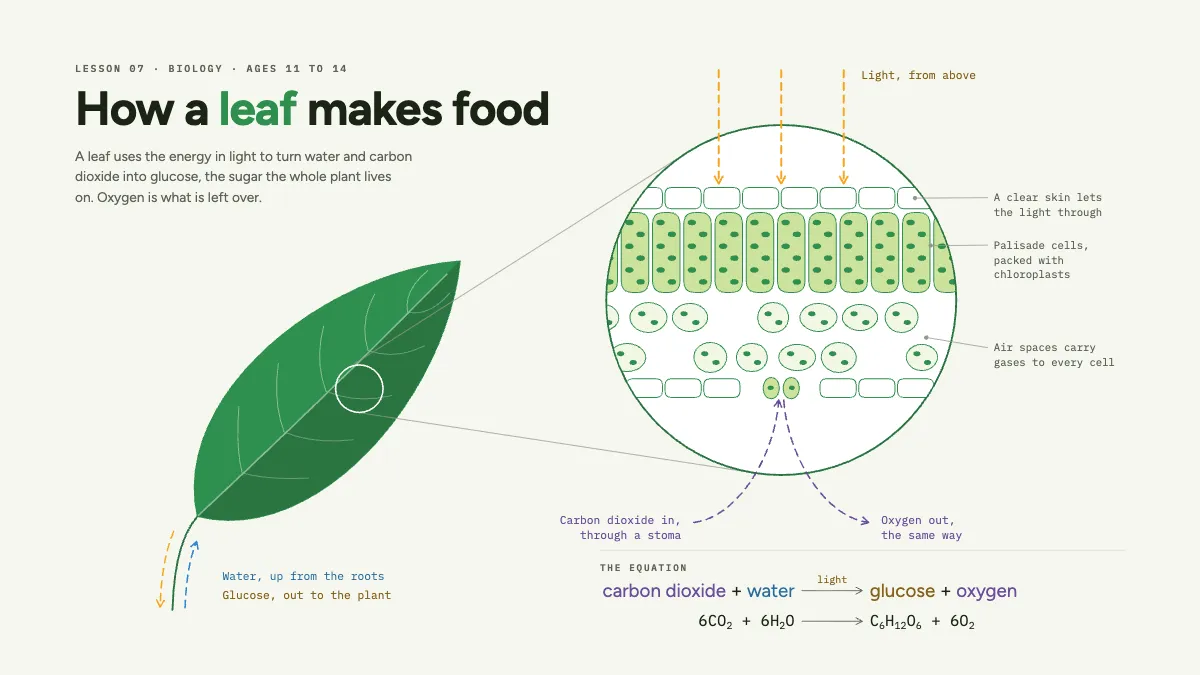
A biology slide with one leaf and a magnified cut through it: light, water and carbon dioxide arrive where they really do, oxygen and glucose leave.
Free. It opens in the Motionix editor as your own copy.
Download the pictureWebP, 1200 × 675, free to use. To change the words or colours, open it in the editor.
- Size
- 1920 × 1080 px
- Pages
- 1
- Motion
- Yes, plays live and in GIF or video
- Category
- Lessons
What it shows
- Magnified cut-away
- Inputs and outputs that flow
- Equation set with real subscripts
Good for
How to use it
- Open the template. It becomes a project in your account.
- Change the words, colours and pictures. Every part is an ordinary shape, line or text box.
- Press Play to watch it build, then present it or export it.
What is a photosynthesis diagram?
A photosynthesis diagram shows how a green plant makes its own food from light. It traces water rising from the roots, carbon dioxide entering through tiny pores called stomata and light falling on the leaf, then shows glucose and oxygen leaving. Good ones add a magnified cut through the leaf, so pupils see the palisade cells where most of the work happens, and the balanced equation.
When it helps
- Teaching the word and symbol equations to pupils aged 11 to 14 beside a labelled leaf.
- Linking leaf structure to function: why palisade cells sit near the top and stomata underneath.
- Revising for a biology test on plant nutrition, limiting factors or the carbon cycle.
- Setting up a practical where pupils test leaves for starch or count bubbles from pondweed.
Tips
- Draw stomata on the underside of the leaf, not the top; examiners notice, and it is a common slip in pupils' own diagrams.
- Say plainly that oxygen is a by-product. Many pupils believe plants make oxygen for us, rather than as something left over from making sugar.
- Keep chlorophyll and chloroplasts apart in the labels: chloroplasts are the structures, and chlorophyll is the green pigment inside them that absorbs light.
How to draw a photosynthesis diagram
Draw one large leaf
Sketch a single leaf with its stalk, big enough to hold labels around it. A midrib and a few veins make it read as a leaf straight away.
Add a magnified cross-section
Beside the leaf, draw a circle showing a cut through it: the upper epidermis, a row of tall palisade cells, loose spongy cells with air gaps, and the lower epidermis with a stoma.
Bring in the three inputs
Arrow light down onto the upper surface, water up the stalk from the roots, and carbon dioxide in through the stoma on the underside. Each should arrive where it really enters.
Show the two outputs
Draw oxygen leaving by the same stoma and glucose travelling out along the stalk to feed the rest of the plant.
Write the equation underneath
Give the word equation, carbon dioxide plus water gives glucose plus oxygen, with light over the arrow. Add the balanced symbol equation, 6CO₂ + 6H₂O → C₆H₁₂O₆ + 6O₂, for older pupils.
Colour by substance
Give each substance one colour and keep it from arrow to equation, so pupils can match the gas going in with its formula.
FAQQuestions
Common questions.
What is the equation for photosynthesis?
In words, carbon dioxide plus water gives glucose plus oxygen, using energy from light. The balanced symbol equation is 6CO₂ + 6H₂O → C₆H₁₂O₆ + 6O₂. Chlorophyll is often written above the arrow too, because the reaction only happens where light can be absorbed.
Where does photosynthesis take place?
In the chloroplasts, found mostly in the palisade cells just under the upper surface of the leaf. Their position lets them catch the most light, and the spongy layer below leaves air spaces so gases can reach every cell.
What do plants do with the glucose they make?
They use some straight away in respiration to release energy. The rest becomes starch for storage, cellulose for cell walls, oils for seeds and, with nitrates taken from the soil, proteins. It is carried to roots, fruits and growing shoots through the phloem.
More lessons templates
Concepts, processes and revision pages for classrooms and courses.