Free templateFraction wall
Fractions that line up
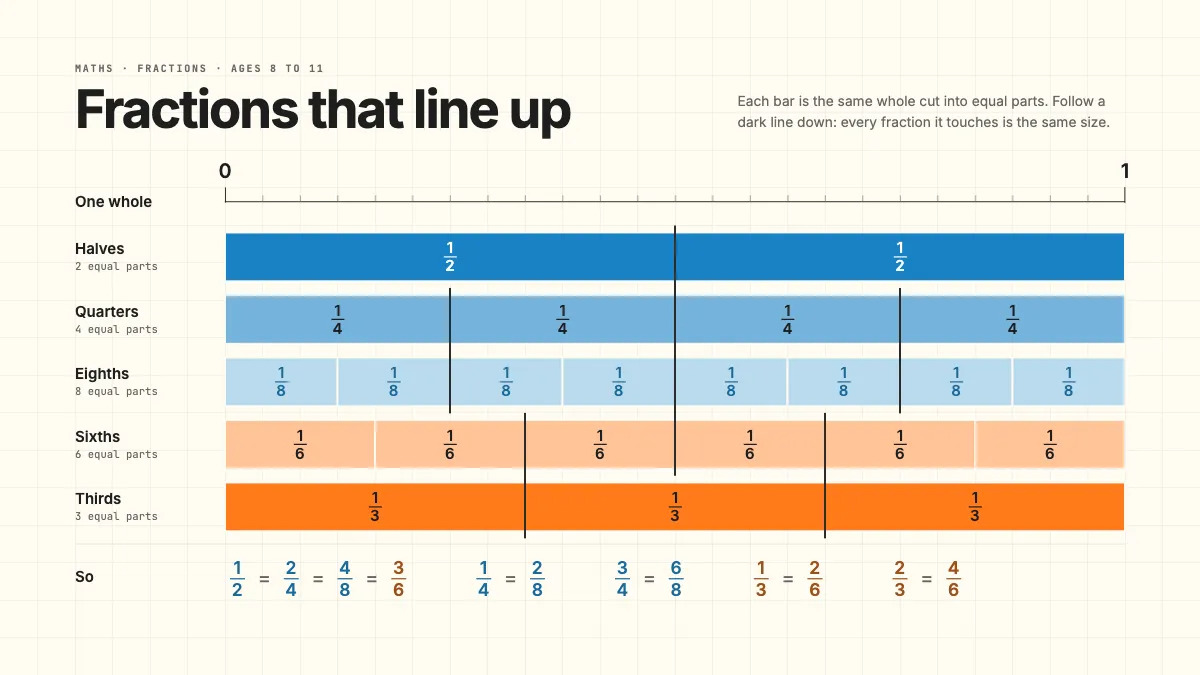
A maths slide where five bars cut into halves, quarters, eighths, sixths and thirds sit under one ruler, so equal fractions share a line.
Free. It opens in the Motionix editor as your own copy.
Download the pictureWebP, 1200 × 675, free to use. To change the words or colours, open it in the editor.
- Size
- 1920 × 1080 px
- Pages
- 1
- Motion
- Yes, plays live and in GIF or video
- Category
- Lessons
What it shows
- Bars drawn to exact scale
- A figure that proves its point
- Bars that wipe in one by one
Good for
How to use it
- Open the template. It becomes a project in your account.
- Change the words, colours and pictures. Every part is an ordinary shape, line or text box.
- Press Play to watch it build, then present it or export it.
What is a fraction wall?
A fraction wall is a stack of bars of equal length, each one whole cut into a different number of equal parts: halves, thirds, quarters and so on. Because every bar starts and ends at the same place, a straight line drawn down through the stack shows which fractions are the same size, such as one half, two quarters and four eighths.
When it helps
- Showing pupils aged 8 to 11 why 2/4 and 1/2 name the same amount before teaching any rule.
- Comparing fractions such as 2/3 and 3/4 by eye, without finding a common denominator.
- Supporting pupils who struggle with the idea that a bigger denominator means a smaller piece.
- A desk reference while pupils add fractions with related denominators, like halves and eighths.
Tips
- Have pupils fold paper strips first; folding a half into quarters builds the idea that the drawn wall then records.
- Leave fifths and sevenths out of a first wall. They line up with almost nothing, and the point of the lesson is that the lines do match.
- Ask pupils to explain an equivalence from the cuts, not the labels; a child who can say why 3/4 equals 6/8 without reading numbers has understood it.
How to make a fraction wall
Fix the length of one whole
Draw one long bar and label it 1. Every other bar must be exactly this length, so measure it carefully or build it on squared paper.
Choose a length that divides well
A whole of 24 squares or 24 cm splits evenly into halves, thirds, quarters, sixths, eighths and twelfths, so every cut lands on a line.
Cut each bar into equal parts
Rule a second bar into two halves, a third into quarters, and carry on down. Write the unit fraction, such as 1/4, inside every piece.
Group the bars by family
Keep halves, quarters and eighths together, and thirds with sixths. Pupils then see that each bar in a family splits the pieces of the one above it in two.
Draw the equivalence lines
Run a ruler straight down wherever cuts meet in several bars. Every fraction ending on that line, in any row, is the same amount of the whole.
Write what the lines prove
Below the wall, record each equal set as a statement, for example 1/3 = 2/6, so the picture and the notation sit side by side.
FAQQuestions
Common questions.
What is the difference between a fraction wall and a fraction strip?
A fraction strip is one bar of the wall: a single whole divided into equal parts. A fraction wall stacks several strips under each other so they can be compared. Many teachers hand out strips to cut and arrange before showing the finished wall.
How do you find equivalent fractions on a fraction wall?
Choose a fraction and lay a ruler on the line where it ends. Read down the wall: any other bar with a cut on that same line gives an equivalent fraction. A cut at 1/3 meets one at 2/6, for example.
Is a fraction wall the same as a number line?
Not quite. A wall shows fractions as lengths of a whole, while a number line shows them as points, which lets you carry on past 1 into improper fractions. They work well together: the top edge of a wall can be read as a number line from 0 to 1.
More lessons templates
Concepts, processes and revision pages for classrooms and courses.