Free templateSUVAT equations sheet
SUVAT formula sheet
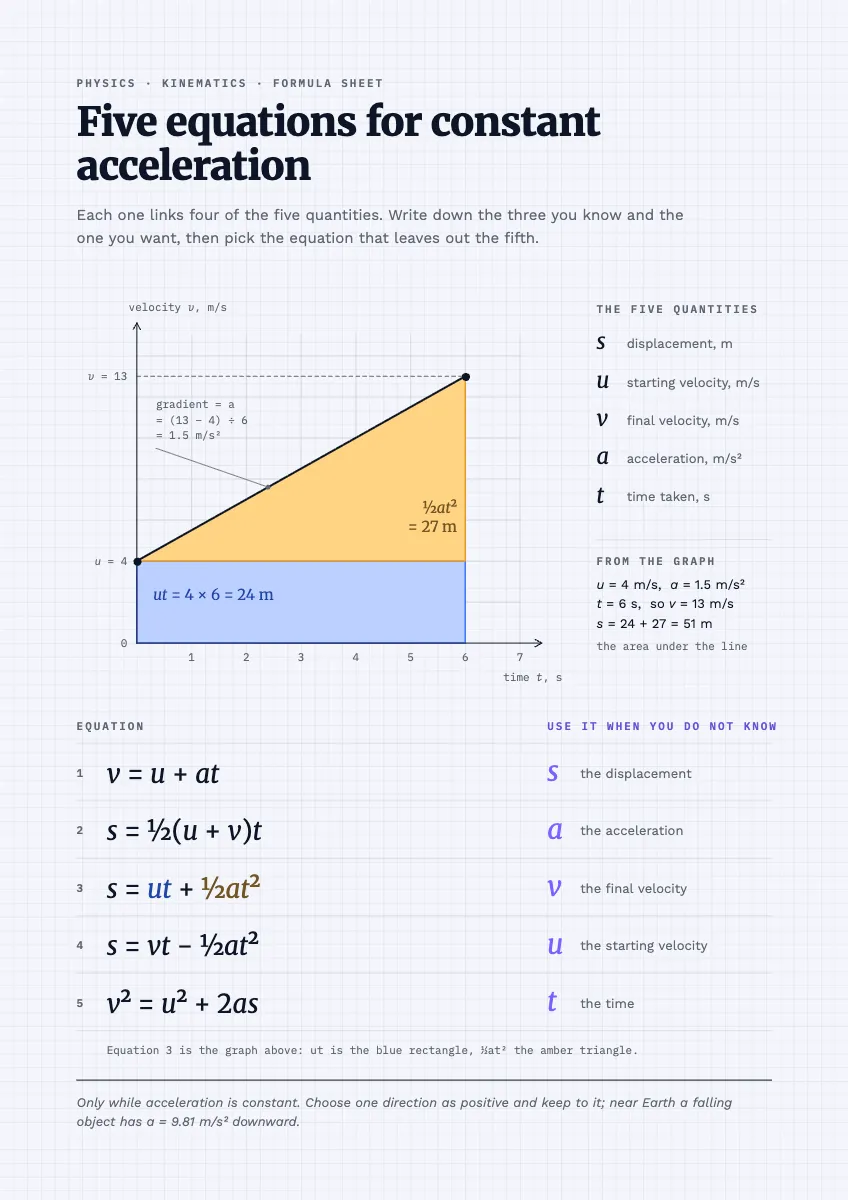
An A4 physics sheet with the five equations of constant acceleration, each filed by what it leaves out, beside a graph whose area is the displacement.
Free. It opens in the Motionix editor as your own copy.
Download the pictureWebP, 848 × 1200, free to use. To change the words or colours, open it in the editor.
- Size
- 1240 × 1754 px
- Pages
- 1
- Motion
- Yes, plays live and in GIF or video
- Category
- Lessons
What it shows
- Equations set with italic variables
- Graph computed from a worked example
- Symbols key
Good for
How to use it
- Open the template. It becomes a project in your account.
- Change the words, colours and pictures. Every part is an ordinary shape, line or text box.
- Press Play to watch it build, then present it or export it.
What are the SUVAT equations?
The SUVAT equations are five formulas for motion in a straight line with constant acceleration. Each links four of the five quantities: displacement s, initial velocity u, final velocity v, acceleration a and time t. Because every equation leaves one quantity out, any problem with three known values can be solved by choosing the equation without the one you neither know nor need.
When it helps
- A formula sheet for A level physics or mechanics students working through kinematics questions.
- Solving projectile problems by treating horizontal and vertical motion separately.
- Tutoring sessions that need a quick, reliable way to pick the right equation.
- Linking the equations to velocity-time graphs, where gradient is acceleration and area is displacement.
Tips
- Learn each equation by the quantity it leaves out; it turns every question into the same routine and ends the guessing.
- Sketch a velocity-time graph for tricky questions. The area under the line is the displacement, which is where s = ut + ½at² comes from in the first place.
- Repeat the condition often: these only work while acceleration stays constant. A car braking harder and harder, or strong air resistance, breaks them.
How to use the SUVAT equations
Write down all five letters
List s, u, v, a and t down the side of the page. Fill in each value the question gives, with units, and mark the one you want.
Spot the missing quantity
One letter will be neither given nor asked for. Choose the equation that leaves that letter out: v = u + at has no s, and v² = u² + 2as has no t.
Pick a positive direction
Decide which way counts as positive and keep to it. A ball thrown upwards has a positive u and an acceleration of minus 9.81 m/s² if up is positive.
Substitute and rearrange
Put the numbers in, then rearrange for the unknown. With s = ut + ½at², solving for t can give a quadratic with two answers, and you choose the one that fits.
Check the answer makes sense
Look at the sign and size of the result. A negative time, or a car reaching the speed of sound, means a slip somewhere earlier.
FAQQuestions
Common questions.
What does SUVAT stand for?
It is named after the five quantities the equations connect: s for displacement, u for initial velocity, v for final velocity, a for acceleration and t for time. The letters are a convention used in most British textbooks and exam formula booklets.
What are the 5 SUVAT equations?
v = u + at, s = ½(u + v)t, s = ut + ½at², s = vt − ½at² and v² = u² + 2as. Each one leaves out a different quantity, s, a, v, u and t in that order, which is how you choose between them.
When can you not use the SUVAT equations?
When acceleration changes during the motion. That includes objects slowed by significant air resistance, masses on springs and motion in a circle, where the direction of acceleration keeps turning. These need calculus or another model, though motion can sometimes be split into stages of constant acceleration.
More lessons templates
Concepts, processes and revision pages for classrooms and courses.