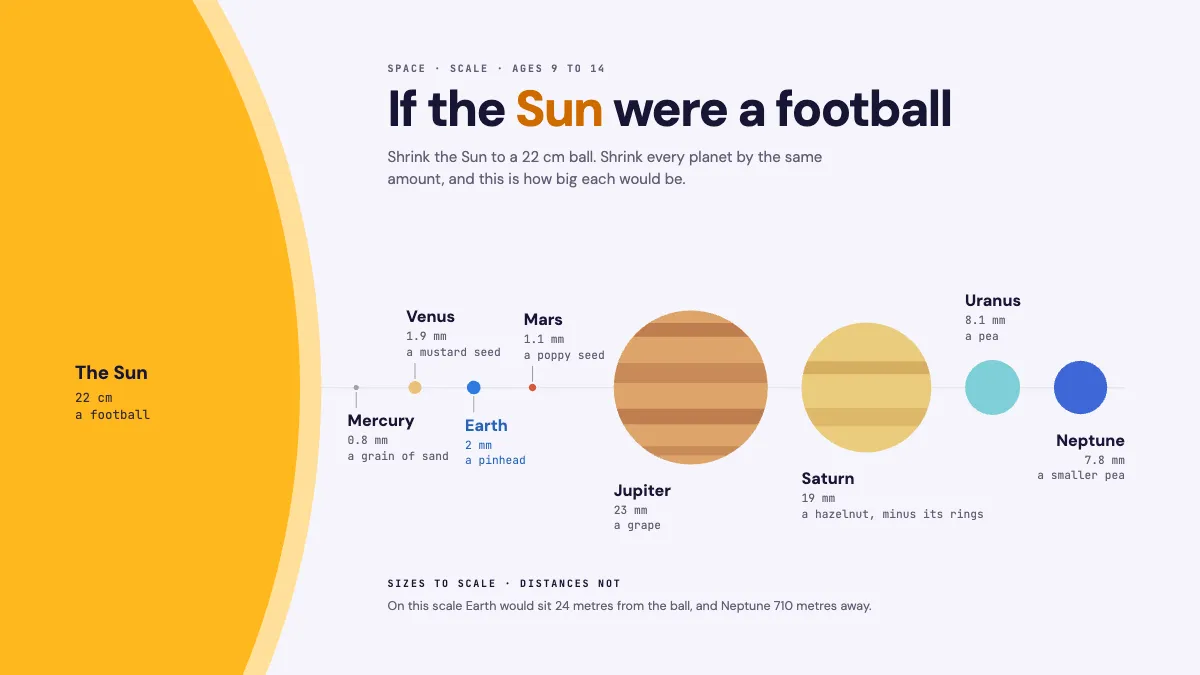
Free templateSolar system scale model
If the Sun were a football
A space slide with the Sun as a 22 cm ball and every planet at its true size beside it, each named by something you could hold.
Free. It opens in the Motionix editor as your own copy.
Download the pictureWebP, 1200 × 675, free to use. To change the words or colours, open it in the editor.
- Size
- 1920 × 1080 px
- Pages
- 1
- Motion
- Yes, plays live and in GIF or video
- Category
- Lessons
What it shows
- Sizes computed to true scale
- A figure that bleeds off the page
- Planets that arrive in order
Good for
How to use it
- Open the template. It becomes a project in your account.
- Change the words, colours and pictures. Every part is an ordinary shape, line or text box.
- Press Play to watch it build, then present it or export it.
What is a solar system scale model?
A solar system scale model shrinks the Sun and planets by the same factor so their sizes, and sometimes their distances, can be compared. If the Sun were a 22 cm football, Earth would be a pinhead about 2 mm across and Jupiter a grape about 23 mm wide. Distances on that scale are huge: Earth would sit around 24 metres from the ball.
When it helps
- Showing pupils aged 9 to 14 how small Earth is beside the Sun as a space topic begins.
- Planning a field walk where pupils pace out the distances to the inner planets.
- Correcting textbook pictures that draw the planets large and bunched together to fit a page.
- A maths lesson on ratio and scale factors using real astronomical figures.
Tips
- Treat sizes and distances as two separate models; on any scale where Earth is big enough to see, Neptune ends up hundreds of metres away.
- Let pupils hold the objects. A pinhead next to a football makes the difference felt in a way a table of figures never does.
- Expect questions about Pluto. It was reclassified as a dwarf planet in 2006, and explaining why makes a good discussion about how science sorts things.
How to make a scale model of the solar system
Pick the size of the Sun
Choose an object for the Sun, such as a 22 cm ball. Everything else follows from comparing it with the real diameter, about 1.39 million kilometres.
Work out the scale factor
Divide the model Sun's diameter by the real one. Multiply each planet's true diameter by that factor to get its model size in millimetres.
Match each planet to an object
Find everyday things of about the right size: a grain of sand for Mercury, a pinhead for Earth, a grape for Jupiter, a pea for Uranus. Objects stick in the memory better than numbers.
Decide about distances
Use the same factor for distances if you have the room. On the football scale, Earth sits about 24 metres away and Neptune about 710 metres, so a long field or street helps.
Label what is to scale
State clearly whether distances are to scale or only sizes. If you do not, pupils will assume the planets really sit close together.
FAQQuestions
Common questions.
How big would Earth be if the Sun were a football?
With the Sun as a 22 cm ball, Earth would be about 2 mm across, roughly the size of a pinhead. The Sun is about 109 times wider than Earth, so over a hundred Earths would fit side by side across its face.
Why are most pictures of the solar system not to scale?
Because a true scale will not fit on a page. If the planets are drawn large enough to see, the gaps between them would need a sheet hundreds of metres long. Most pictures shrink the gaps and enlarge the planets, which helps with names and order but misleads about size.
What is the order of the planets from the Sun?
Mercury, Venus, Earth, Mars, Jupiter, Saturn, Uranus and Neptune. The first four are small rocky planets; the outer four are giants, Jupiter and Saturn mostly gas, Uranus and Neptune mostly ices and gas. A common mnemonic is My Very Easy Method Just Speeds Up Naming.
More lessons templates
Concepts, processes and revision pages for classrooms and courses.