Free templatePresent perfect vs past simple
Past simple or present perfect
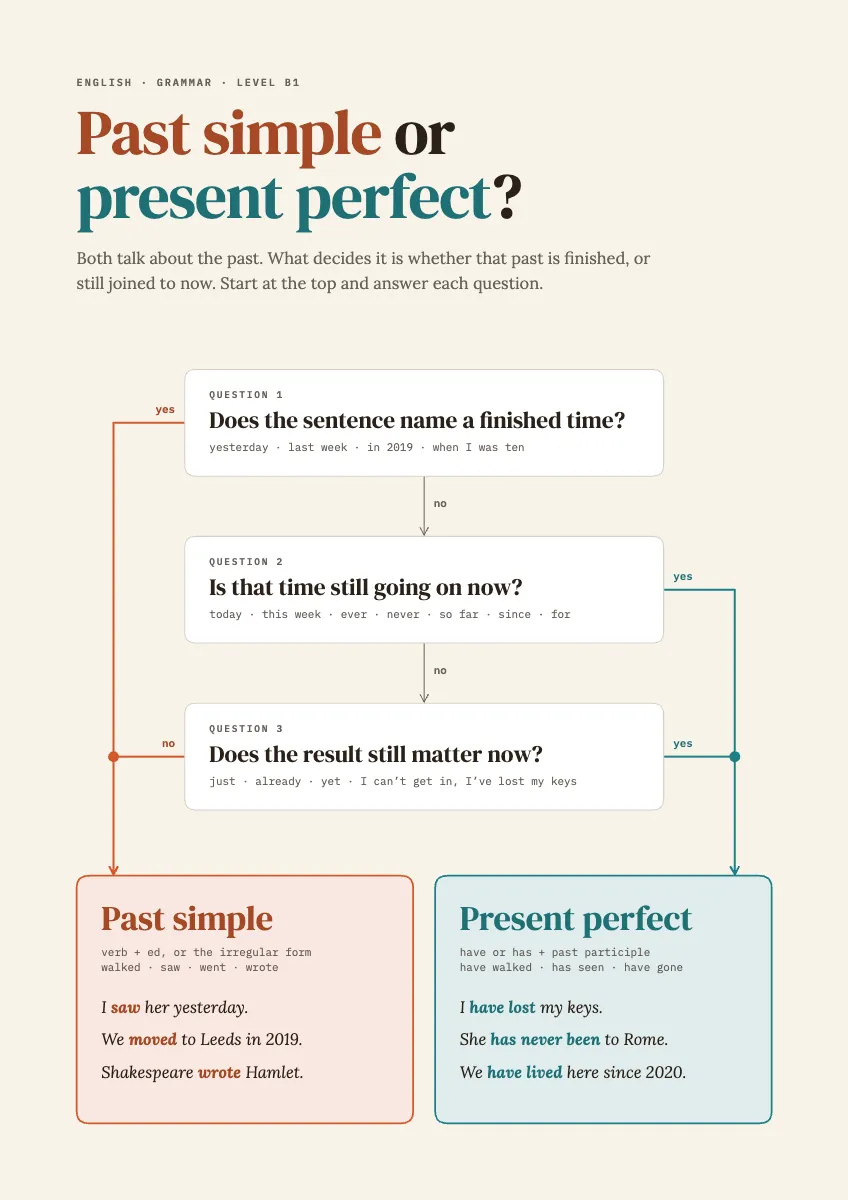
An A4 handout for English teachers: three yes or no questions lead to the right tense, each with its form and example sentences.
Free. It opens in the Motionix editor as your own copy.
Download the pictureWebP, 848 × 1200, free to use. To change the words or colours, open it in the editor.
- Size
- 1240 × 1754 px
- Pages
- 1
- Motion
- Yes, plays live and in GIF or video
- Category
- Lessons
What it shows
- Decision flowchart
- Colour that carries the answer
- True italics for examples
Good for
How to use it
- Open the template. It becomes a project in your account.
- Change the words, colours and pictures. Every part is an ordinary shape, line or text box.
- Press Play to watch it build, then present it or export it.
What is the difference between present perfect and past simple?
Both tenses talk about the past, but the past simple places an action in a finished time, while the present perfect links a past action to now. "I lost my keys yesterday" is over and dated. "I have lost my keys" means they are still missing. Time words often decide it: yesterday and in 2019 take the past simple; ever, never, yet and since take the present perfect.
When it helps
- Teaching B1 learners who pair the present perfect with finished times, as in "I have seen him yesterday".
- A handout to stick in exercise books for quick reference during writing tasks.
- Helping speakers of French or German, whose perfect forms are used for finished past events.
- Revising before an exam that tests tense choice in gap-fill sentences.
Tips
- Teach the time words as two groups before the rule; learners pick up "yesterday means past simple" faster than the abstract idea of a link to now.
- Mention that American English often uses the past simple with just, already and yet, so learners copying American films are not wrong.
- Drill irregular past participles on their own; many errors that look like tense mistakes are really "have went" instead of "have gone".
How to choose between the past simple and present perfect
Look for a finished time
If the sentence names a time that is over, such as yesterday, last week, in 2019 or when I was ten, use the past simple.
Check whether the period is open
Words like today, this week, ever, never, so far, since and for describe a period that includes now. These usually take the present perfect.
Ask whether the result matters now
If the past action has a result in the present, as in "I have lost my keys, I cannot get in", the present perfect fits. Just, already and yet are strong clues.
Otherwise use the past simple
When the time is finished or understood, as in "Shakespeare wrote Hamlet", the past simple is the safe choice. The writer is dead, so the period is closed.
Form the verb correctly
Past simple is the verb plus ed or its irregular form: walked, saw, went. Present perfect is have or has with the past participle: have walked, has seen, have gone.
FAQQuestions
Common questions.
Can you use the present perfect with yesterday?
No. Yesterday names a finished time, so it needs the past simple: "I saw her yesterday", not "I have seen her yesterday". The same goes for last week, ago, and specific dates or years.
Is it "I have lived here for five years" or "I lived here for five years"?
Both are correct but they mean different things. "I have lived here for five years" means you still live here. "I lived here for five years" means you have since moved away, and those five years are over.
When do you use since and for with the present perfect?
Use since with a starting point, such as since 2020 or since Monday, and for with a length of time, such as for three weeks. Both describe a period running up to now, which is why they take the present perfect.
More lessons templates
Concepts, processes and revision pages for classrooms and courses.