Free templateLessons
Pond food web
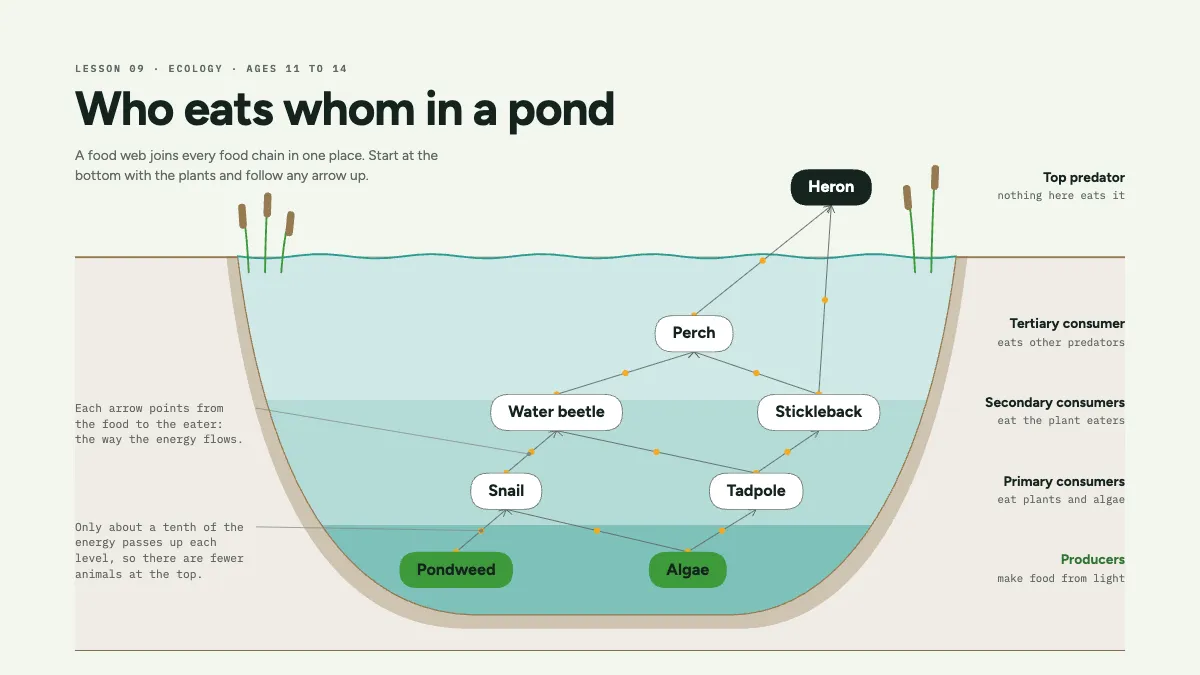
An ecology slide that draws the food web inside a cross-section of the pond, with energy dots travelling from food to eater.
Free. It opens in the Motionix editor as your own copy.
Download the pictureWebP, 1200 × 675, free to use. To change the words or colours, open it in the editor.
- Size
- 1920 × 1080 px
- Pages
- 1
- Motion
- Yes, plays live and in GIF or video
- Category
- Lessons
What it shows
- Concept map in levels
- Energy that travels the arrows
- Margin notes with leaders
Good for
How to use it
- Open the template. It becomes a project in your account.
- Change the words, colours and pictures. Every part is an ordinary shape, line or text box.
- Press Play to watch it build, then present it or export it.
What is a pond food web?
A pond food web is a diagram of who eats whom in a freshwater pond. It joins several food chains into one picture, with arrows pointing from each food to the animal that eats it. Producers such as pondweed and algae sit at the bottom, plant eaters like snails and tadpoles above them, then predators such as water beetles, sticklebacks and perch, with a heron at the top.
When it helps
- Teaching producers, consumers and trophic levels to pupils aged 11 to 14 through a habitat they may know.
- Following up a pond-dipping trip, so pupils place the animals they caught into the web.
- Asking what would happen if one species vanished, such as a disease wiping out the snails.
- Explaining why herons are far rarer than snails, using the energy lost at each level.
Tips
- Arrows are where most marks are lost: pupils point them at the food, reading them as "eats". Teach every arrow as "is eaten by" instead.
- Include an animal with two food sources, like a snail grazing on pondweed and algae, so pupils see why a web is more honest than one chain.
- Add decomposers only after the first version is clear; bacteria and fungi break down every level, and drawing all those arrows at once clutters the web.
How to draw a pond food web
List the living things
Write down the pond species you will include, then sort them by what they eat. Six to ten organisms is plenty for a clear first web.
Put producers at the bottom
Place plants and algae along the foot of the page, since every chain starts with something that makes food from sunlight.
Stack consumers in levels
Arrange primary consumers above the producers, secondary consumers above them, and the top predator highest. Keeping each level on its own row makes the structure visible.
Draw arrows from food to eater
Every arrow should point towards the animal doing the eating, because it shows the direction energy flows. Check each one: snail to beetle, never beetle to snail.
Label the trophic levels
Name each row at the side, producers, primary, secondary and tertiary consumers and top predator, with a short note on what that level feeds on.
FAQQuestions
Common questions.
What is the difference between a food chain and a food web?
A food chain follows one path of feeding, such as algae to tadpole to stickleback to heron. A food web links many chains together, showing that most animals eat more than one thing and are eaten by more than one predator.
Why do arrows in a food web point to the eater?
Because they show the flow of energy, not who attacks whom. When a snail eats pondweed, the energy stored in the plant passes into the snail, so the arrow runs from the pondweed to the snail.
Why are there fewer animals at the top of a food web?
Only around a tenth of the energy at one level reaches the next; the rest is used for movement, warmth and staying alive, or lost in waste. Each level up has less energy to support it, so top predators are always few.
More lessons templates
Concepts, processes and revision pages for classrooms and courses.