Free templateDiabetes care pathway
Type 2 diabetes pathway
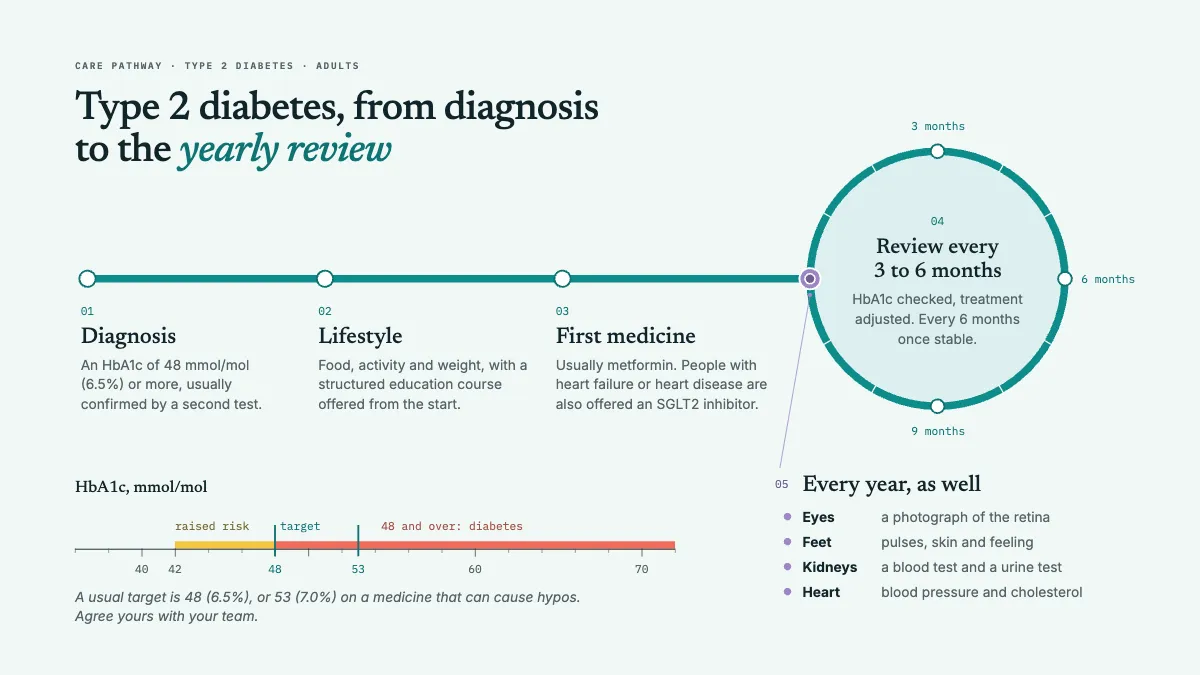
A care pathway drawn as one route that runs into a yearly loop, with the HbA1c targets on a ruler below.
Free. It opens in the Motionix editor as your own copy.
Download the pictureWebP, 1200 × 675, free to use. To change the words or colours, open it in the editor.
- Size
- 1920 × 1080 px
- Pages
- 1
- Motion
- Yes, plays live and in GIF or video
- Category
- Health and science
What it shows
- Route into a loop
- A dot that laps the year
- Ruler with target marks
Good for
How to use it
- Open the template. It becomes a project in your account.
- Change the words, colours and pictures. Every part is an ordinary shape, line or text box.
- Press Play to watch it build, then present it or export it.
What is a diabetes care pathway?
A diabetes care pathway sets out the route a person with type 2 diabetes usually follows, from diagnosis through lifestyle support and a first medicine into a cycle of regular reviews and yearly checks. It turns national guidance, such as NICE guideline NG28 in England, into steps a patient and practice team can see. A pathway describes the usual route; each person's plan is agreed with their own clinicians.
When it helps
- A practice nurse walking a newly diagnosed patient through what happens over their first year.
- Onboarding new GP practice staff to how the local diabetes service is organised.
- A structured education session where people with type 2 diabetes ask why each yearly check matters.
- A waiting room display that reminds patients their eye screening and foot check are due every year.
Tips
- Write HbA1c in mmol/mol first and the percentage in brackets; UK results use mmol/mol, but many patients still know the older percentage.
- Leave drug names general unless a clinician signs them off, since first-line choices change as guidance is updated.
- Date the pathway and name the guideline version in small print, so anyone can tell when it needs a review.
How to draw a care pathway for type 2 diabetes
Start from the local guideline
Take the steps from the guidance your service follows, such as NICE NG28 or a local formulary, and have a clinician check the wording before anyone sees it.
Draw diagnosis as the entry point
Name the test that confirms the condition. An HbA1c of 48 mmol/mol (6.5%) or above is the usual threshold, often confirmed by a repeat test.
Add lifestyle and first treatment
Show food, activity, weight and structured education as their own step before or alongside the first medicine, so the route does not read as tablets only.
Turn the reviews into a loop
Ongoing care repeats, so draw it as a circle rather than more boxes in a line. Mark how often reviews happen, for example every 3 to 6 months at first.
List the yearly checks
Give eyes, feet, kidneys and heart a short line each, saying what is checked. Patients remember a check better when they know what it looks for.
Show HbA1c on a scale
A ruler with the raised risk band (42 to 47) and the diabetes threshold (48) lets people place their own result, with a note that targets are agreed individually.
FAQQuestions
Common questions.
What HbA1c level means type 2 diabetes?
An HbA1c of 48 mmol/mol (6.5%) or higher is the level used to diagnose type 2 diabetes in the UK and by the WHO. A result between 42 and 47 mmol/mol is usually described as raised risk, sometimes called prediabetes. Diagnosis is made by a clinician, often after a second test.
What checks do people with diabetes have every year?
Usually an HbA1c test, blood pressure, cholesterol, kidney blood and urine tests, a foot check, weight and a review of smoking, plus retinal eye screening. The exact list is set by national and local programmes, and the practice team will say which are due.
What is the difference between a care pathway and a care plan?
A care pathway describes the usual route for everyone with a condition in a service. A care plan is personal: it records one person's goals, treatment and targets, agreed with them. A pathway is useful for explaining the system; the plan is what the person follows.
More health and science templates
Patient guides, care pathways and the life sciences.