Free templateHealth and science
Box breathing
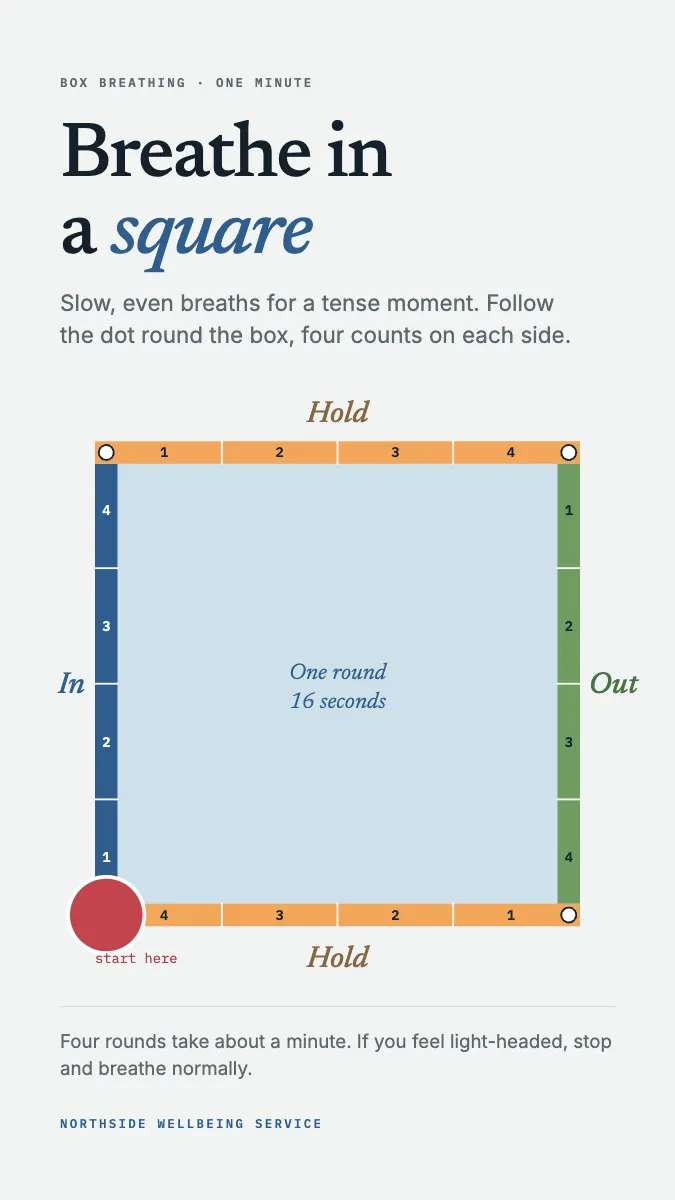
A story that teaches box breathing with a square and a dot that laps it at the real pace.
Free. It opens in the Motionix editor as your own copy.
Download the pictureWebP, 675 × 1200, free to use. To change the words or colours, open it in the editor.
- Size
- 1080 × 1920 px
- Pages
- 1
- Motion
- Yes, plays live and in GIF or video
- Category
- Health and science
What it shows
- A dot at real pace
- Counts on every side
- Story format
Good for
How to use it
- Open the template. It becomes a project in your account.
- Change the words, colours and pictures. Every part is an ordinary shape, line or text box.
- Press Play to watch it build, then present it or export it.
What is box breathing?
Box breathing is a slow breathing pattern with four equal parts: breathe in for a count of four, hold for four, breathe out for four, and hold again for four. Each part is one side of an imagined square, so one round takes about 16 seconds. It is used as a simple way to steady breathing in a tense moment and is also called square breathing or 4-4-4-4 breathing.
When it helps
- A therapist giving a client a calming technique to practise between sessions.
- A school wellbeing lesson teaching pupils one way to settle before an exam.
- A workplace mental health post that staff can follow at their desk in a minute.
- A social story showing the count visually for people who find spoken instructions hard to follow.
Tips
- Teach the count at a real pace; a dot or finger moving round the square at one count a second works better than numbers alone.
- Shorten every side to three counts for children or anyone who finds four uncomfortable, keeping the sides equal so it stays a square.
- Practise when calm first, so the pattern is familiar before someone needs it in a stressful moment.
How to do box breathing
Sit comfortably
Sit upright with your feet on the floor and your shoulders relaxed, or lie down. Breathe out gently to empty your lungs before you start.
Breathe in for four
Breathe in slowly through your nose while counting to four, feeling your belly and lower ribs rise rather than your shoulders.
Hold for four
Hold the breath softly for a count of four. The hold should feel easy, not strained; there is no need to clench your throat.
Breathe out for four
Breathe out steadily through your mouth or nose for a count of four, letting the air go at an even pace.
Hold, then repeat
Hold with empty lungs for four, then begin the next round. Four rounds take about a minute; stop and breathe normally if you feel light-headed.
FAQQuestions
Common questions.
Does box breathing help with anxiety?
Many people find slow, paced breathing helps them feel calmer in the moment, and it is widely taught in therapy and wellbeing programmes. It is a coping technique, not a treatment, so anyone with ongoing anxiety should talk to a GP or mental health professional.
How long should you do box breathing for?
A minute or two, about four to eight rounds, is enough for most people in a tense moment. Some practise for around five minutes as a daily habit. Stop if it causes dizziness or discomfort, and return to normal breathing.
What is the difference between box breathing and 4-7-8 breathing?
Box breathing uses four equal counts with a hold after both the in-breath and the out-breath. The 4-7-8 pattern breathes in for four, holds for seven and breathes out for eight, so the out-breath is longer and there is no second hold.
More health and science templates
Patient guides, care pathways and the life sciences.