Free templateHeart blood flow diagram
Blood flow through the heart
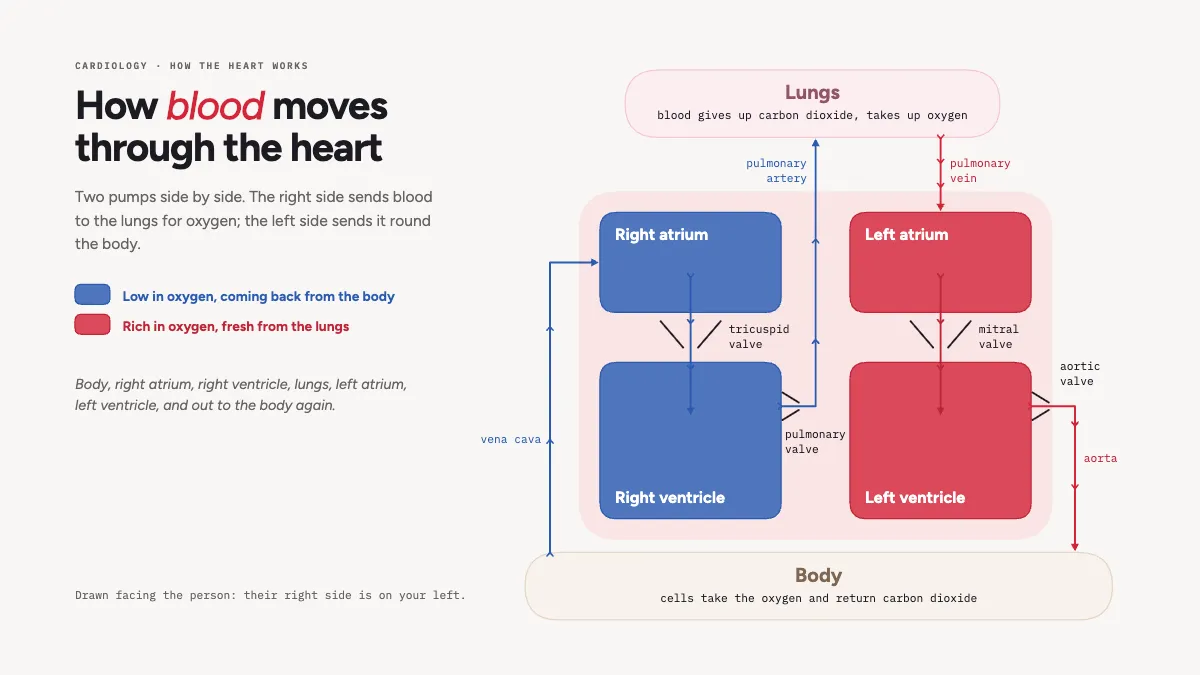
Four chambers and four valves as a clean schematic, with blood low in oxygen in blue and rich in oxygen in red, flowing in order.
Free. It opens in the Motionix editor as your own copy.
Download the pictureWebP, 1200 × 675, free to use. To change the words or colours, open it in the editor.
- Size
- 1920 × 1080 px
- Pages
- 1
- Motion
- Yes, plays live and in GIF or video
- Category
- Health and science
What it shows
- Schematic in two colours
- Flow that builds in order
- Valves drawn as leaflets
Good for
How to use it
- Open the template. It becomes a project in your account.
- Change the words, colours and pictures. Every part is an ordinary shape, line or text box.
- Press Play to watch it build, then present it or export it.
What is a heart blood flow diagram?
A heart blood flow diagram shows the route blood takes through the four chambers and four valves of the heart. Blood low in oxygen enters the right atrium from the vena cava, passes to the right ventricle and is pumped to the lungs; oxygen-rich blood returns to the left atrium, passes to the left ventricle and leaves through the aorta. Blue and red are used by convention to tell the two apart.
When it helps
- A biology lesson on the circulatory system, before pupils label a heart diagram themselves.
- Nursing or medical students revising which valve sits between which two spaces.
- A cardiology clinic explaining to a patient where their valve problem is.
- A quick check where students put the stages of blood flow into the right order.
Tips
- Remind learners that blue is a convention; blood low in oxygen is dark red, and pupils sometimes come away believing veins carry blue blood.
- The pulmonary artery carries blood low in oxygen and the pulmonary veins carry oxygen-rich blood, the opposite of every other artery and vein, so label these colours carefully.
- Draw valves as leaflets that open one way; it explains why blood cannot flow backwards better than any caption.
How to label a diagram of the heart
Draw it facing the viewer
Heart diagrams are drawn as if you face the person, so the right side of the heart sits on the left of the page. Note this on the diagram.
Place the four chambers
Put the right and left atria on top and the ventricles below. Make the left ventricle wall thickest, since it pumps blood round the whole body.
Mark the four valves
Label the tricuspid valve between the right atrium and ventricle, the pulmonary valve at the exit to the lungs, the mitral valve on the left, and the aortic valve at the exit to the body.
Add the great vessels
Draw the vena cava into the right atrium, the pulmonary artery to the lungs, the pulmonary veins back to the left atrium, and the aorta leaving the left ventricle.
Colour blood by oxygen
Shade blood low in oxygen blue on the right side and oxygen-rich blood red on the left, then add arrows in the order the blood flows.
FAQQuestions
Common questions.
What is the order of blood flow through the heart?
Body, vena cava, right atrium, tricuspid valve, right ventricle, pulmonary valve, pulmonary artery, lungs, pulmonary veins, left atrium, mitral valve, left ventricle, aortic valve, aorta, and back out to the body. The right side pumps to the lungs and the left side pumps to the body.
Why is the left ventricle wall thicker than the right?
The left ventricle pumps blood all the way round the body, which needs much higher pressure than the right ventricle needs to push blood the short distance to the lungs. Its thicker muscle wall produces that extra force.
What are the four valves of the heart?
The tricuspid valve, between the right atrium and right ventricle; the pulmonary valve, between the right ventricle and pulmonary artery; the mitral or bicuspid valve, between the left atrium and left ventricle; and the aortic valve, between the left ventricle and aorta.
More health and science templates
Patient guides, care pathways and the life sciences.