Free templateHealthy eating plate
The balanced plate
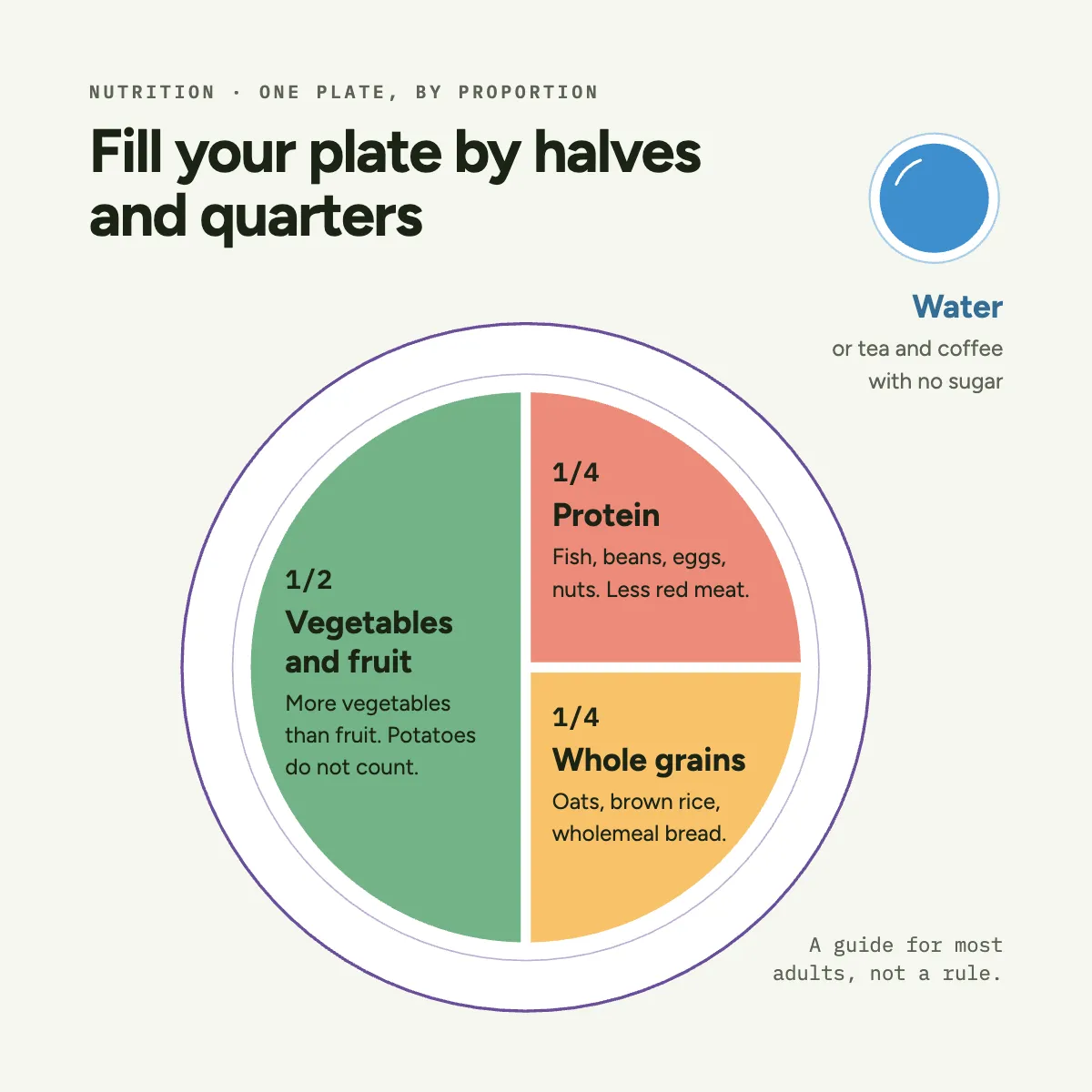
A plate from above, divided by real proportions: half vegetables and fruit, a quarter protein, a quarter whole grains.
Free. It opens in the Motionix editor as your own copy.
Download the pictureWebP, 1200 × 1200, free to use. To change the words or colours, open it in the editor.
- Size
- 1080 × 1080 px
- Pages
- 1
- Motion
- Yes, plays live and in GIF or video
- Category
- Health and science
What it shows
- Sectors at true proportions
- Plate fills like a clock
- Labels inside the figure
Good for
How to use it
- Open the template. It becomes a project in your account.
- Change the words, colours and pictures. Every part is an ordinary shape, line or text box.
- Press Play to watch it build, then present it or export it.
What is a healthy eating plate?
A healthy eating plate is a picture of one meal divided by proportion, used to show balance without counting calories. In the widely used version, half the plate is vegetables and fruit, a quarter is protein such as fish, beans, eggs or nuts, and a quarter is whole grains, with water as the drink. It is a general guide for most adults, not a personal diet plan.
When it helps
- A dietitian explaining portion balance to a patient without asking them to weigh food.
- A school nurse teaching pupils how to build a lunch from what is on offer.
- A community health post with one simple message people can apply at their next meal.
- A cookery class checking whether a planned dish covers each part of the plate.
Tips
- Label foods inside the sections they belong to rather than in a legend; readers should never have to match colours to a key to read a plate.
- Say which model you are drawing, since the NHS Eatwell Guide and the plate model divide food differently and readers may know one already.
- Avoid pictures of specific branded products; they date quickly and can read as advertising on health material.
How to make a healthy eating plate diagram
Draw the plate from above
A plate seen from directly above makes the proportions honest. An angled plate distorts the sizes, and the halves and quarters stop looking equal.
Divide it by true proportions
Give vegetables and fruit exactly half, then split the other half into a quarter for protein and a quarter for whole grains. Measure the angles rather than guessing.
Name examples in each section
Write two or three everyday foods inside each part, such as oats, brown rice and wholemeal bread for grains, so readers can picture a real meal.
Add the qualifying notes
Short notes carry the nuance: more vegetables than fruit, potatoes counting as a starch rather than a vegetable, and less red and processed meat.
Put water beside the plate
Draw a glass of water next to the plate as the default drink, so the message about sugary drinks needs no extra words.
FAQQuestions
Common questions.
What should be on a balanced plate?
In the plate model, half is vegetables and fruit, with more vegetables than fruit, a quarter is protein such as fish, poultry, beans, eggs or nuts, and a quarter is whole grains such as brown rice, oats or wholemeal bread. Water is the suggested drink, with healthy oils used in moderation.
Is the healthy eating plate the same as the Eatwell Guide?
No. The Eatwell Guide, the UK government's model, divides a whole day's food into five groups, with fruit and vegetables and starchy foods each making up just over a third. The plate model describes a single meal in halves and quarters. Both encourage more plants and wholegrain starches.
Do potatoes count as vegetables on the plate?
Not in most healthy eating guidance. Potatoes are treated as a starchy food, alongside bread, rice and pasta, so on a plate they belong with the grains. The NHS also does not count potatoes toward the five portions of fruit and vegetables a day.
More health and science templates
Patient guides, care pathways and the life sciences.