Free templateMedication chart
Weekly medicine chart
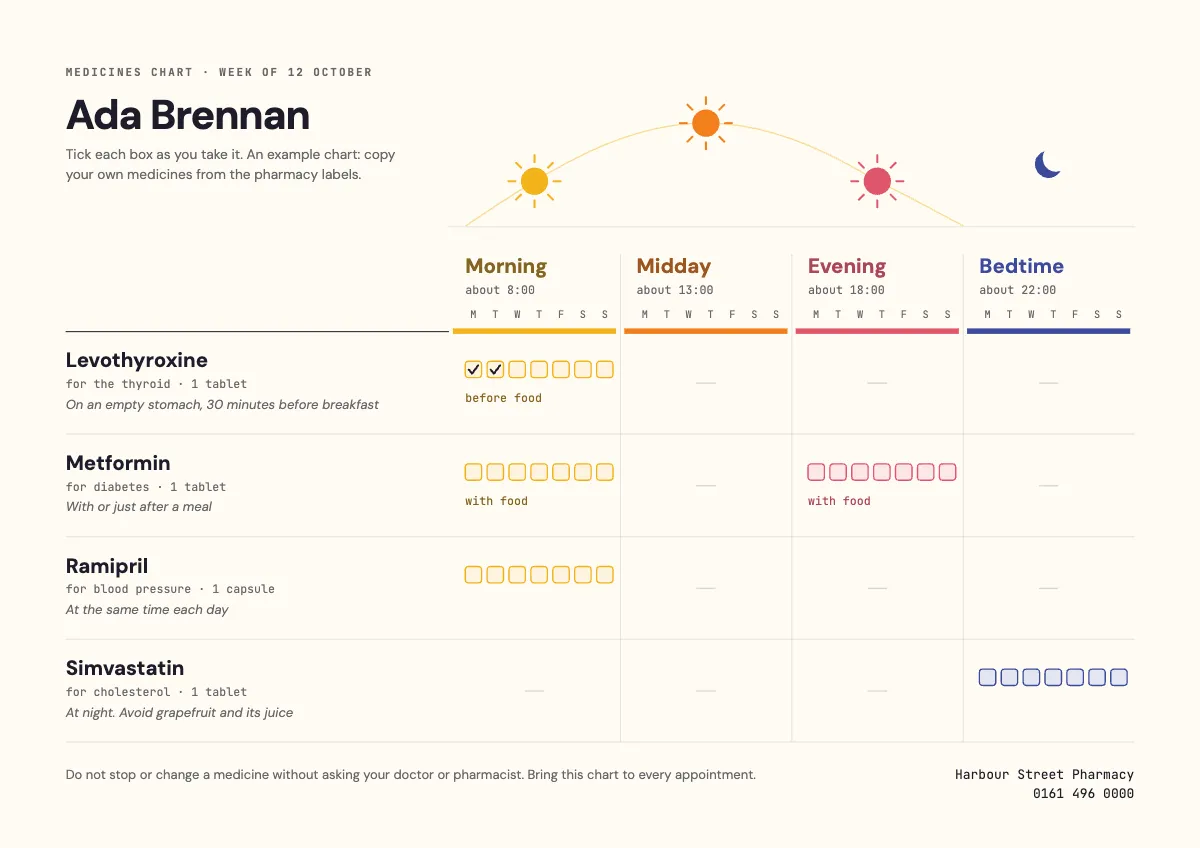
A landscape A4 chart for a week of medicines, with the times of day under the sun's path and a box for every dose.
Free. It opens in the Motionix editor as your own copy.
Download the pictureWebP, 1200 × 848, free to use. To change the words or colours, open it in the editor.
- Size
- 1754 × 1240 px
- Pages
- 1
- Motion
- A still page; add motion if you like
- Category
- Health and science
What it shows
- Tick boxes for a week
- Times of day on a sun path
- With food notes
Good for
How to use it
- Open the template. It becomes a project in your account.
- Change the words, colours and pictures. Every part is an ordinary shape, line or text box.
- Add motion if it helps, then present it or export it.
What is a medication chart?
A medication chart is a table that lists each medicine a person takes, when to take it and any instructions, with a box to tick for every dose. Home charts are usually laid out as a week, with times of day such as morning, midday, evening and bedtime. They help patients and carers keep track, especially when several medicines are taken at different times.
When it helps
- A pharmacist setting up a chart for a patient starting several new medicines after a hospital stay.
- A family carer tracking doses for a parent so nothing is missed or doubled.
- Bringing an accurate list of current medicines to a GP or hospital appointment.
- A person with memory problems using ticks to confirm what they have already taken.
Tips
- Have a pharmacist check the chart against the prescription before it is used; a chart with one wrong instruction is worse than none.
- Make a fresh chart whenever a medicine changes, rather than crossing out lines, which quickly becomes unreadable.
- Print the boxes large enough to tick with a shaky hand, since many people using these charts are older or unwell.
How to make a medication chart
Copy names from the labels
Write each medicine exactly as it appears on the pharmacy label, with its strength, so the chart matches what is in the box.
Set the times of day
Use columns for the times the person actually takes medicines, such as morning, midday, evening and bedtime, rather than clock times they may not keep.
Add the instructions
Note anything the label says about food or timing, for example on an empty stomach, with a meal, or at night, beside each medicine.
Make a box for every dose
Give each medicine one tick box per day for each time it is due, and grey out times when it is not taken, so a blank box always means a missed dose.
Add contacts and a warning
Put the pharmacy's name and phone number on the chart, and a line reminding the reader not to stop or change a medicine without asking.
FAQQuestions
Common questions.
What is a MAR chart?
MAR stands for medication administration record. It is the formal chart care homes, hospitals and home care services use to record each dose given to a person, by whom and when. A home medication chart is a simpler version for patients and family carers.
What should you do if you miss a dose of your medicine?
Check the patient leaflet that came with the medicine, which says what to do for that particular drug, or ask a pharmacist. Advice differs between medicines, so do not take a double dose to make up unless a pharmacist or doctor tells you to.
Why should you bring a list of your medicines to appointments?
An accurate, current list helps doctors, nurses and pharmacists avoid interactions, duplicate prescriptions and mistakes when treatment changes. It should include everything taken, including medicines bought over the counter, vitamins and herbal remedies.
More health and science templates
Patient guides, care pathways and the life sciences.