Free templateMedicine interaction card
Grapefruit and your medicines
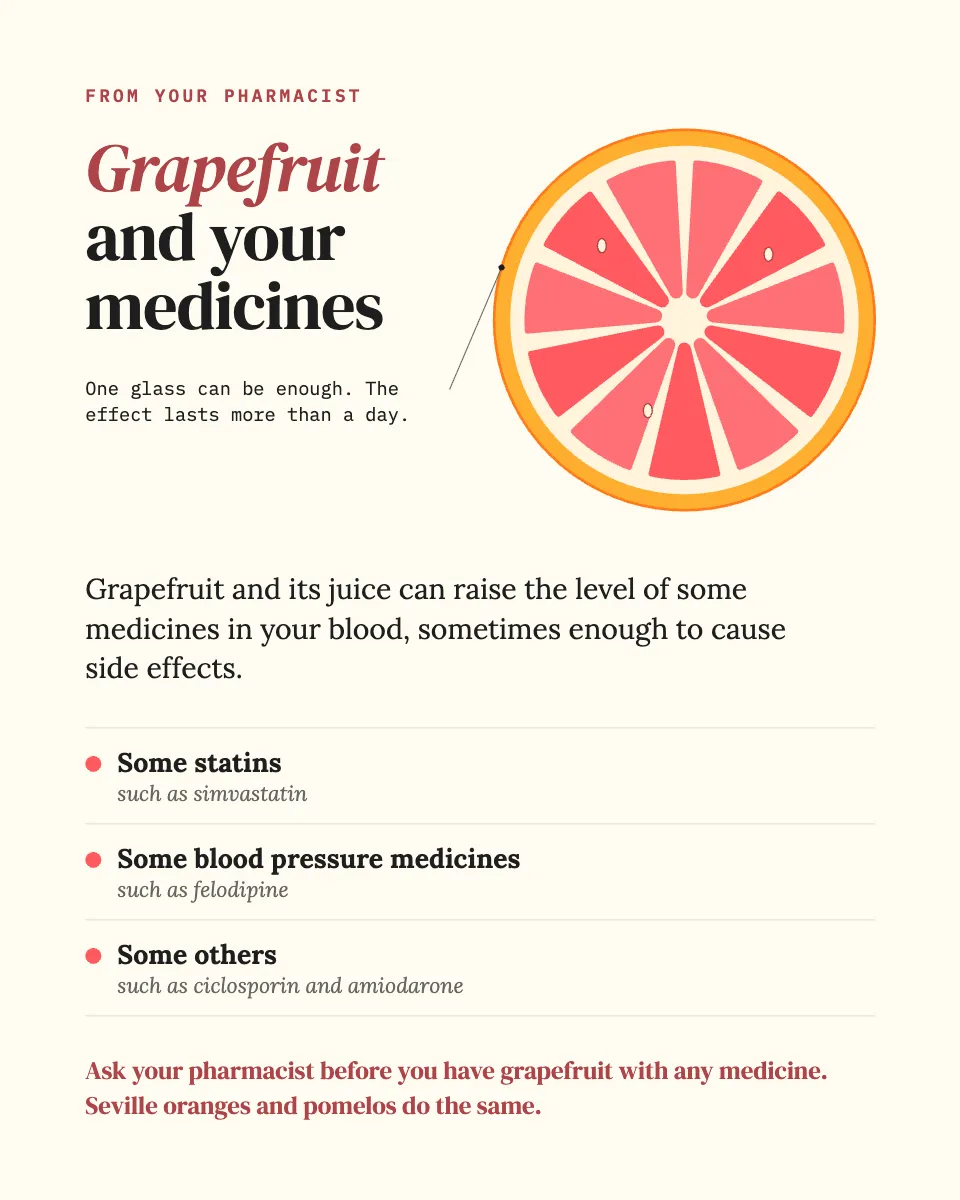
A pharmacist's card with one drawn grapefruit half and a plain list of the medicines it affects.
Free. It opens in the Motionix editor as your own copy.
Download the pictureWebP, 960 × 1200, free to use. To change the words or colours, open it in the editor.
- Size
- 1080 × 1350 px
- Pages
- 1
- Motion
- Yes, plays live and in GIF or video
- Category
- Health and science
What it shows
- Drawn fruit cross-section
- Segments that fill in turn
- Plain-language warning
Good for
How to use it
- Open the template. It becomes a project in your account.
- Change the words, colours and pictures. Every part is an ordinary shape, line or text box.
- Press Play to watch it build, then present it or export it.
What is a medicine interaction card?
A medicine interaction card is a short warning, usually from a pharmacist, about a food, drink or other medicine that changes how certain medicines work. Grapefruit is one of the best-known examples: it can raise the blood levels of some medicines, including certain statins and some blood pressure medicines, which may increase side effects. A card names the risk plainly and tells people to check with their pharmacist.
When it helps
- A pharmacy counter card that prompts customers to ask about foods and their prescriptions.
- Handing a patient a reminder when they start a medicine known to interact with grapefruit.
- A care home briefing staff on why breakfast juice may need checking for some residents.
- A pharmacy social post during a healthy eating campaign.
Tips
- Have a pharmacist approve the examples you list; interactions vary within a drug group, and naming the wrong one causes needless worry.
- Point out that the effect can last more than a day, because many people assume taking the tablet at a different time solves it.
- A single drawn grapefruit makes the card recognisable at a glance from across a counter, without needing to read the text.
How to make a medicine interaction card
Name one interaction per card
Keep each card to a single food or medicine so the warning is unmistakable. Several warnings on one card compete and none are remembered.
Say what happens in plain words
Explain the effect, for example that grapefruit can raise the level of some medicines in the blood, rather than naming the enzyme involved.
List medicine groups with examples
Give the group first and one or two examples in smaller type, and use the word some, since not every medicine in a group is affected.
Include related foods
Mention fruits with the same effect, such as Seville oranges and pomelos, which people would not otherwise connect with the warning.
End with who to ask
Finish by telling readers to ask a pharmacist before combining the food with any medicine, and to read the leaflet in the medicine pack.
FAQQuestions
Common questions.
Why does grapefruit interact with some medicines?
Grapefruit contains compounds that block an enzyme in the gut wall which normally breaks down certain medicines. With less broken down, more of the medicine reaches the blood. For some medicines that can raise levels enough to cause side effects.
Which statins interact with grapefruit?
Simvastatin is the example given most often. Some other statins are affected less or not at all, which is why advice differs between them. The leaflet in your medicine pack and your pharmacist can tell you whether grapefruit matters for the statin you take.
How long after grapefruit can I take my medicine?
Spacing them apart does not reliably help, because the effect of grapefruit on the gut enzyme can last more than 24 hours. If your medicine interacts, the usual advice is to avoid grapefruit and its juice altogether. Check with a pharmacist for your own medicines.
More health and science templates
Patient guides, care pathways and the life sciences.