Free templateOKR
Team OKRs
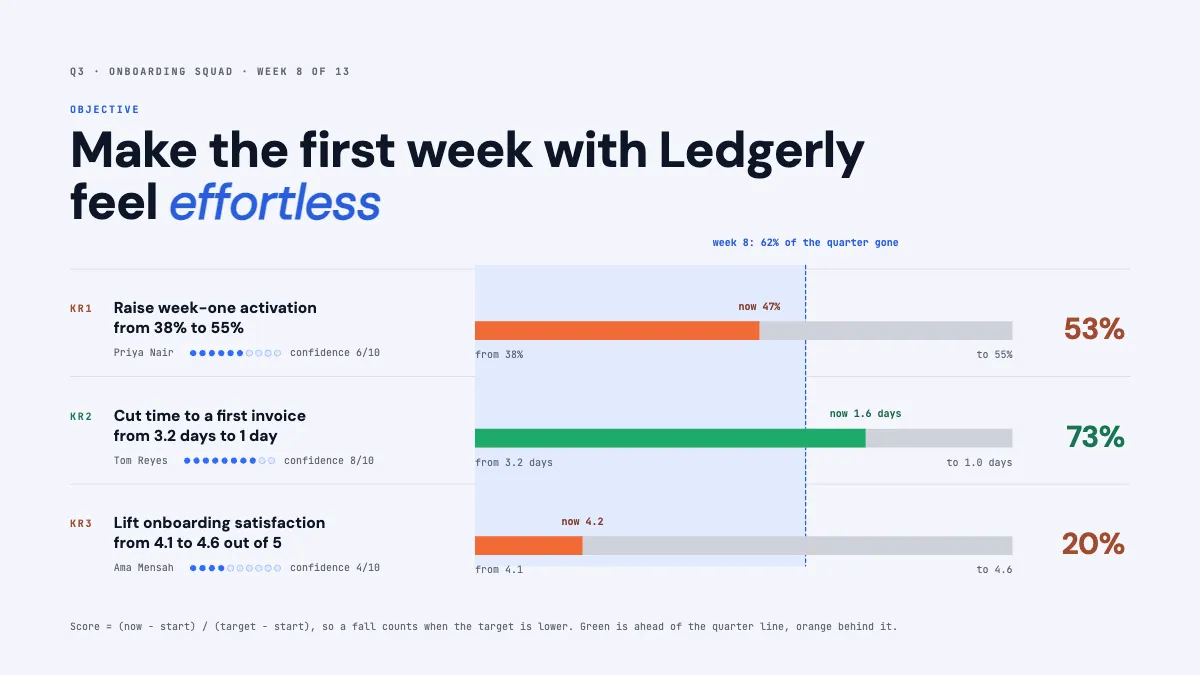
One objective and three key results, each scored from its start and target and checked against how much of the quarter has gone.
Free. It opens in the Motionix editor as your own copy.
Download the pictureWebP, 1200 × 675, free to use. To change the words or colours, open it in the editor.
- Size
- 1920 × 1080 px
- Pages
- 1
- Motion
- Yes, plays live and in GIF or video
- Category
- Frameworks
What it shows
- Computed progress bars
- Ahead and behind at a glance
- Owners and confidence
Good for
How to use it
- Open the template. It becomes a project in your account.
- Change the words, colours and pictures. Every part is an ordinary shape, line or text box.
- Press Play to watch it build, then present it or export it.
What is an OKR?
An OKR, short for objectives and key results, is a goal written in two parts. The objective says what you want to achieve in plain, memorable words; the key results, usually three, say how you will know you got there, each as a measured change from a starting value to a target by a deadline. Andy Grove developed the method at Intel, and John Doerr brought it to Google in 1999.
When it helps
- A product team agreeing its focus for the coming quarter: one objective and three measurable results.
- A quarterly review where each key result is scored from its own start and target.
- A founder lining up several small teams so their goals add up to the company's.
- A mid-quarter check-in that spots key results falling behind while there is still time to act.
Tips
- Keep objectives few: one to three per team per quarter. Ten objectives is a task list, and nothing on it gets the focus a key result needs.
- Key results can go down as well as up, such as cutting days to a first invoice. The score still works because you divide by target minus start.
- Do not tie OKR scores to pay or bonuses. Once they are, people set targets they know they can hit, and the stretch disappears.
How to write OKRs
Write one objective
State the change you want in a sentence people remember, such as "make the first week feel effortless". It should be ambitious and qualitative, with no number in it.
Add about three key results
For each one, name a metric, its value today and its target for the end of the quarter, as in "raise week-one activation from 38% to 55%". Two to five is the usual range.
Measure outcomes, not tasks
"Launch a new tutorial" is an activity. Ask what the tutorial should change and measure that instead, so the team stays free to find a better route to it.
Give every key result an owner
One named person tracks each result and reports on it. Owners can add a confidence score from 1 to 10 that the target will be reached, updated at each check-in.
Score progress against the calendar
Progress is (now minus start) divided by (target minus start). Compare it with the share of the quarter gone, so a result at half its target in week 8 of 13 reads as behind.
Grade and reset at quarter end
Score each key result, write down what you learned, and decide whether the objective carries on. Many teams treat 0.7 on a stretch goal as a good result.
FAQQuestions
Common questions.
What is the difference between an OKR and a KPI?
A KPI is a measure you watch continuously to check the health of something, like churn or revenue. An OKR is a time-boxed goal to change something, usually over a quarter. A key result is often a KPI with a starting value, a target and a deadline attached.
How many key results should an objective have?
Usually three, and rarely more than five. One key result often means the objective is really a single metric in disguise; more than five spreads the team thin and makes it hard to say whether the objective was met at all.
How are OKRs scored?
Each key result gets a score between 0 and 1, or 0% and 100%, from how far it moved from its start towards its target. On the scale Google made popular, 0.6 to 0.7 on a stretch goal counts as success, and a steady 1.0 suggests the targets were set too low.
More frameworks templates
Matrices, org charts, canvases and models for thinking.