Free templateFlywheel diagram
Referral flywheel
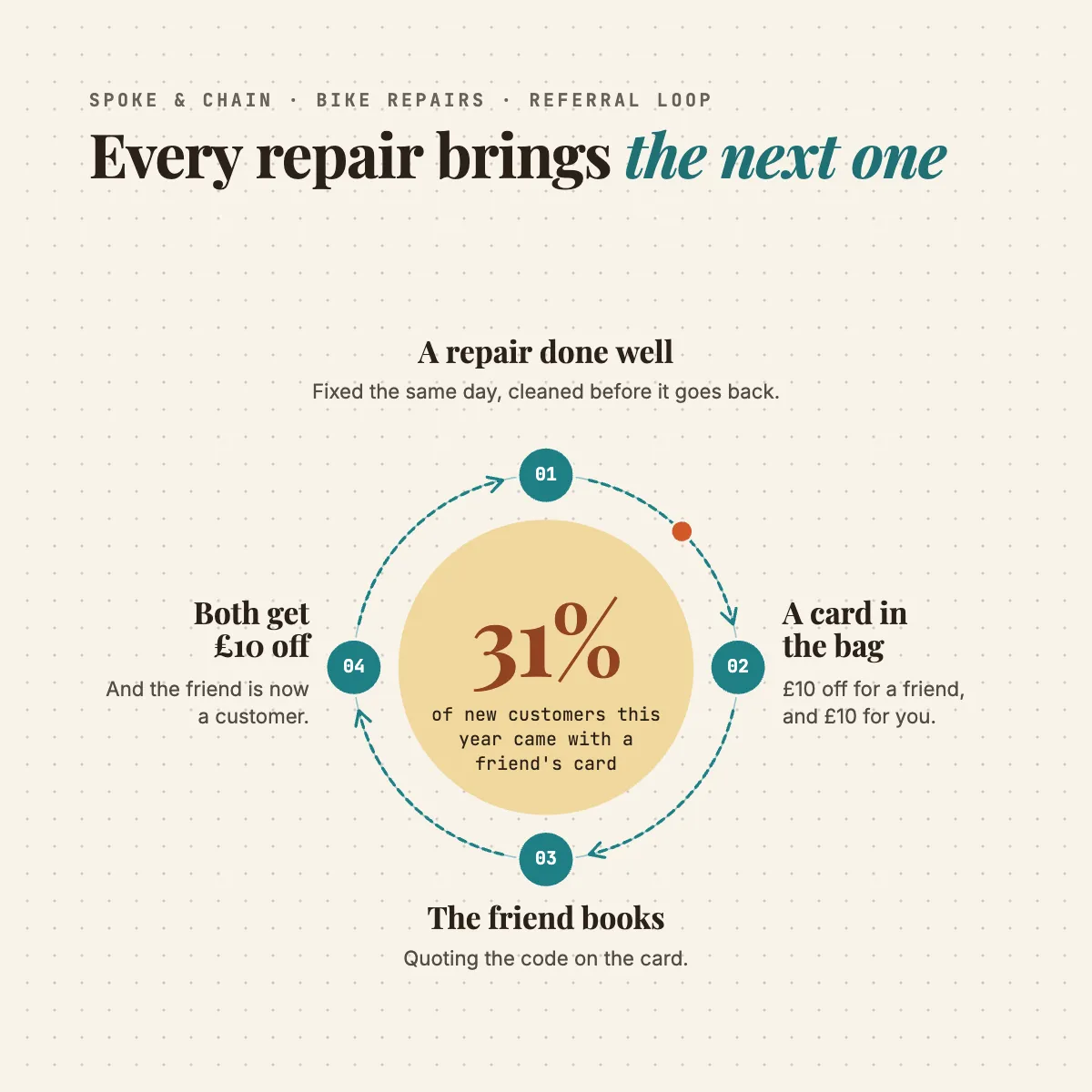
A small business referral loop drawn as a circle that keeps turning, four stages and the share of customers it brings.
Free. It opens in the Motionix editor as your own copy.
Download the pictureWebP, 1200 × 1200, free to use. To change the words or colours, open it in the editor.
- Size
- 1080 × 1080 px
- Pages
- 1
- Motion
- Yes, plays live and in GIF or video
- Category
- Frameworks
What it shows
- A loop that turns
- A marker riding the circle
- Square post format
Good for
How to use it
- Open the template. It becomes a project in your account.
- Change the words, colours and pictures. Every part is an ordinary shape, line or text box.
- Press Play to watch it build, then present it or export it.
What is a flywheel diagram?
A flywheel diagram shows a business as a loop in which each stage feeds the next, so effort builds momentum instead of starting from zero every time. The idea comes from Jim Collins's book Good to Great, and HubSpot later popularised it in marketing as an alternative to the funnel. A referral loop is a simple example: happy customers bring friends, who become customers and bring friends of their own.
When it helps
- A small repair shop explaining on social media why every customer gets a card for a friend.
- A founder showing investors how growth can feed itself rather than depend on advertising.
- A team meeting choosing which stage of the loop to strengthen next.
- Replacing a funnel slide when most new customers arrive through existing ones.
Tips
- Look for friction as well as force. A stage that leaks people, like a referral code that is awkward to redeem, slows the wheel more than extra push elsewhere speeds it up.
- Reward both sides of a referral. A discount for the friend gives them a reason to act, not only the customer who passed the card on.
- Skip the flywheel if nothing repeats. If customers buy once and never mention you, a funnel is the honest picture of the business.
How to draw a flywheel diagram
Find the loop
Write down how one customer leads to the next. If the last stage does not feed back into the first, you have a funnel or a process, not a flywheel.
Keep to three to six stages
Name each stage as a short outcome, such as "a repair done well" or "the friend books". With more than six, the loop becomes hard to follow.
Draw a circle with arrows
Space the stages evenly round a circle and join them with arrows that all point the same way, usually clockwise. Arrows running one way are what make it read as momentum.
Put the result in the hub
Use the centre for what the loop produces, such as the share of new customers who arrived through a referral. It ties the drawing to a number.
Make every stage measurable
For each arrow, decide what you will count: cards handed out, codes redeemed, repeat bookings. A flywheel you cannot measure is one you cannot tune.
FAQQuestions
Common questions.
What is the difference between a flywheel and a funnel?
A funnel shows people moving one way, from awareness to purchase, and stops at the sale. A flywheel loops back, so satisfied customers drive new ones through referrals and repeat business. The funnel measures where people are lost; the flywheel shows where momentum comes from.
What is the flywheel effect?
It is Jim Collins's name for how lasting success builds up: many small pushes in the same direction add momentum, like turning a heavy wheel, until it keeps going with less effort. No single push makes the difference; the accumulation of them does.
What is Amazon's flywheel?
The often quoted loop says lower prices improve the customer experience, which brings more customers, which attracts more sellers and a wider selection, which improves the experience again, while growth lowers costs and allows lower prices. It is the best-known example of a business described as a self-reinforcing loop.
More frameworks templates
Matrices, org charts, canvases and models for thinking.