Free templateEisenhower matrix
The Eisenhower week
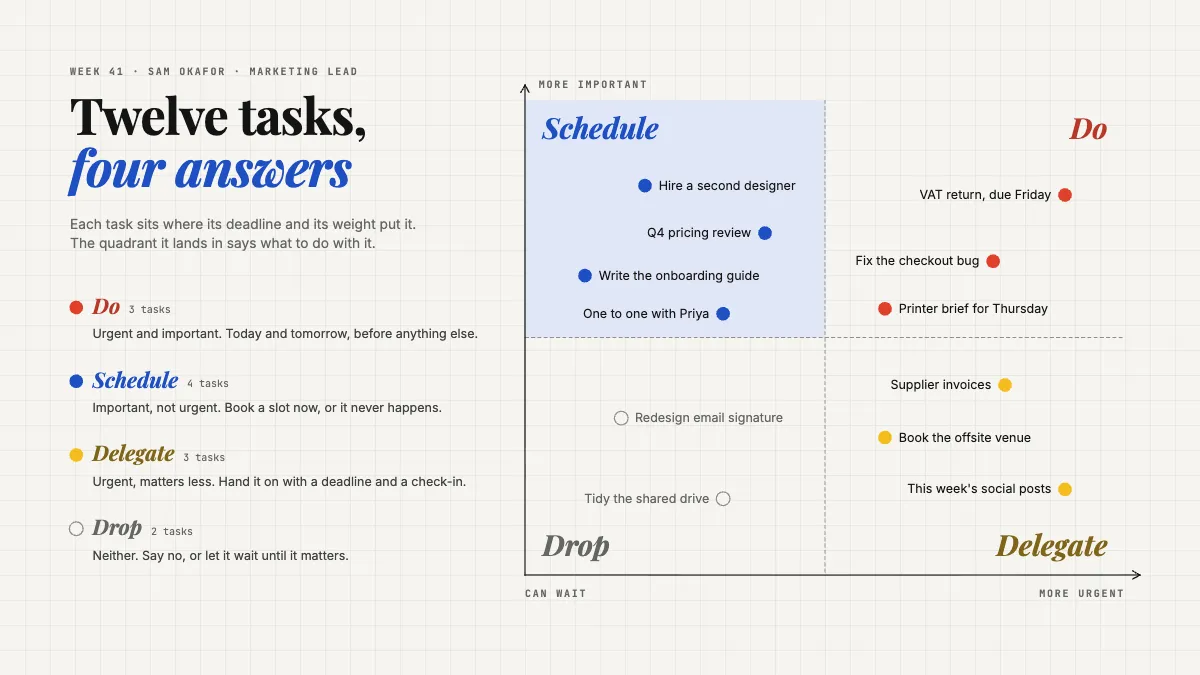
A real week of twelve tasks plotted by urgency and importance, with what to do in each quadrant.
Free. It opens in the Motionix editor as your own copy.
Download the pictureWebP, 1200 × 675, free to use. To change the words or colours, open it in the editor.
- Size
- 1920 × 1080 px
- Pages
- 1
- Motion
- Yes, plays live and in GIF or video
- Category
- Frameworks
What it shows
- Tasks plotted as points
- One tinted quadrant
- Builds quadrant by quadrant
Good for
How to use it
- Open the template. It becomes a project in your account.
- Change the words, colours and pictures. Every part is an ordinary shape, line or text box.
- Press Play to watch it build, then present it or export it.
What is an Eisenhower matrix?
An Eisenhower matrix is a two-by-two grid that sorts tasks by two questions: is it urgent, and is it important? The four quadrants give four answers: do it now, schedule it, delegate it or drop it. It is named after Dwight D. Eisenhower, who drew a line between urgent and important problems, and Stephen Covey later popularised it as the time management matrix.
When it helps
- A manager on Monday morning splitting a long to-do list into what happens today and what gets booked for later.
- A founder deciding which jobs to hand to a first hire, by looking at what lands in the delegate quadrant.
- A weekly review that checks how much of the week went on urgent work that did not matter.
- Coaching a new team member who says yes to every request and never reaches the important work.
Tips
- The Schedule quadrant is where the value is. If it is empty, you are planning only around deadlines, and next month's emergencies are already sitting there unbooked.
- A task does not belong in Do just because someone asked loudly. Ask what happens if it waits a day; the honest answer often moves it to Delegate.
- Delegating is not dumping. Hand the task over with the outcome you want, a deadline and one check-in, or it comes back to you urgent.
How to make an Eisenhower matrix
List everything on your plate
Write down every task for the week, large or small, before sorting any of them. Sorting while you list makes it easy to skip the awkward jobs you would rather not see.
Draw two axes
Put urgency along the bottom and importance up the side, then split each at its midpoint. Plotting tasks as points rather than dropping them in boxes shows which ones sit near a boundary.
Judge importance by your goals
A task is important if it moves something you care about forward. It is urgent if it has a deadline or a person waiting. Keep the two questions apart.
Place each task
Urgent and important is Do. Important but not urgent is Schedule. Urgent but less important is Delegate. Neither urgent nor important is Drop.
Give each quadrant its action
Do the first quadrant today, book Schedule tasks into the calendar at a set time, hand Delegate tasks on with a deadline, and say no to whatever landed in Drop.
Redraw it every week
Tasks drift towards urgent as deadlines approach. Redrawing the grid at the same time each week means important work gets a slot before it turns into a fire.
FAQQuestions
Common questions.
What are the four quadrants of the Eisenhower matrix?
Quadrant one is urgent and important: do it now. Quadrant two is important but not urgent: schedule it. Quadrant three is urgent but not important: delegate it. Quadrant four is neither urgent nor important: drop it, or leave it until it starts to matter.
What is the difference between urgent and important?
Urgent tasks demand attention now because of a deadline or someone waiting on you. Important tasks contribute to your longer-term goals. A ringing phone is urgent; planning next year's hiring is important. The matrix works because it refuses to let one question stand in for the other.
Who invented the Eisenhower matrix?
It is named after Dwight D. Eisenhower, the wartime general and US president, who spoke about separating urgent problems from important ones. Stephen Covey turned the idea into the four-quadrant time management matrix in The 7 Habits of Highly Effective People, published in 1989.
More frameworks templates
Matrices, org charts, canvases and models for thinking.