Free templateHierarchy of evidence
The evidence pyramid
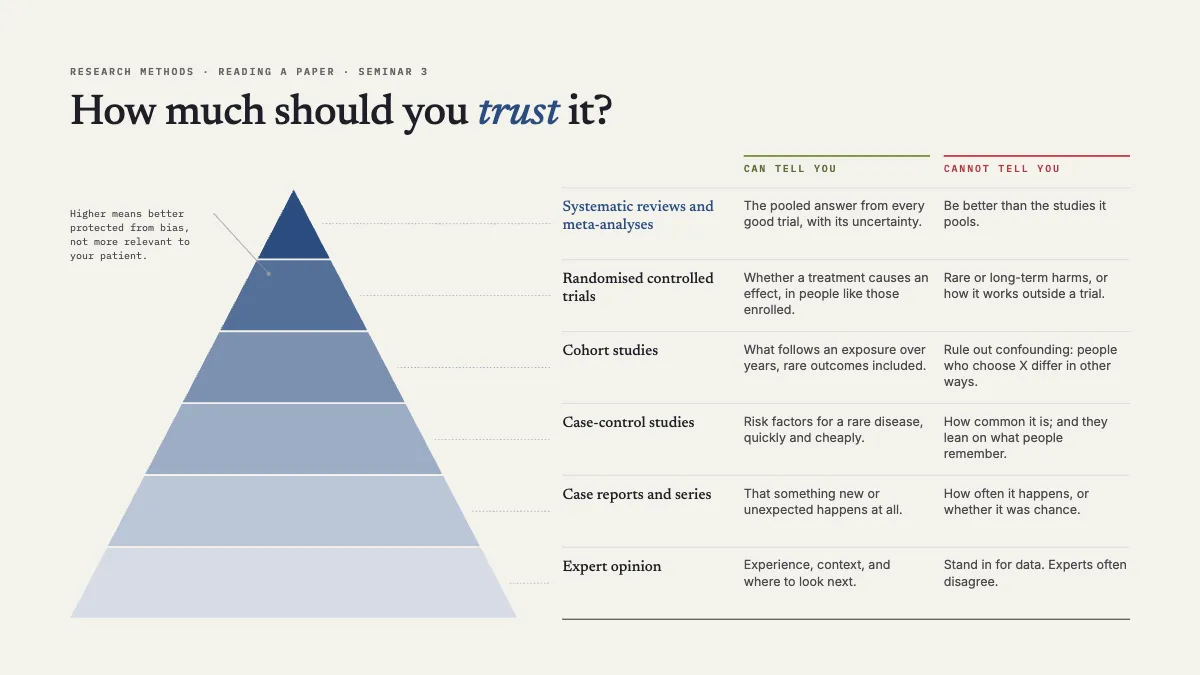
The hierarchy of evidence from expert opinion to systematic reviews, each level read across into what it can and cannot tell you.
Free. It opens in the Motionix editor as your own copy.
Download the pictureWebP, 1200 × 675, free to use. To change the words or colours, open it in the editor.
- Size
- 1920 × 1080 px
- Pages
- 1
- Motion
- Yes, plays live and in GIF or video
- Category
- Frameworks
What it shows
- Pyramid drawn to its geometry
- Can and cannot, side by side
- Builds from the ground up
Good for
How to use it
- Open the template. It becomes a project in your account.
- Change the words, colours and pictures. Every part is an ordinary shape, line or text box.
- Press Play to watch it build, then present it or export it.
What is the hierarchy of evidence?
The hierarchy of evidence ranks kinds of research by how well their design protects against bias, and is usually drawn as a pyramid. Expert opinion and case reports form the base, followed by case-control studies, cohort studies and randomised controlled trials, with systematic reviews and meta-analyses at the top. It is a starting point for judging a study, not a verdict on any single paper.
When it helps
- A medical student learning critical appraisal before presenting a trial at journal club.
- A clinician weighing a new treatment claim against the kind of study behind it.
- Teaching research methods, so students see what each design can and cannot show.
- Writing a guideline that grades the strength of evidence behind each recommendation.
Tips
- Higher does not mean more relevant. A trial in young adults may tell you little about an 85-year-old patient, however strong its design.
- Some questions cannot be answered by trials. Rare and long-term harms usually come to light in cohort studies and case reports, so the right level depends on the question.
- A meta-analysis is only as good as the studies it pools. Combining small, biased trials gives a precise-looking answer that is still biased.
How to use the hierarchy of evidence
Identify the study design
Read the methods section, not the headline. Ask whether researchers assigned the treatment, followed people over time, compared cases with controls, or pooled earlier studies.
Place it on the pyramid
Put the design on its level. Higher levels are better protected from bias because of how they are built, such as random allocation in a controlled trial.
Ask what it can tell you
Each design answers some questions well. Cohort studies follow exposures over years, case-control studies find risk factors for rare diseases quickly, and trials test whether a treatment causes an effect.
Ask what it cannot
Note each design's blind spot, such as confounding in cohort studies or recall bias in case-control studies. These limits matter more than the rank itself.
Judge quality within the level
A poorly run trial can be weaker than a careful cohort study. Use an appraisal checklist, such as those from CASP, to judge the individual study.
Look for a systematic review
Before relying on one study, search for a systematic review of the same question. It gathers every good study and states how uncertain the combined answer is.
FAQQuestions
Common questions.
What is the highest level of evidence?
Systematic reviews and meta-analyses of well-conducted randomised controlled trials. They gather every relevant trial on a question, appraise each one and, where possible, combine the results statistically. Some versions of the pyramid place guidelines or evidence summaries above them.
What is the difference between a cohort study and a case-control study?
A cohort study starts with an exposure, such as smoking, and follows people forward to see who develops an outcome. A case-control study starts with the outcome, comparing people who have a disease with people who do not, and looks back at what they were exposed to.
Why is expert opinion at the bottom of the hierarchy of evidence?
Because it does not rest on a systematic test and is open to personal bias and selective memory. Experts are valuable for context and for knowing where to look next, but they often disagree, and opinion cannot stand in for data when data exists.
More frameworks templates
Matrices, org charts, canvases and models for thinking.