Free templatePitch deck
Seed pitch: Larder
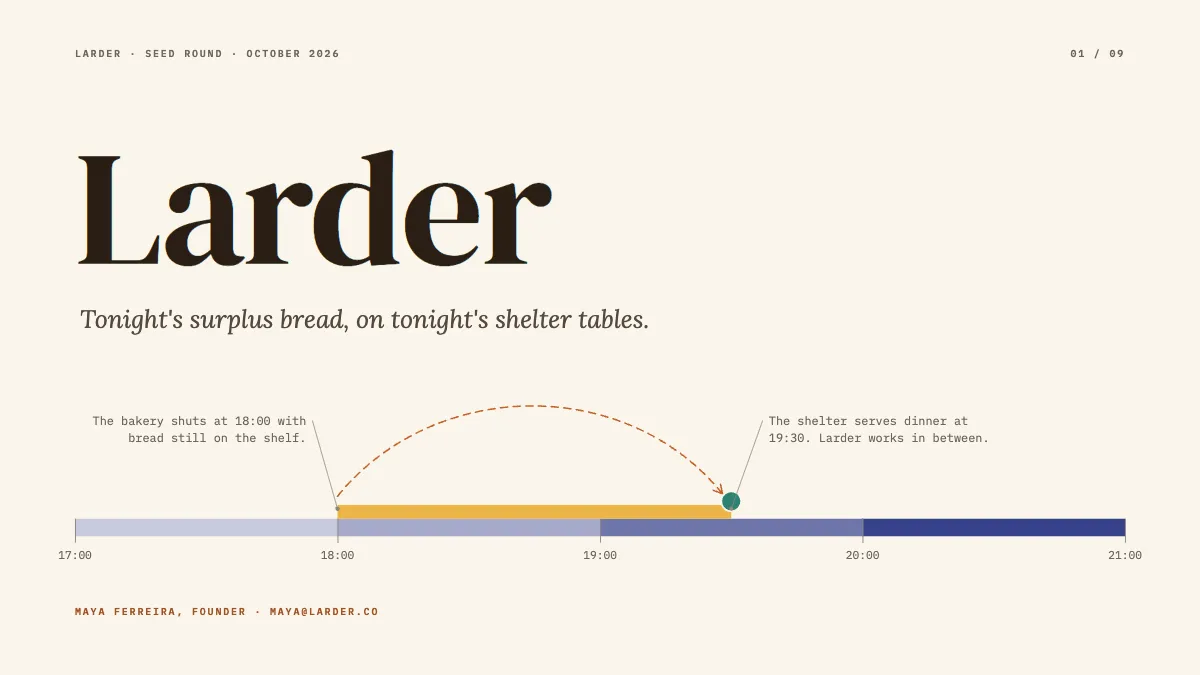
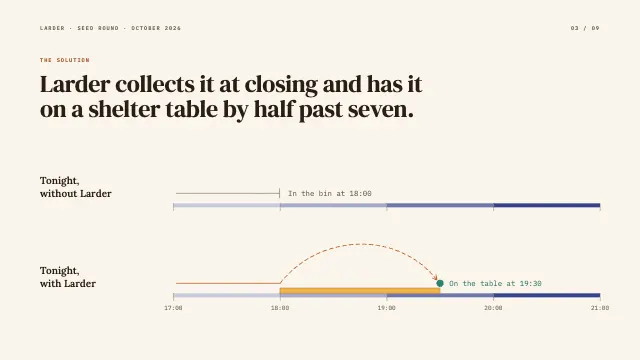
A nine-page founder pitch built on one evening timeline: the ninety minutes between a bakery closing and a shelter serving dinner.
Free. It opens in the Motionix editor as your own copy.
Download the pictureWebP, 1200 × 675, free to use. To change the words or colours, open it in the editor.
- Size
- 1920 × 1080 px
- Pages
- 9
- Motion
- Yes, plays live and in GIF or video
- Category
- Presentations
Every page
 Page 2
 Page 3
 Page 4
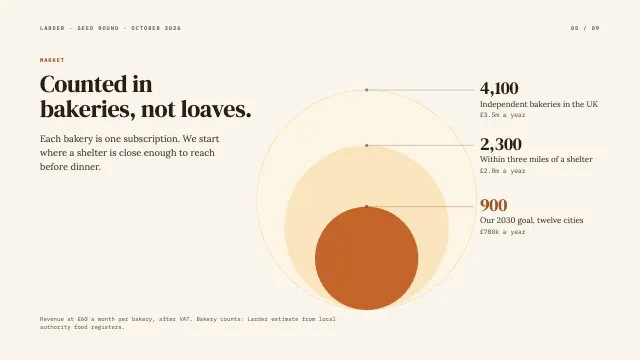 Page 5
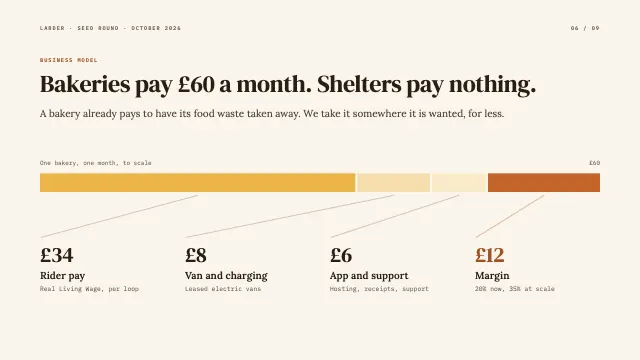 Page 6
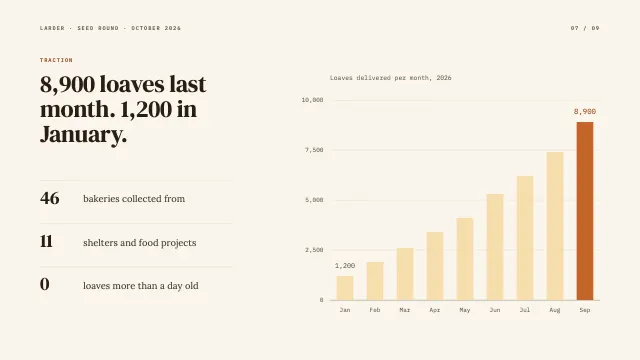 Page 7
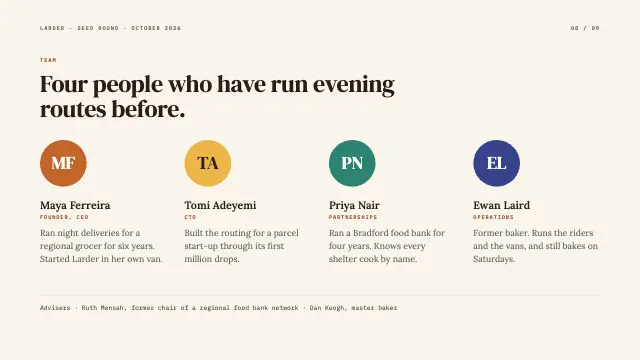 Page 8
 Page 9
What it shows
- Nine-page pitch
- A timeline that recurs as the motif
- Computed charts and a unit split
Good for
How to use it
- Open the template. It becomes a project in your account.
- Change the words, colours and pictures. Every part is an ordinary shape, line or text box.
- Press Play to watch it build, then present it or export it.
What is a pitch deck?
A pitch deck is a short presentation a founder uses to explain a company to investors and ask them for money. Most follow a familiar order: the problem, the solution, the market, the business model, traction, the team and the ask, often in a dozen slides or fewer. The strongest decks tell one story around a recurring image, so an investor can retell it to a partner afterwards.
When it helps
- A seed round founder presenting to angels or an early-stage fund in a short first meeting.
- Sending a deck ahead of a call, where it must make sense without the founder speaking.
- Applying to an accelerator, many of which ask for a deck with the application.
- Social enterprises pitching impact investors or grant panels alongside a business case.
Tips
- Write each slide title as its conclusion, like bakeries pay £60 a month, so an investor skimming only the titles still gets the whole pitch.
- Make a send-ahead version with more words and a presenting version with fewer. One file rarely does both jobs well.
- Repeat one visual motif across the deck. A timeline that returns on several slides ties the story together and makes the company memorable.
How to make a pitch deck
Open with the problem
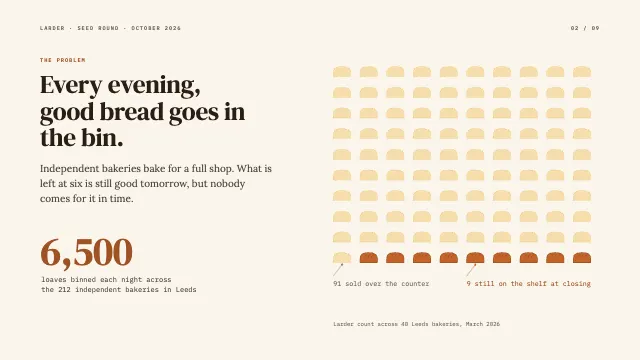
Start with a moment the investor can picture, like a bakery shutting at six with bread still on the shelf. A concrete scene beats an abstract statement on the first slide.
Show how the solution works
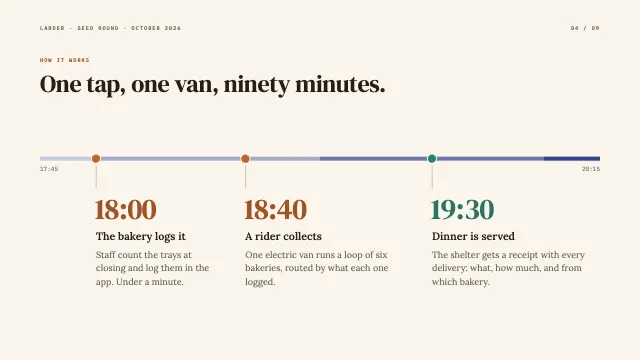
Explain on one slide what happens, step by step, ideally on a simple diagram or timeline. Investors need to see the mechanism, not a list of features.
Size the market honestly
Count the market in the units you sell to, such as bakeries rather than loaves, and show how you will reach them. Bottom-up numbers convince more than one huge top-down figure.
Explain how money flows
Say who pays, how much and what it costs to serve them. A unit split, showing where each £60 a month goes, proves the business can work at scale.
Prove traction with one chart
One clear chart of growth over months, like loaves delivered per month, says more than a dozen metrics. Label the first and latest values so the change is obvious.
Close with the ask
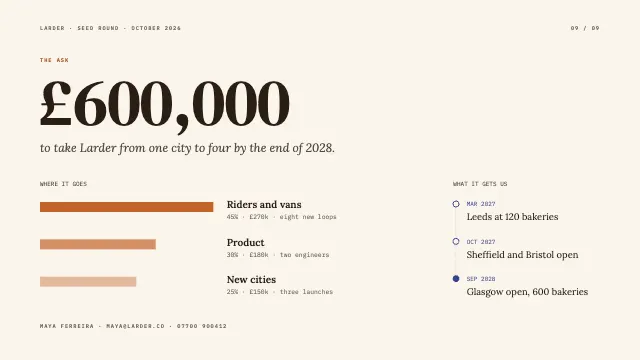
State how much you are raising and what it pays for, such as riders, product and new cities, with dated milestones. End with your contact details on screen.
FAQQuestions
Common questions.
What should be in a pitch deck?
The problem, your solution, why now, the market, the business model, traction so far, competition, the team, and the ask with how the money will be used. Not every deck needs every slide, but investors will look for an answer to each of those questions.
How many slides should a pitch deck have?
Roughly 10 to 15 for most early-stage pitches. Fewer is fine if the story is clear, while much longer decks tend to lose focus. Keep supporting detail, such as full financial models, in an appendix you can send when an investor asks.
What is the difference between a pitch deck and a business plan?
A pitch deck is a short visual summary meant to win a meeting or a follow-up; a business plan is a long written document covering operations, finances and strategy in depth. Most early-stage investors want the deck first and the detail later.
More presentations templates
Decks for pitches, lectures, reviews and talks.