Free templateSBI feedback training
Training: feedback with SBI
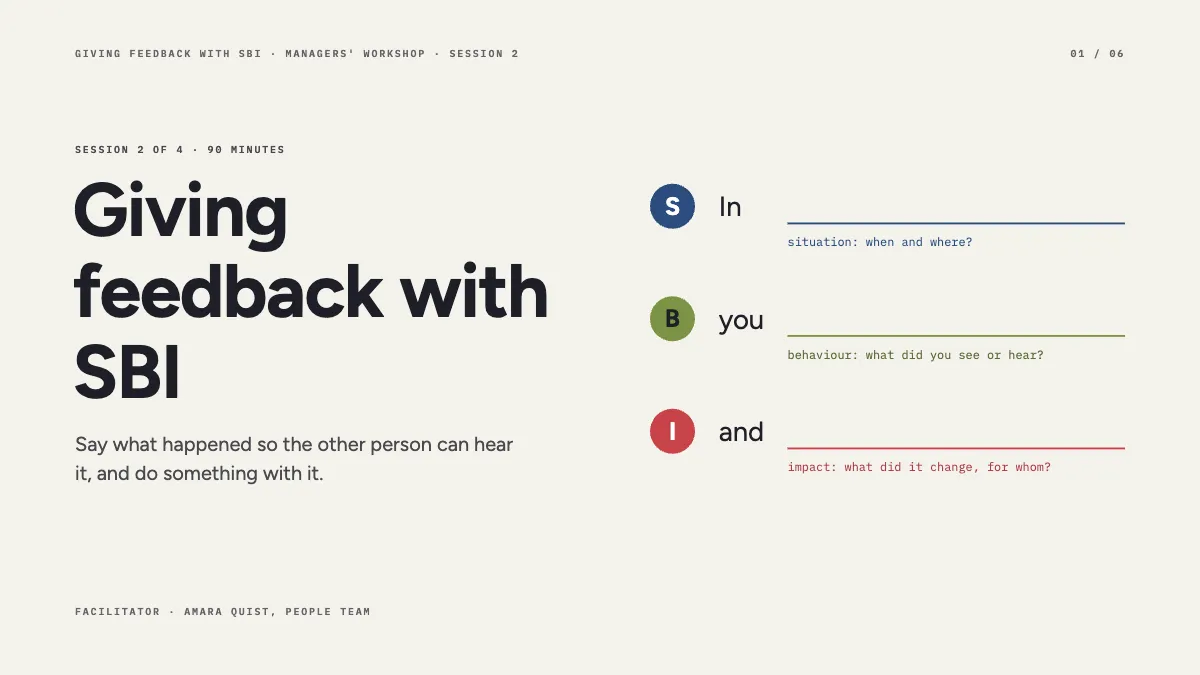
A six-page workshop on giving feedback: situation, behaviour and impact, each with its own colour, then one sentence taken apart and two prompts to practise.
Free. It opens in the Motionix editor as your own copy.
Download the pictureWebP, 1200 × 675, free to use. To change the words or colours, open it in the editor.
- Size
- 1920 × 1080 px
- Pages
- 6
- Motion
- Yes, plays live and in GIF or video
- Category
- Presentations
Every page
 Page 2
 Page 3
 Page 4
 Page 5
 Page 6
What it shows
- Colour that teaches a framework
- A sentence coloured by its parts
- A practice worksheet page
Good for
How to use it
- Open the template. It becomes a project in your account.
- Change the words, colours and pictures. Every part is an ordinary shape, line or text box.
- Press Play to watch it build, then present it or export it.
What is SBI feedback training?
SBI feedback training teaches a three-part model for giving feedback: situation, behaviour and impact. You say when and where something happened, describe exactly what the person did, and explain the effect it had. The model comes from the Center for Creative Leadership, and it keeps feedback specific and factual, which makes it easier to hear and act on, whether it is praise or criticism.
When it helps
- Training new managers before their first round of one-to-ones.
- A workshop for teams whose feedback tends to be vague praise or none at all.
- HR sessions preparing staff to write and discuss performance reviews.
- Coaching a leader who needs to raise a difficult issue with a colleague.
Tips
- Practise positive feedback with SBI as often as corrective. Specific praise shows people what to repeat and makes harder conversations easier later.
- Listen for hidden judgements in the behaviour part. Words like always, never, careless or defensive are interpretations, not observations.
- After the impact, ask a question and listen. SBI opens the conversation rather than replacing it, which is why some trainers add intent as a fourth step.
How to run SBI feedback training
Teach the situation first
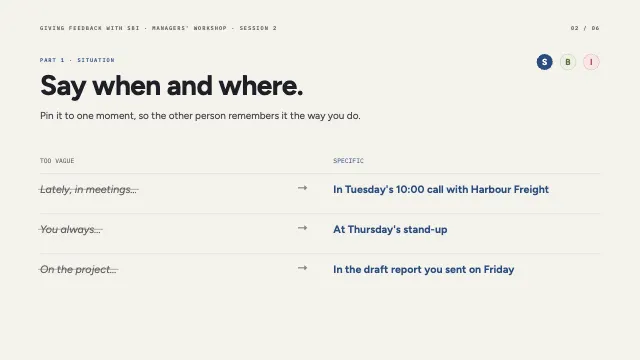
Show how to anchor feedback in one moment, like Tuesday's 10:00 call with a client, and contrast it with vague openings such as lately or you always.
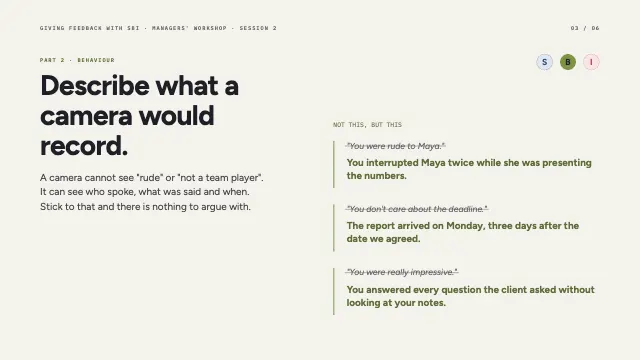
Describe behaviour like a camera
Practise wording that records what someone did or said, not why. You interrupted Maya twice is observable; you were rude is a judgement.
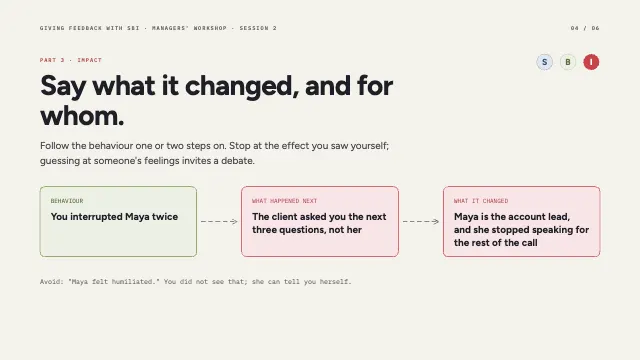
Connect behaviour to impact
Trace the chain from what the person did to what happened next and why it mattered, and for whom. The impact is what makes feedback worth giving.
Give each part its own colour
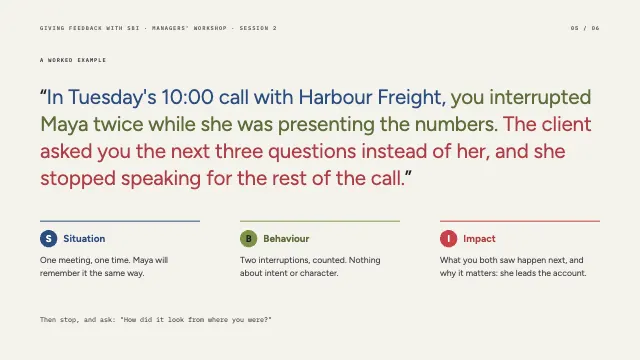
Use one colour for situation, one for behaviour and one for impact throughout the session, so participants can spot the parts in any sentence.
Take one sentence apart
Display a full piece of feedback with each part highlighted in its colour, so learners see how the three fit together in natural speech.
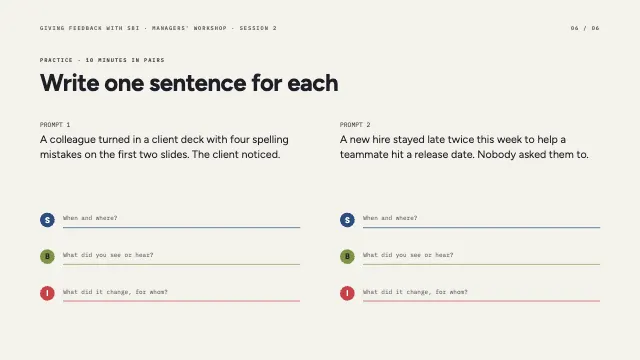
Finish with written practice
Give two prompts, one positive and one corrective, and have everyone write a sentence for each, then read it to a partner for comment.
FAQQuestions
Common questions.
What does SBI stand for in feedback?
Situation, behaviour, impact. The situation says when and where; the behaviour describes what the person actually did, as a camera would record it; and the impact explains what that behaviour changed for you, the team or a customer.
What is an example of SBI feedback?
In this morning's client call (situation), you answered every question without looking at your notes (behaviour). The client told me afterwards it gave them confidence in the whole team (impact). Corrective feedback follows the same pattern, with each part kept specific and factual.
What is the difference between SBI and SBII?
SBII adds a fourth step, intent: after describing the impact, you ask what the person intended and listen to the answer. It turns the feedback into a two-way conversation and can uncover reasons you did not know about.
More presentations templates
Decks for pitches, lectures, reviews and talks.