Free templateNonprofit donor presentation
Donor deck: clean water
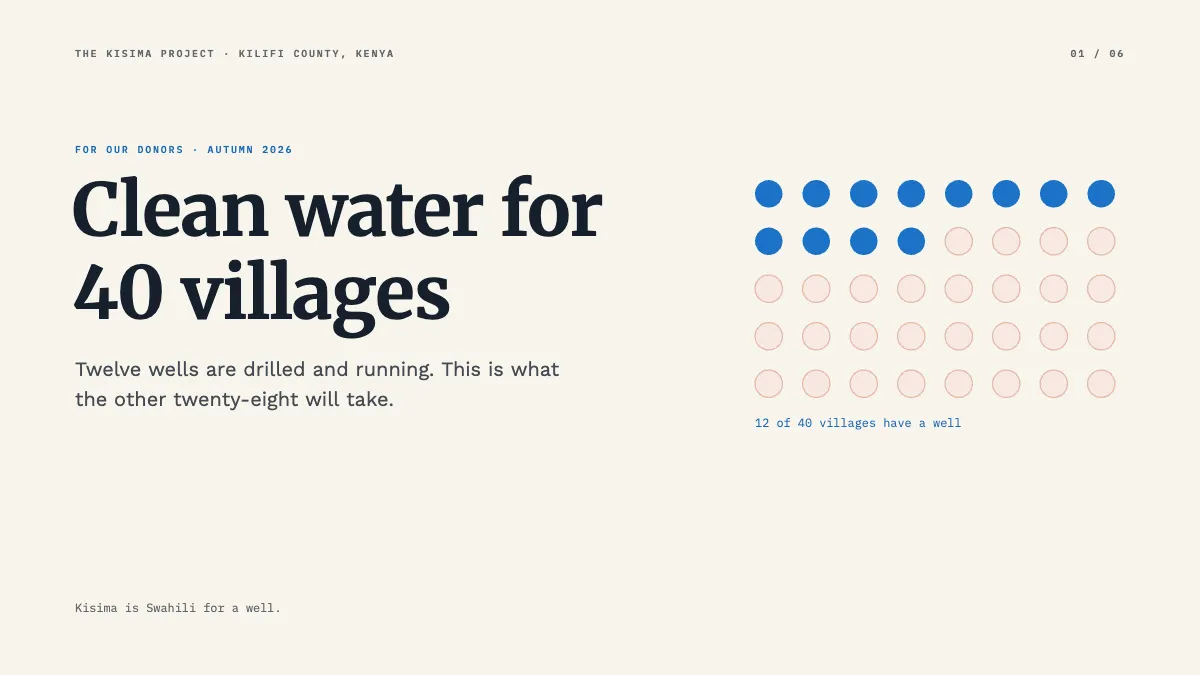
A six-page NGO deck for donors where forty dots are forty villages: on a map, filled as wells are finished, and counted into the ask.
Free. It opens in the Motionix editor as your own copy.
Download the pictureWebP, 1200 × 675, free to use. To change the words or colours, open it in the editor.
- Size
- 1920 × 1080 px
- Pages
- 6
- Motion
- Yes, plays live and in GIF or video
- Category
- Presentations
Every page
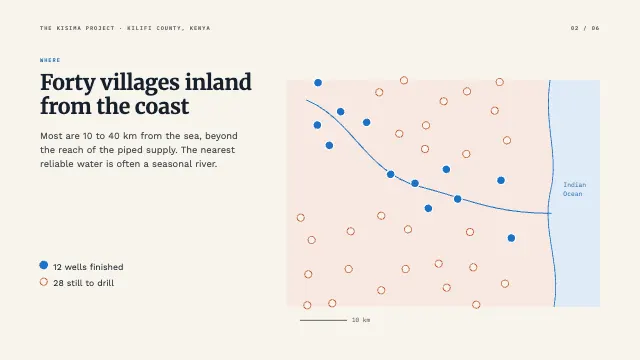 Page 2
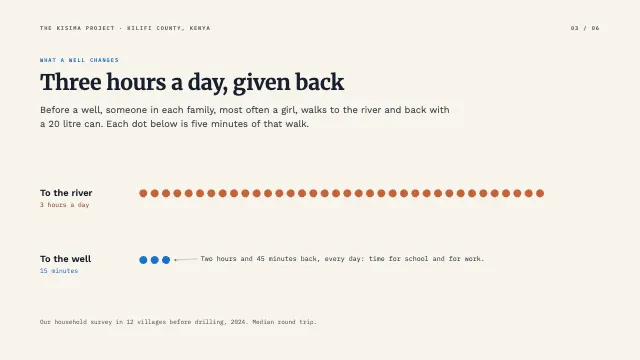 Page 3
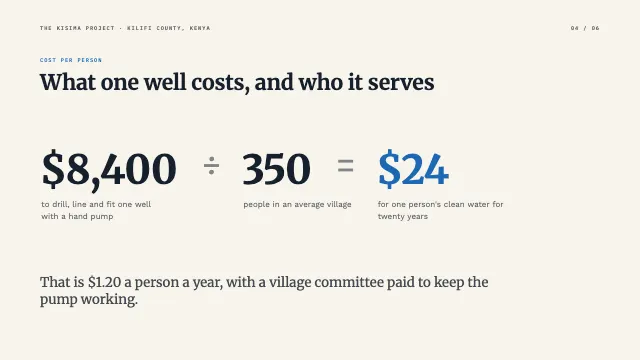 Page 4
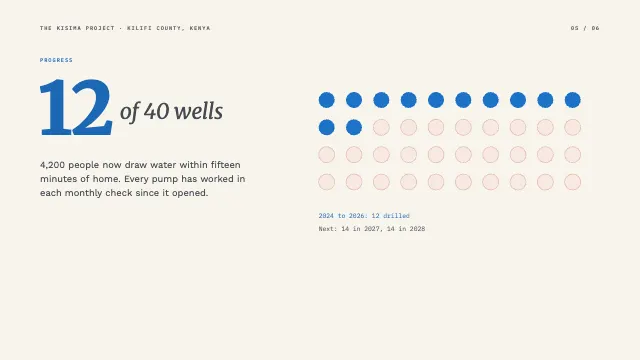 Page 5
 Page 6
What it shows
- An abstract dot map
- A walk drawn to scale in minutes
- Cost per person set as an equation
Good for
How to use it
- Open the template. It becomes a project in your account.
- Change the words, colours and pictures. Every part is an ordinary shape, line or text box.
- Press Play to watch it build, then present it or export it.
What is a nonprofit donor presentation?
A nonprofit donor presentation explains to a funder what problem a charity tackles, what it has achieved, what a gift will pay for and exactly how much is being asked. It is used with major donors, trusts, foundations and corporate partners. Good donor decks make impact concrete in units a donor can picture, such as one well, one village or one person, rather than in totals alone.
When it helps
- Meeting a major donor or a family foundation to ask for a specific gift.
- Presenting to the giving committee of a corporate partner.
- An annual impact report shown at a supporters' evening.
- A trust that invites a short presentation after reading a written application.
Tips
- Ask for a specific amount. A deck that ends with any support helps leaves the donor guessing what would be appropriate.
- Use one headline statistic you can source, not ten, and footnote where each figure on the slides came from.
- Present communities as partners in the work, with their consent for any photos or names, rather than as passive recipients of help.
How to make a nonprofit donor presentation
Make the place real
Open with where the work happens, on a simple map. Drawing each community as a dot shows the scale of the programme at once.
Show the problem in human time
Translate need into something a donor can feel, such as three hours a day spent walking for water, with the source of the figure on the slide.
Give the cost per unit
Set out what one well costs to drill and fit, how many people it serves and the resulting cost per person. Donors want to know what their money buys.
Report progress honestly
Show what has been done and what remains, for example 12 of 40 wells drilled, with the timeline for finishing the rest.
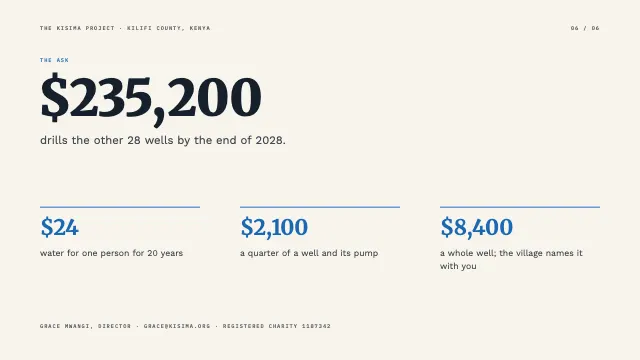
Make the ask in tiers
Offer a few specific amounts, each tied to an outcome: water for one person, part of a well, a whole well. Close with a named contact and the charity's registration.
FAQQuestions
Common questions.
What should be in a donor presentation?
The problem, your approach, evidence that it works, progress so far, what a gift will achieve, the specific ask and how to give. Add the charity's registration number and a named contact, and leave time for the donor's questions.
How do you make a donation ask in a presentation?
State the amount plainly and tie it to a result, for example a whole well for one village. Many charities offer two or three levels so a donor can choose. Then stop talking and let the donor respond.
What is cost per beneficiary?
The total cost of a programme divided by the number of people it helps. It lets donors picture their gift and compare value. Say what is included, such as maintenance, and over how many years, because a low figure without context can mislead.
More presentations templates
Decks for pitches, lectures, reviews and talks.