Free templateOrder to cash process map
Order to cash, now and next
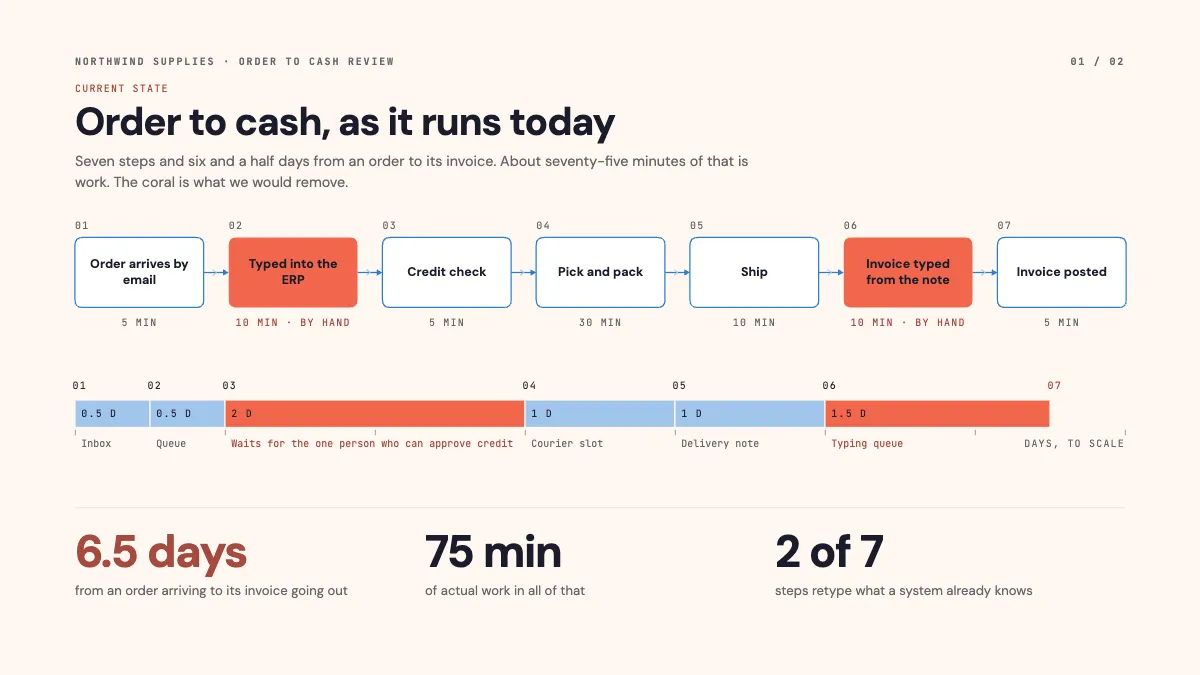
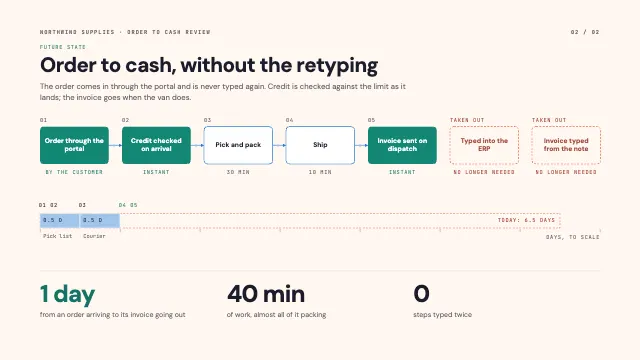
Two pages for a process review: today's order to cash with its waste in coral, then the future state on the same time bar.
Free. It opens in the Motionix editor as your own copy.
Download the pictureWebP, 1200 × 675, free to use. To change the words or colours, open it in the editor.
- Size
- 1920 × 1080 px
- Pages
- 2
- Motion
- Yes, plays live and in GIF or video
- Category
- Processes
Every page
 Page 2
What it shows
- Current and future state
- A time bar drawn to scale
- Waste marked in one colour
Good for
How to use it
- Open the template. It becomes a project in your account.
- Change the words, colours and pictures. Every part is an ordinary shape, line or text box.
- Press Play to watch it build, then present it or export it.
What is an order to cash process map?
An order to cash process map shows every step between a customer placing an order and the company receiving payment: order entry, credit check, fulfilment, shipping, invoicing, collection and applying the cash. Analysts draw it to find where time is lost, usually comparing a current state map of how the process runs today with a future state map of how it should run.
When it helps
- A business analyst showing leadership where orders wait between steps before they are invoiced.
- A lean improvement workshop agreeing which steps add value and which only retype data.
- Making the case for a customer portal or ERP integration with days saved, not opinions.
- A finance team investigating why cash arrives later than the sales figures suggest.
Tips
- Measure lead time and touch time separately. Teams usually guess the work accurately and the waiting badly, and the waiting is where the improvement lies.
- Look for every place data is typed twice. Each retyping step is a delay and a source of errors that shows up later as disputed invoices and late payment.
- Draw the current state with the people who do the work. Managers' versions of a process tend to skip the workarounds that cause the delays.
How to map the order to cash process
Fix the start and end
Agree where the map begins and ends. A full order to cash map runs to cash in the bank; a review of delays inside the company may stop when the invoice goes out.
Walk one real order
Follow a recent order through every desk and system, noting each step, who does it and how long the work took. Use real timestamps from email and the ERP, not memory.
Separate work from waiting
For every step, record the touch time and the queue before it. In most order to cash maps, minutes of work sit inside days of waiting.
Mark the waste
Highlight steps that add no value for the customer: retyping, chasing approvals, waiting for one person. Use one colour so the waste can be counted at a glance.
Draw the future state
Redraw the process without the waste on the same time scale, so the saving is visible as a shorter bar, and list what must change to get there.
FAQQuestions
Common questions.
What are the steps in the order to cash cycle?
The usual stages are order management, credit management, order fulfilment, shipping, invoicing, accounts receivable and collections, cash application, and reporting. Some companies add contract or quote management at the start. Each stage hands data to the next, which is why errors early in the cycle often surface as late payments.
What is the difference between order to cash and procure to pay?
Order to cash is the selling side: from a customer's order to the payment arriving. Procure to pay is the buying side: from raising a purchase requisition to paying the supplier. One company's order to cash is often its customer's procure to pay.
What is a current state and future state map?
Both come from lean value stream mapping. The current state map records how a process actually runs today, with its delays and rework. The future state map shows the improved process the team is aiming for. Comparing the two on the same time scale shows exactly what the change will save.
More processes templates
Flowcharts, procedures and step-by-step journeys.