Free templateHome buying process
Buying your first home
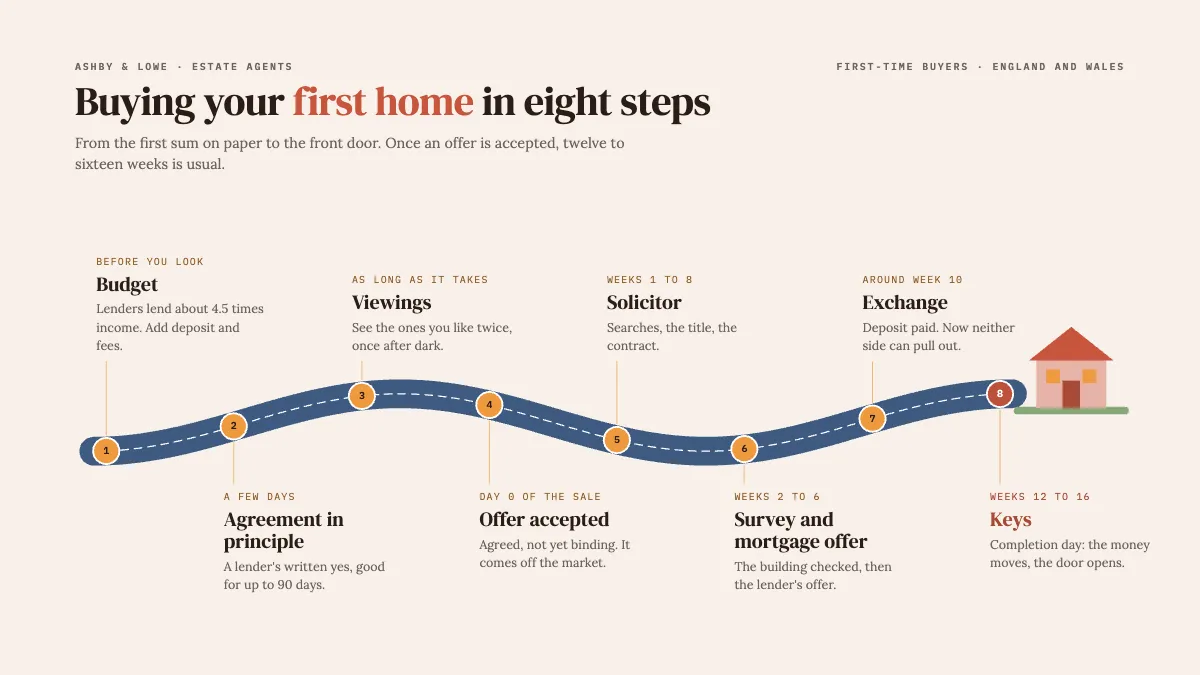
An estate agent explainer drawn as one road through eight stops, from the budget to the keys at the house.
Free. It opens in the Motionix editor as your own copy.
Download the pictureWebP, 1200 × 675, free to use. To change the words or colours, open it in the editor.
- Size
- 1920 × 1080 px
- Pages
- 1
- Motion
- Yes, plays live and in GIF or video
- Category
- Processes
What it shows
- A road that draws across the page
- Labels either side of a route
- A drawn house
Good for
How to use it
- Open the template. It becomes a project in your account.
- Change the words, colours and pictures. Every part is an ordinary shape, line or text box.
- Press Play to watch it build, then present it or export it.
What is the home buying process?
The home buying process is the series of steps from deciding what you can afford to collecting the keys. For first-time buyers in England and Wales it usually runs through budgeting, a mortgage agreement in principle, viewings, an accepted offer, conveyancing by a solicitor, a survey and mortgage offer, exchange of contracts and completion. Other countries follow a similar shape with different legal steps.
When it helps
- An estate agent sending first-time buyers a clear picture of the route once an offer is accepted.
- A mortgage broker explaining why an agreement in principle comes before viewings.
- A buyer working out which stages they control and which depend on solicitors and lenders.
Tips
- Explain that an accepted offer is not a contract in England and Wales. First-time buyers who think the house is theirs at that point are hit hardest if the sale falls through.
- Encourage buyers to choose a solicitor or conveyancer before making an offer. Instructing one early saves days once the offer is accepted.
- Keep figures like lending multiples as rough guides, not promises. Lenders assess each applicant differently, and a guide that sounds like a quote invites disputes.
How to explain the home buying process
Start before the search
Begin with the budget: deposit, likely mortgage and the costs people forget, such as legal fees, surveys, moving and any property tax. Buyers who start here waste fewer viewings.
Put the stages in order
List each stage as the buyer meets it, from agreement in principle to completion, using the names solicitors and lenders use so the buyer recognises them later.
Mark the point of no return
Show clearly where the purchase becomes legally binding. In England and Wales that is exchange of contracts; before it, either side can still withdraw.
Give honest time ranges
Say how long each stage typically takes and that the whole sale, from accepted offer to keys, often takes several months. Chains and slow searches stretch it further.
Explain who does what
Beside each stage, name who acts: the buyer, the lender, the solicitor, the surveyor or the agent. Buyers chase the right person when they know whose turn it is.
FAQQuestions
Common questions.
What is the difference between exchange and completion?
At exchange of contracts the buyer and seller swap signed contracts, the buyer pays the deposit and the sale becomes legally binding. At completion, usually days or weeks later, the rest of the money is transferred, ownership passes and the buyer collects the keys. Both terms are used in England and Wales.
What is a mortgage agreement in principle?
An agreement in principle, sometimes called a decision in principle, is a lender's written estimate of how much it is likely to lend you, based on your income and a credit check. It is not a guaranteed offer, but it shows sellers and agents you are a serious buyer. It typically lasts 30 to 90 days.
How long does it take to buy a house?
In England and Wales, the time from an accepted offer to completion is commonly around three to four months, though simple purchases with no chain can be quicker. Finding a property and arranging a mortgage beforehand add to that. Chains, survey problems and slow searches are the usual causes of delay.
More processes templates
Flowcharts, procedures and step-by-step journeys.