Free templateCourt case timeline
How a civil case moves through court
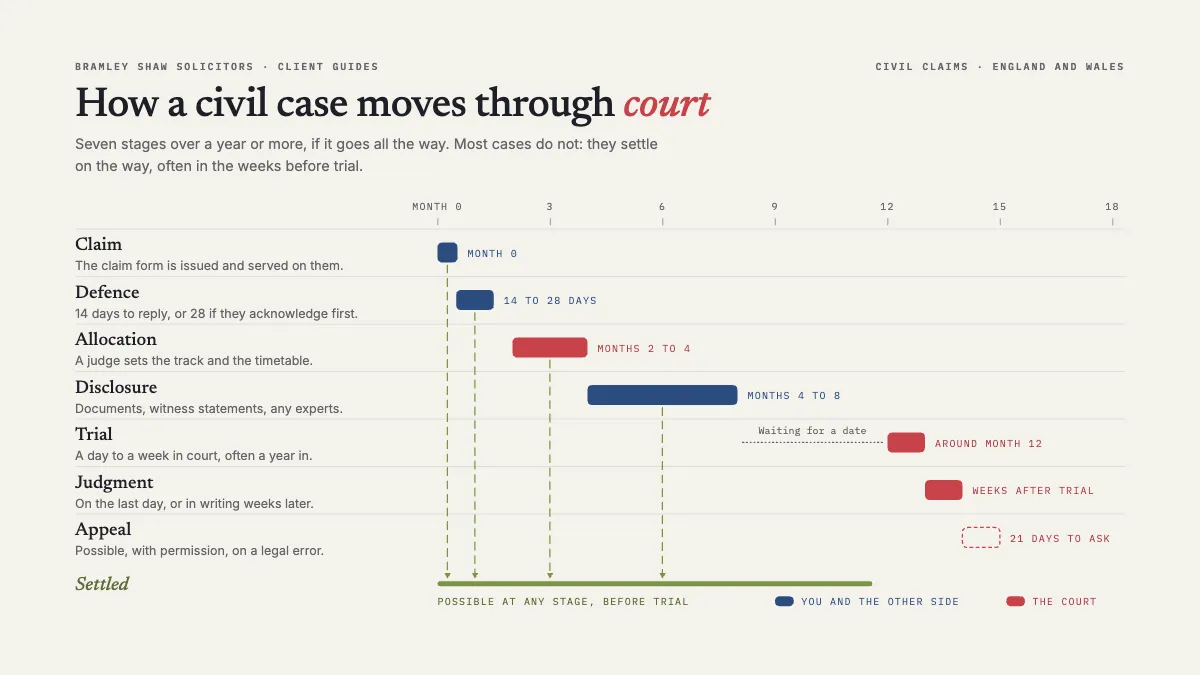
For a law firm's clients: seven stages as bars on a scale of months, with the settlement exits most cases take.
Free. It opens in the Motionix editor as your own copy.
Download the pictureWebP, 1200 × 675, free to use. To change the words or colours, open it in the editor.
- Size
- 1920 × 1080 px
- Pages
- 1
- Motion
- Yes, plays live and in GIF or video
- Category
- Processes
What it shows
- Gantt on a month scale
- Who acts, in two tints
- Exits that peel off the route
Good for
How to use it
- Open the template. It becomes a project in your account.
- Change the words, colours and pictures. Every part is an ordinary shape, line or text box.
- Press Play to watch it build, then present it or export it.
What is a court case timeline?
A court case timeline shows the stages a legal case moves through and roughly how long each takes, from the first claim to judgment and any appeal. For a civil claim in England and Wales the usual stages are issuing the claim, the defence, allocation to a track, disclosure and evidence, trial and judgment. Real cases vary, and many settle before they reach court.
When it helps
- A solicitor giving a new client a realistic picture of how long litigation can take.
- Explaining at a first meeting where most of the waiting happens and why it is normal.
- Showing a business client the points where settlement talks are most likely.
- Law students revising the order of civil procedure before an exam.
Tips
- Keep the legal terms but define them. Clients will meet allocation and disclosure in letters, so the timeline should teach those words, not replace them.
- Show waiting as waiting. Clients who expect a long gap between evidence and trial do not ring every week asking whether something has gone wrong.
- Never present a timeline as advice on a particular case. It explains the usual route; only a lawyer who knows the facts can say what will happen.
How to make a court case timeline
Name the jurisdiction
Say which court system and type of case the timeline follows. Civil and criminal cases move differently, and stages, names and time limits differ between countries.
List the procedural stages
Write the stages in order using the names clients will hear from their lawyer, with one plain sentence each saying what happens and who acts.
Use a scale of months
Draw each stage as a bar on a month scale so its length is honest. Long gaps, such as waiting for a trial date, should look long.
Show who acts at each stage
Mark which stages are in the parties' hands and which belong to the court. Clients worry less when they see the case is waiting on the court list, not on their lawyer.
Mark the ways out
Show that settlement is possible at any stage before trial, so the timeline reads as the longest possible route rather than the expected one.
Add a clear caveat
State that timings are typical, not promised, and that the client's own lawyer will confirm the timetable once the court has set it.
FAQQuestions
Common questions.
How long does a civil court case take?
It depends on the court, the value and complexity of the claim, and how busy the courts are. In England and Wales a defended claim that goes all the way to trial commonly takes a year or more, while small claims are usually faster. Most cases settle before trial.
What are the stages of a civil case?
In broad terms: the claim is issued and served, the defendant responds with a defence, the court allocates the case to a track and sets a timetable, the parties exchange documents and evidence, the case is tried, and a judgment is given. Either side may then seek permission to appeal.
What is allocation to a track?
In the civil courts of England and Wales, a judge allocates each defended claim to a track based mainly on its value and complexity: the small claims track, the fast track, the intermediate track or the multi-track. The track decides how much preparation is needed and how the case is managed.
More processes templates
Flowcharts, procedures and step-by-step journeys.