Free templateTravel itinerary
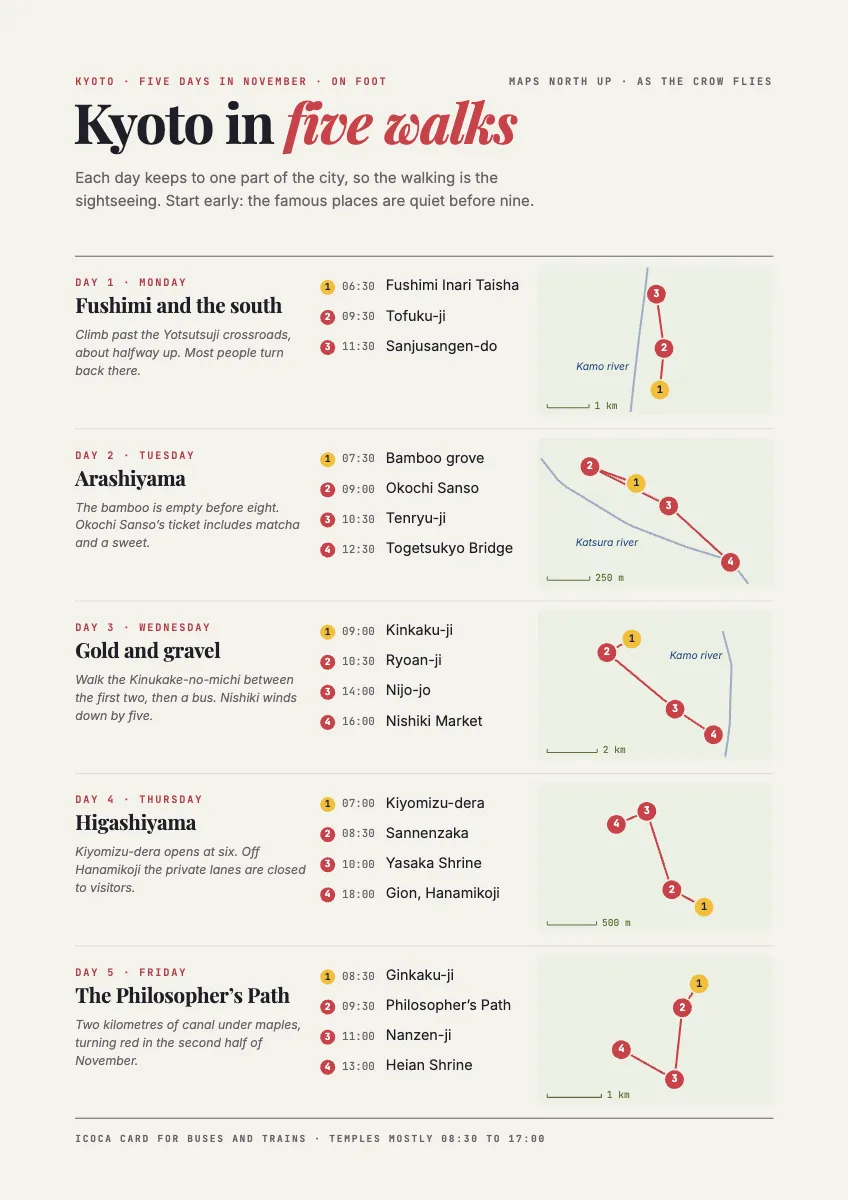
Kyoto in five walks
A five-day travel itinerary where each day is a small map drawn from the real places it visits, with times and a note.
Free. It opens in the Motionix editor as your own copy.
Download the pictureWebP, 848 × 1200, free to use. To change the words or colours, open it in the editor.
- Size
- 1240 × 1754 px
- Pages
- 1
- Motion
- Yes, plays live and in GIF or video
- Category
- Plans
What it shows
- Maps from real coordinates
- Routes that draw on
- A4 print
Good for
How to use it
- Open the template. It becomes a project in your account.
- Change the words, colours and pictures. Every part is an ordinary shape, line or text box.
- Press Play to watch it build, then present it or export it.
What is a travel itinerary?
A travel itinerary is a day-by-day plan for a trip: where you go, in what order, at roughly what times, and how you get between places. A good one groups each day around one area so less time is spent travelling, puts the most popular sights early before the crowds, and leaves gaps, because no trip runs exactly to plan.
When it helps
- Planning five days in Kyoto so each day stays in one district and is walkable.
- Sharing a plan with travel companions so everyone knows the morning meeting time.
- Leaving a family member a copy of where you will be on each day abroad.
- A travel writer or guide publishing a suggested route for first-time visitors.
Tips
- Plan around the season. In Kyoto, autumn leaves and spring blossom draw huge crowds, so an early start matters far more then than in quieter months.
- Draw each day on its own small map. Seeing the stops in space shows at once when a route doubles back or a walk is longer than it looks.
- Do not schedule a full day after a long flight. Arrival days are for checking in, a short walk and an early night.
How to plan a travel itinerary
List the must-sees
Write down the places you most want to see, then mark each on a map. The clusters that appear are the shape of your days.
Give each day one area
Group nearby places into a single day and plan to walk between them. Crossing a city twice in one day can waste hours that could be spent seeing it.
Check opening times
Look up when each place opens and closes and which days it shuts. Temples, markets and museums often close earlier than visitors expect.
Put the busiest sights first
Visit the most famous places at opening time or before. Popular sights that are packed by mid-morning are often almost empty soon after dawn.
Leave room to wander
Plan two or three fixed stops a day and leave the rest open. The cafés, side streets and detours you find yourself are often the best part of a trip.
Add the practical details
Note transport passes, travel cards, booking references and any tickets that sell out, so the plan also works as a reference on the day.
FAQQuestions
Common questions.
How many days do you need in Kyoto?
Many visitors find three to five days enough to see the main temples, shrines and districts without rushing, with a day trip to Nara or Osaka if time allows. With fewer than three days, choose two or three areas rather than trying to see everything.
What should a travel itinerary include?
Dates and places for each day, the order of visits with rough times, how you will travel between them, where you are staying, booking references and tickets, opening times and closing days, and emergency contacts. A copy kept offline is useful when signal or roaming fails.
How do you avoid crowds at popular sights?
Go at opening time or late in the day, avoid weekends and national holidays, and visit the most famous places first. Some sights, such as Fushimi Inari shrine in Kyoto, never close, and are far quieter early in the morning than at midday.
More plans templates
Timelines, schedules, itineraries and trackers.