Free templateWorkout plan
Four-week strength plan
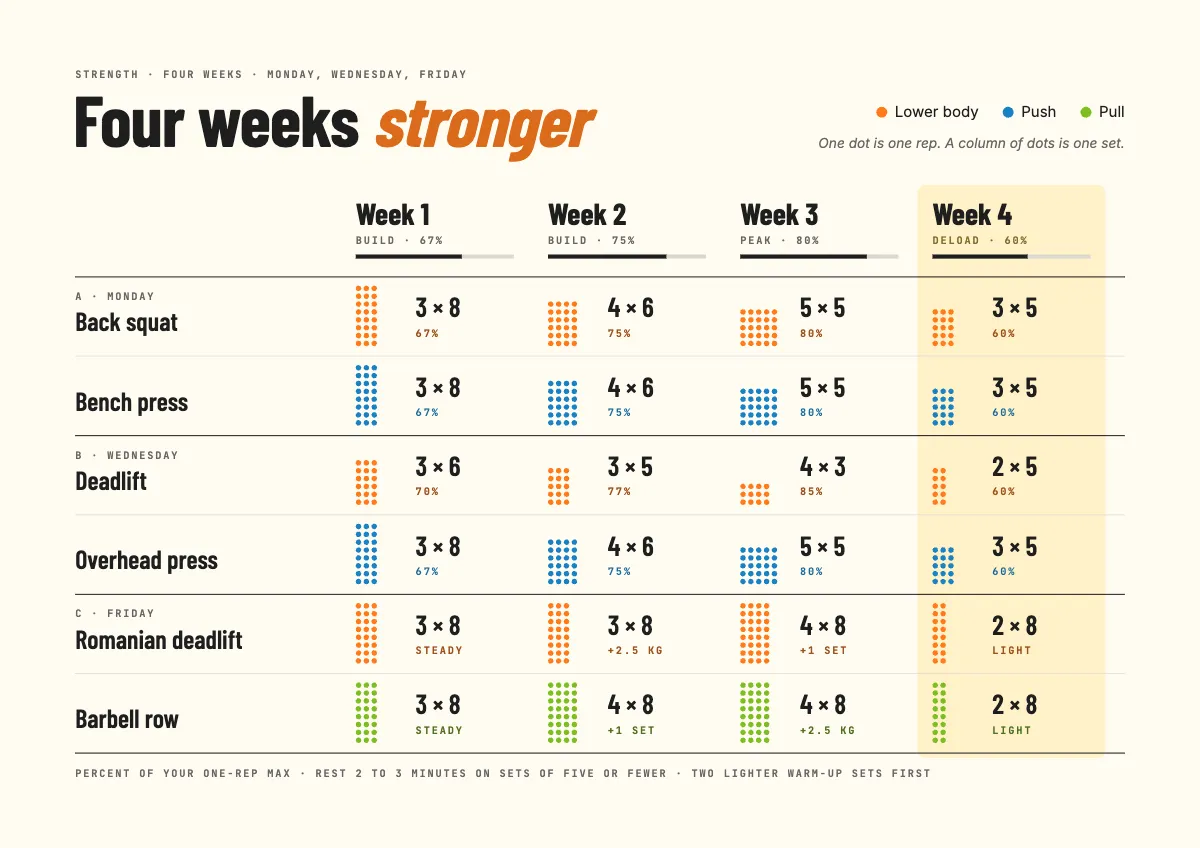
Three lifting days a week for four weeks, every rep drawn as a dot so the volume changes shape as the load climbs.
Free. It opens in the Motionix editor as your own copy.
Download the pictureWebP, 1200 × 848, free to use. To change the words or colours, open it in the editor.
- Size
- 1754 × 1240 px
- Pages
- 1
- Motion
- Yes, plays live and in GIF or video
- Category
- Plans
What it shows
- Sets and reps drawn as dots
- Load line per week
- Key for the lifts
Good for
How to use it
- Open the template. It becomes a project in your account.
- Change the words, colours and pictures. Every part is an ordinary shape, line or text box.
- Press Play to watch it build, then present it or export it.
What is a workout plan?
A workout plan is a schedule of training sessions over several weeks, listing the exercises for each day with their sets, repetitions and loads. A strength plan usually raises the load or volume a little each week, known as progressive overload, then follows with a lighter deload week so the body can recover and adapt before the next block.
When it helps
- A personal trainer giving a client four weeks of sessions to follow between check-ins.
- A beginner moving from random gym visits to three structured lifting days a week.
- A coach showing how weekly volume and load change across a training block.
- Logging lifts against the plan to see whether strength is actually going up.
Tips
- Start lighter than you think. Beginning a block too heavy leaves no room to progress and is a common reason plans stall within a few weeks.
- Rest properly between heavy sets, often two to three minutes or more for sets of five or fewer. Short rests turn a strength session into a fitness session.
- Record every session. Without a log you cannot tell whether the plan is working, and progress over weeks is easy to misremember.
How to make a workout plan
Choose the training days
Decide how many days a week you can train consistently, for example three non-consecutive days such as Monday, Wednesday and Friday, with rest days between for recovery.
Pick the main lifts
Build each day around one or two compound lifts, such as the squat, bench press, deadlift, overhead press and row, then add lighter accessory work if time allows.
Set sets, reps and load
Give each lift its sets and repetitions, and the load as a percentage of your one-rep max or a weight you can lift with good form for every rep.
Progress week by week
Increase the load, the sets or the reps a little each week. Change one variable at a time so you know what is working.
Plan a deload
After three to five weeks of building, schedule a lighter week with less load and volume. Recovery is when the body adapts to the work you have done.
FAQQuestions
Common questions.
What is progressive overload?
Progressive overload means gradually increasing the demand on your muscles over time, by adding weight, repetitions, sets or sessions. The body adapts to the stress it meets, so to keep getting stronger the stress has to keep rising, in small enough steps that recovery keeps up.
What is a deload week?
A deload week is a planned period of easier training, with lower weights, fewer sets or both, usually after several weeks of harder work. It lets the muscles and joints recover, reduces accumulated fatigue, and often leads to better performance in the following block of training.
How many days a week should you lift weights?
For most people, two to four days a week is enough to build strength, with three sessions a popular choice. What matters more than the exact number is training each major muscle group regularly, progressing steadily and recovering between sessions.
More plans templates
Timelines, schedules, itineraries and trackers.