Free templatePosters and print
Fire action notice
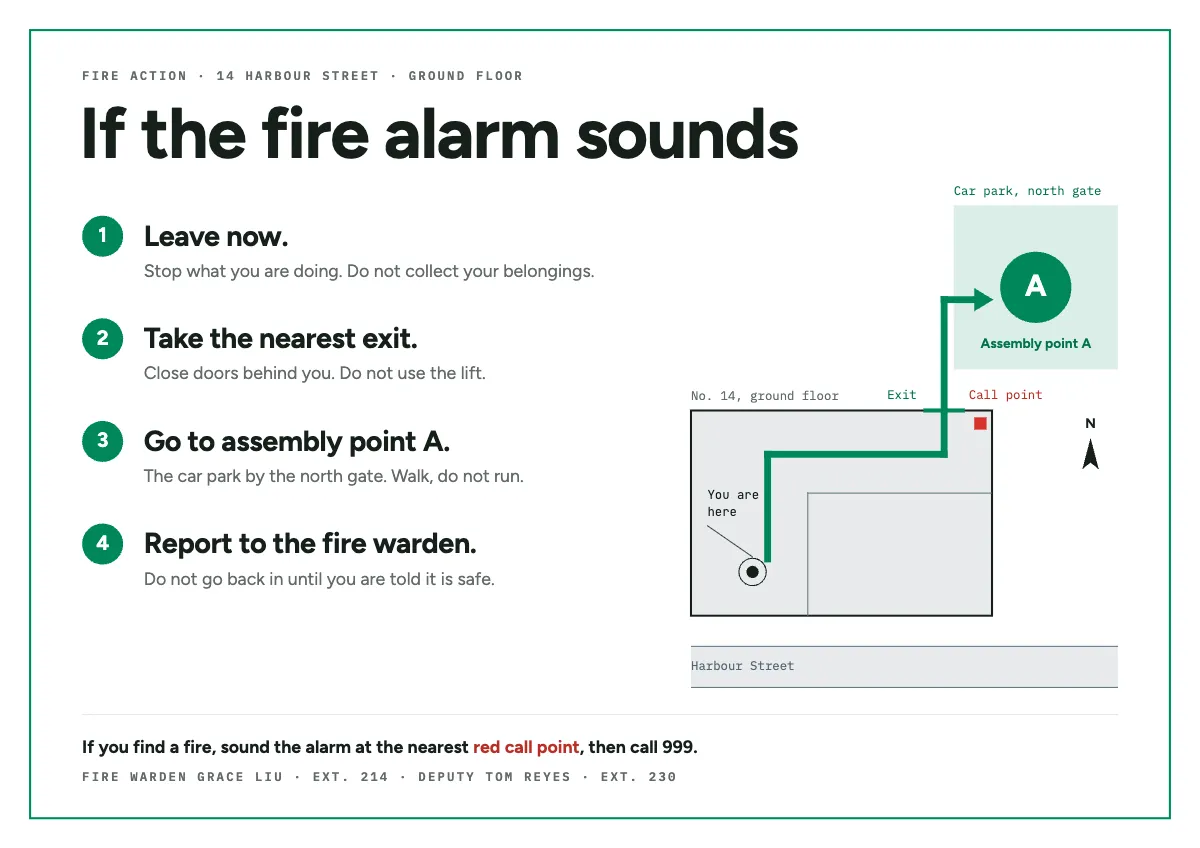
A framed safe-condition sign: four steps readable across a room and a plan of the way out to assembly point A.
Free. It opens in the Motionix editor as your own copy.
Download the pictureWebP, 1200 × 848, free to use. To change the words or colours, open it in the editor.
- Size
- 1754 × 1240 px
- Pages
- 1
- Motion
- A still page; add motion if you like
- Category
- Posters and print
What it shows
- Escape route drawn as a plan
- Type for reading at distance
- Green that means one thing
Good for
How to use it
- Open the template. It becomes a project in your account.
- Change the words, colours and pictures. Every part is an ordinary shape, line or text box.
- Add motion if it helps, then present it or export it.
What is a fire action notice?
A fire action notice is a sign that tells everyone in a building what to do if they discover a fire or hear the alarm. In common UK practice it says to raise the alarm at the nearest call point, call the fire service, leave by the nearest exit without using lifts, go to the assembly point and not re-enter until told it is safe. Notices are usually placed by fire alarm call points and exits.
When it helps
- An office manager replacing generic notices with ones that name the real assembly point.
- Fitting out a new shop, workshop or clinic before staff move in.
- Updating signs after a fire risk assessment changes the escape route.
- Showing visitors and new starters the way out on their first day.
Tips
- Keep each step to a short command; in an alarm people skim, so leave now reads faster than please make your way calmly out.
- Orient any plan to the spot where the notice hangs, with a you are here mark, or readers will turn the wrong way.
- Keep to standard safety colours: green for safe routes and the assembly point, red for fire equipment such as call points, and nothing decorative in either.
How to write a fire action notice
Start from the fire risk assessment
Take the escape routes, assembly point and procedures from the building's current fire risk assessment, so the notice matches what has been planned and practised.
Say what to do on discovery
Tell anyone who finds a fire to raise the alarm at the nearest call point and call the fire service, 999 in the UK, unless the site has another procedure.
Give the evacuation steps
In short numbered lines: leave immediately without belongings, use the nearest exit, close doors behind you, do not use lifts, and go to the assembly point.
Name the assembly point
Say exactly where it is, such as the car park by the north gate, and add a simple plan from the notice to the way out.
Add who is responsible
Name the fire warden and a deputy with contact details, and repeat that nobody goes back in until told it is safe.
FAQQuestions
Common questions.
Is a fire action notice a legal requirement?
In England and Wales, the responsible person for a building must make sure people know what to do in a fire, under the Regulatory Reform (Fire Safety) Order 2005, and notices are the usual way to do it. Requirements vary by country and premises, so follow your fire risk assessment and local rules.
Where should fire action notices be placed?
Usually beside every fire alarm call point, at exits and in places people pass often, such as corridors and reception. They should be at eye level, well lit and not hidden behind doors. The fire risk assessment may set specific positions.
What colour should a fire action notice be?
Many UK fire action notices are blue, the colour for mandatory instructions, while escape route signs and assembly points are green, the colour for safe conditions. Whichever you use, follow the safety sign colour meanings in ISO 7010 and keep them consistent across the building.
More posters and print templates
Menus, notices, invitations, signs and certificates.