Free templateSWOT analysis
Gym SWOT on its street
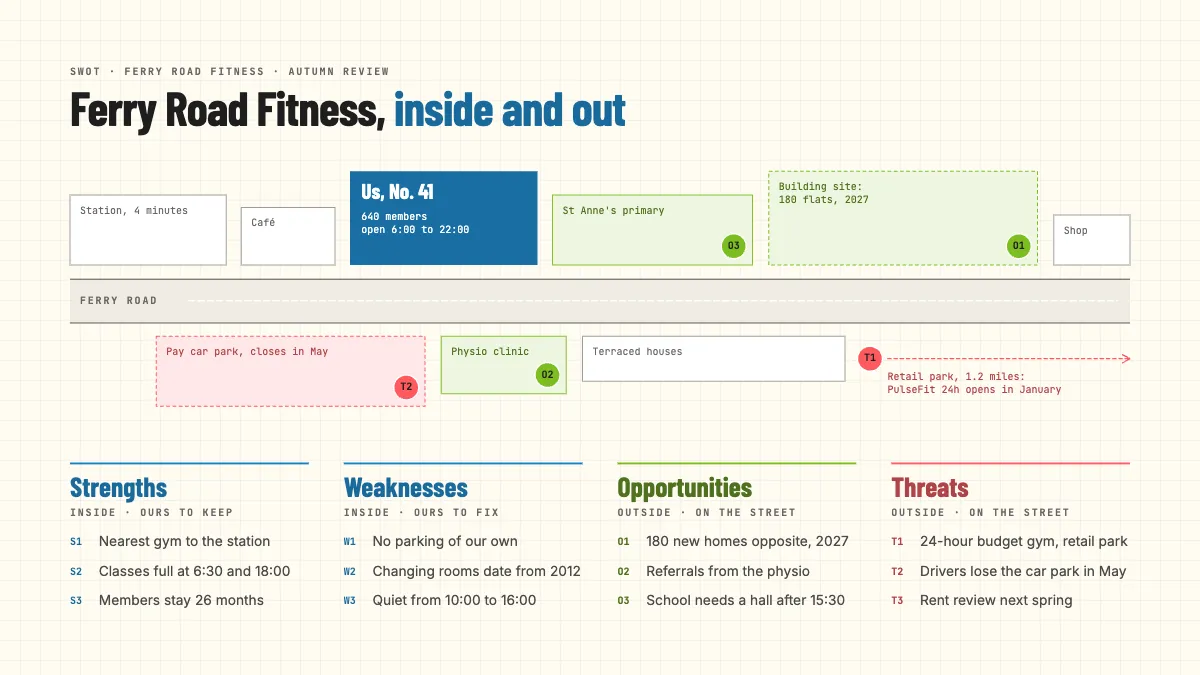
A SWOT for a local gym drawn on a plan of its own street, with every opportunity and threat pinned to where it comes from.
Free. It opens in the Motionix editor as your own copy.
Download the pictureWebP, 1200 × 675, free to use. To change the words or colours, open it in the editor.
- Size
- 1920 × 1080 px
- Pages
- 1
- Motion
- Yes, plays live and in GIF or video
- Category
- Frameworks
What it shows
- Street plan as the figure
- Pinned opportunities and threats
- Inside and outside made literal
Good for
How to use it
- Open the template. It becomes a project in your account.
- Change the words, colours and pictures. Every part is an ordinary shape, line or text box.
- Press Play to watch it build, then present it or export it.
What is a SWOT analysis?
A SWOT analysis is a simple strategy tool that lists an organisation's strengths, weaknesses, opportunities and threats. Strengths and weaknesses are internal: things the business controls, like its location, staff or facilities. Opportunities and threats are external: changes in the market, the neighbourhood or the economy that it cannot control but can respond to. The point is to decide what to do next, not to fill four boxes.
When it helps
- A local gym owner planning the year ahead before a rent review or a rival opening nearby.
- A consultant's first meeting with a small business, agreeing what matters before proposing anything.
- A loan or grant application that asks how the business will respond to change.
- A team away day comparing what staff and the owner each see as the biggest threat.
Tips
- Beginners put opportunities inside the business, like "we could run more classes". That is an action. Opportunities are outside facts, such as 180 new homes going up opposite.
- Number each point so you can link them later: S1 against O3, W1 against T2. The links between the lists are where a strategy comes from.
- Ask customers and front-desk staff, not only the owner. The owner sees the plans; reception hears why members leave.
How to do a SWOT analysis
Set the scope and the date
Name the business, site or product you are analysing and the period you are planning for. A SWOT for one gym on one street is far more useful than one for "the fitness market".
List strengths and weaknesses
Write down what is true inside the business, with evidence: members stay 26 months, peak classes are full, the changing rooms date from 2012.
List opportunities and threats
Look outside: new housing, nearby partners, competitors, rent, regulation. Tie each one to where it comes from, such as a building site or a new budget gym, so it can be checked.
Make every point specific
Replace "good location" with "nearest gym to the station", and "competition" with "a 24-hour budget gym opening in January". Specific points lead to specific actions.
Turn it into actions
Pair strengths with opportunities, and plan to fix the weaknesses a threat would expose. Losing a public car park hurts most when you have no parking of your own.
FAQQuestions
Common questions.
What is the difference between internal and external factors in a SWOT?
Internal factors, the strengths and weaknesses, are about the organisation itself and within its control: staff, premises, prices, reputation. External factors, the opportunities and threats, come from outside: competitors, customers, the economy, local plans. You can change internal factors directly; external ones you can only prepare for.
What is a TOWS matrix?
A TOWS matrix turns a SWOT into strategies by pairing the lists. Strengths with opportunities suggest ways to grow, weaknesses with opportunities ways to improve, strengths with threats ways to defend, and weaknesses with threats what to fix or avoid first. Heinz Weihrich described it in 1982.
How many points should a SWOT analysis have?
Three to five in each quadrant is usually enough. Beyond that, the important points get lost among minor ones. If a list grows long, rank it and keep only the items that would change a decision.
More frameworks templates
Matrices, org charts, canvases and models for thinking.